A chef born in 1999 cooked the best kaiseki I’ve had in years
Ginza Ugai (銀座 有涯) is a seven-seat kaiseki counter in a basement in Ginza 1-chome, Tokyo, run by chef Fujii Ryogo, who was born in 1999. My bill was ¥39,550 with drinks and service, about US$270 (2025/09), which is rare for Japanese cuisine in Tokyo now. Booking was not hard yet: Tabelog takes reservations online, and I’d still message them about two months out. Would I go back? I already did. This is the kaiseki I’d send anyone to who couldn’t land the famous impossible counters. Every flavor is strong and direct, the course gets louder as it goes, and the rice at the end is the reason to go. Not everything is perfect, and the misses are below too.
monster gourmetFrom my 2025/09 video
- My share
- ¥39,550
- about US$270, my bill for one: the ¥33,000 course, three soft drinks and the 10% service charge, 2025/09 video
- Highlight
- The nodoguro with its sweet glaze, and the clay-pot rice at the end
- Skip
- Expecting quiet, subtle kaiseki
- Video
- 22:09
- 2025/09
- Where
- Ginza, Tokyo
- Ginza-itchome (Yurakucho Line), 1 minute on foot
¥39,550 with drinks, in Ginza
Ginza Ugai is one omakase kaiseki course at night, ¥33,000, about US$220 (2025/09). With drinks and the 10% service charge my bill was ¥39,550, about US$270. These days you don’t find many Japanese restaurants in Tokyo under ¥40,000, drinks and all. I don’t drink alcohol, so mine was two dry ginger ales and, when I got bored of those, a Kiyomi orange juice. No Coke Zero, I asked.
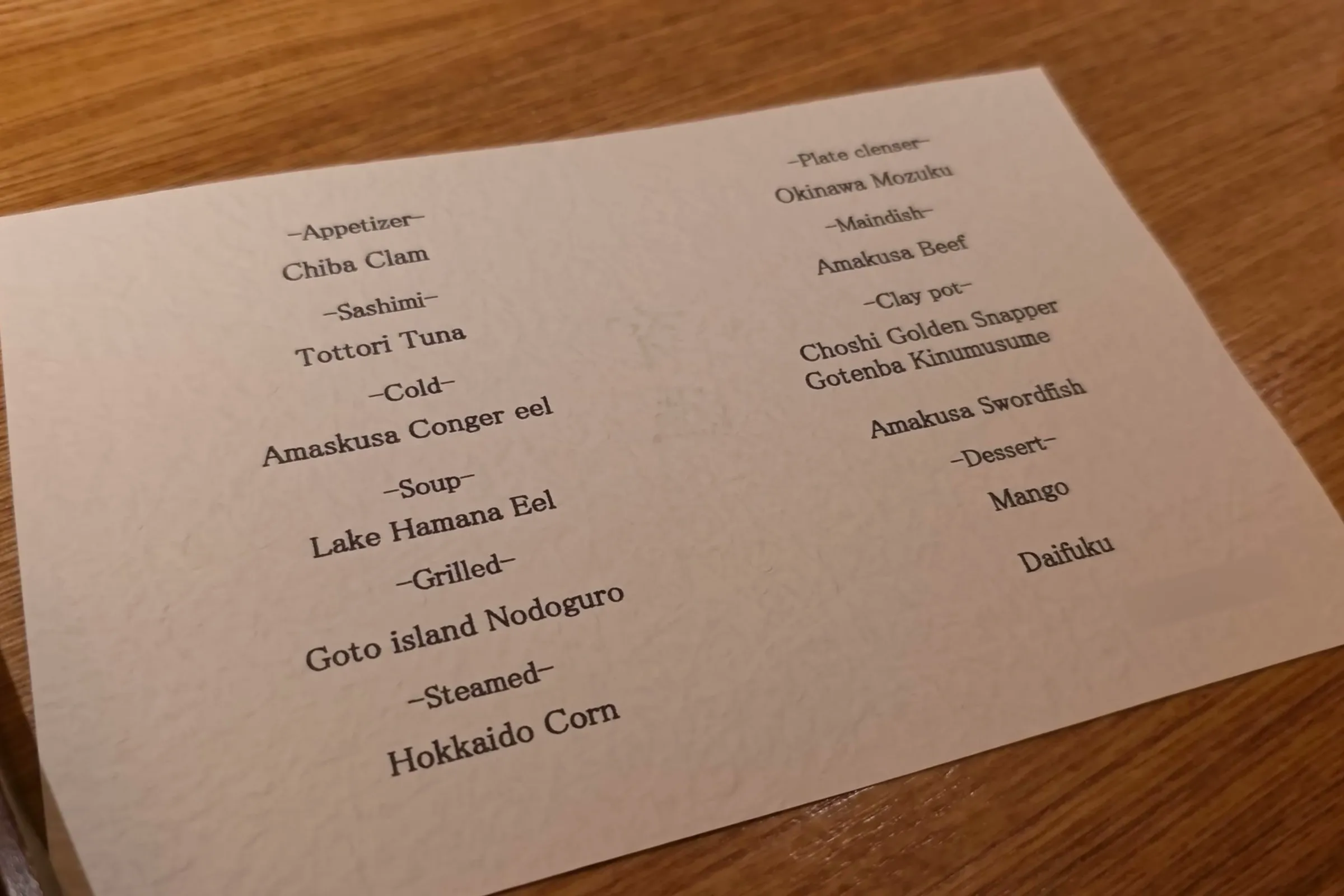
The menu card is in English and Japanese, and it reads like a map of Japan: Chiba clam, Tottori tuna, Amakusa conger eel, Lake Hamana eel, Goto Island nodoguro, Hokkaido corn, Okinawa mozuku, Amakusa beef, Choshi golden snapper over Gotemba rice, then mango and daifuku.
When I checked Tabelog in 2026/11, it listed a dinner budget of ¥40,000 to ¥49,999. Take my number as what it cost me in 2025/09, not as today’s price.
Not hard to book, yet
When I went, Ugai was not a hard booking. So go now, while it’s easy. I’m careful about new places because I hate a bad meal, but I’m also pretty good at buying Japanese restaurants low, before they blow up.
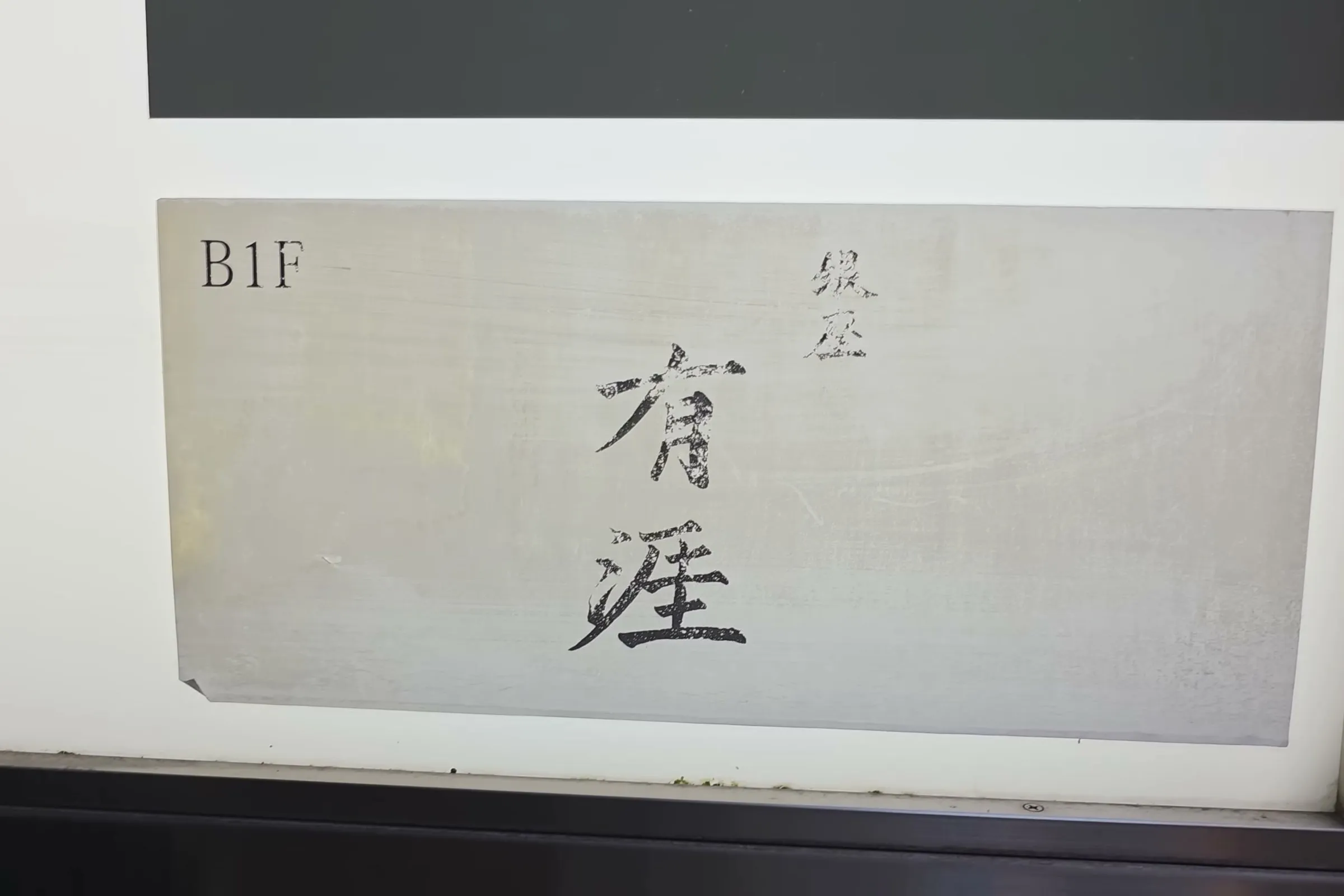
Even so, don’t walk in. Message them about two months ahead (2025/09). When I checked in 2026/11, Tabelog said reservation only and asked for online booking, and the phone line it listed was closed. Google Maps sends its booking button to Tabelog too. Seven counter seats, dinner from 17:00, closed Wednesdays and Sundays.
Why I went at all: a few people kept telling me to. Some were followers whose taste I don’t fully trust. Then a chef friend whose taste I do trust said he loves the place, and the second chef I filmed at another counter said Ugai was where he most wanted to eat. Hearing it from everywhere, I ran out of reasons not to go.
The chef was born in 1999
Ugai is Japanese cuisine, not sushi, and the man in charge is a genius. Fujii Ryogo was born in 1999. That’s not young, that’s a kid. Years ago in Korea, some diners would have dismissed him for his age alone. Nobody could do that after eating this food.
The okami who serves you was born in 2000. I assumed they were a young married couple running the place, so I asked. Not a couple. The whole kitchen came as one team from a ryokan in the countryside, where they’d all worked together. I said the ryokan must have hated losing them all at once, and they said yes, it did. Tabelog Magazine (2024/04) puts it as a ryotei inside a ryokan in Hakone, after he started cooking at 15. Ugai opened on 2022/12/20, per Tabelog.
TMI: I hear the hands cooking in the Kimura Takuya chef drama Grand Maison, the recent Paris one, are his. A hand double. I haven’t seen it. They are nice hands, though. I can see why they got the job.
The name 有涯 is about a finite life. The shop’s own site says it’s thanks for every encounter with ingredients, producers and guests within that one life.
One spoonful of clam porridge and I stopped doubting
Everyone around me said it was great, and you know how that goes. Fine, let’s see how great. I sat down with that attitude.
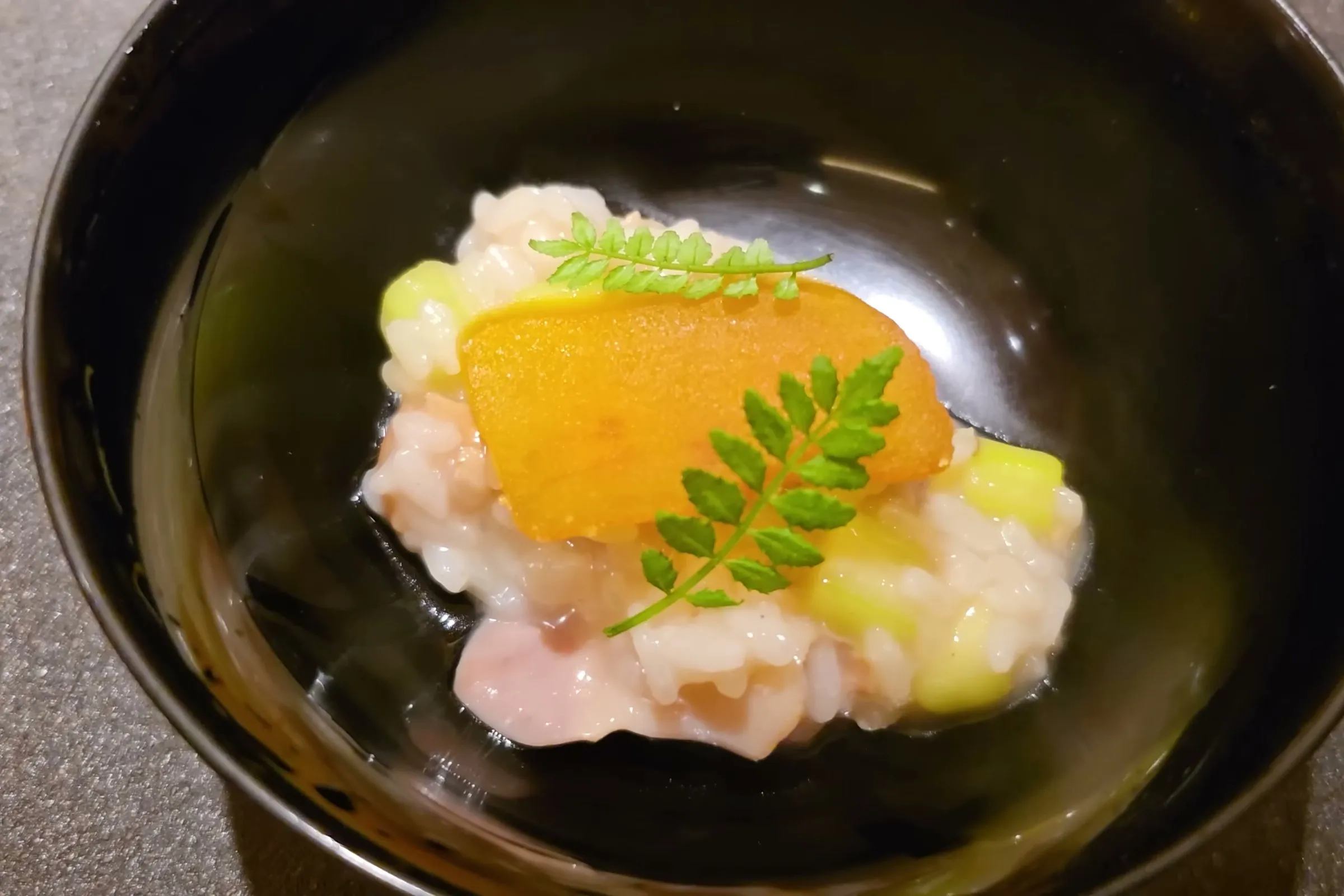
The first dish was a porridge of clam and asparagus with karasumi and kinome, the sansho leaf, on top. One spoonful and I went, wait, what is this? It was better than I expected. Every flavor in it was strong and direct, the clam and the asparagus were cooked just right, the rice too, and together they made something a little unexpected. It surprised me the way my first meal at Kohaku did.
Smoked young tuna, pink all the way through
Then I saw them smoking mejimaguro, young bluefin, and not katsuo. I got suspicious again. Mejimaguro can only get so good, and I had a good one recently.
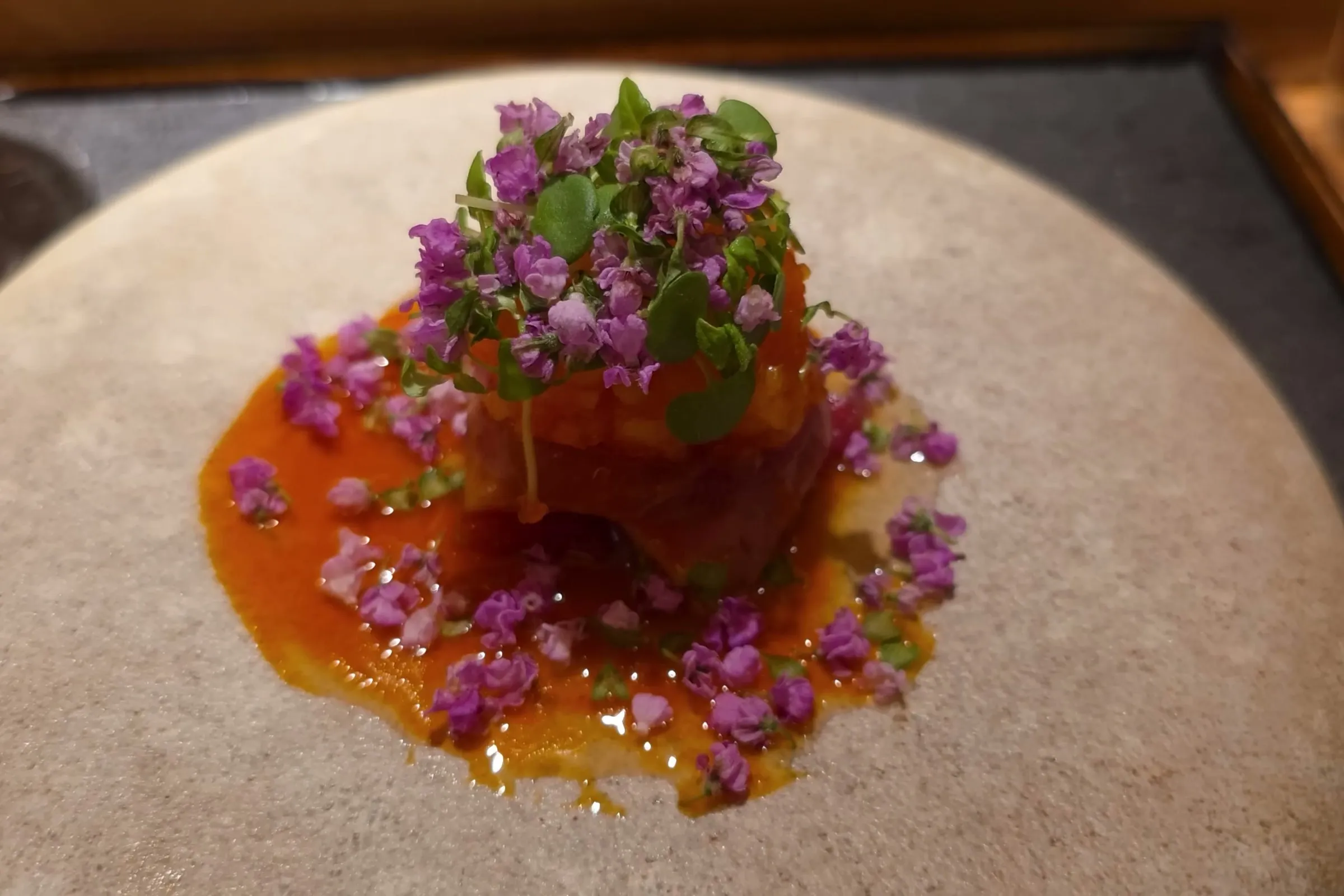
This one was different. They smoked it in thick smoke, and the surface was still a clear pink, more see-through than a fish that’s only been skin-seared. On top went a dark soy sauce, grated daikon, and a pile of hana-shiso flowers. The colors alone are lovely.
I don’t usually like smoked tuna. Here the level of smoke and everything piled on top worked together in one bite. Strong aroma, strong flavor. Not a strange new combination, more like delicious things together tasting better than you’d predict. That’s still a big deal.
Hamo ground into a sauce thicker than kongguksu
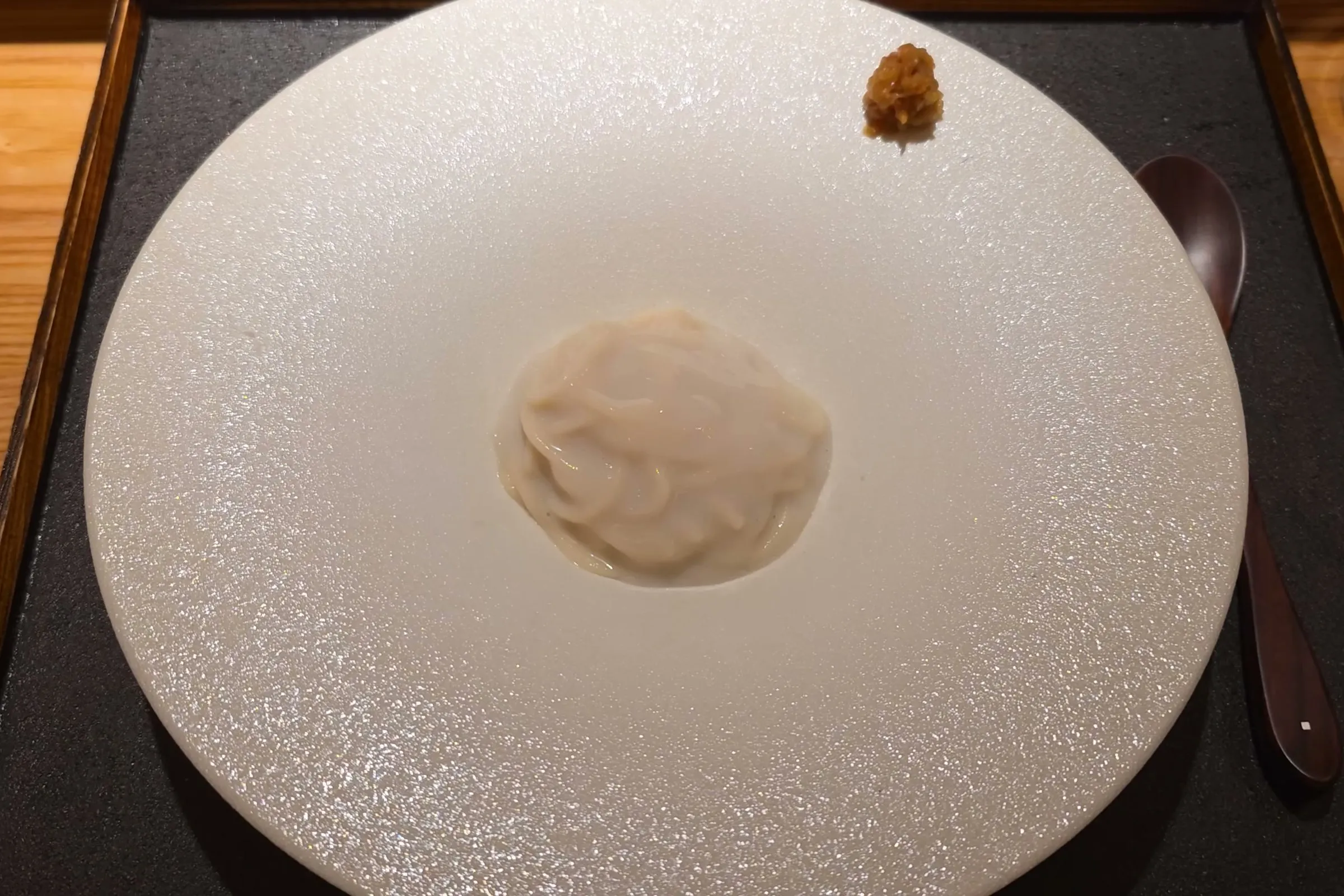
It was summer, so hamo, pike conger. I couldn’t tell how they did it at first. It looks like the hamo was simmered in dashi and blended, then the noodles were dressed in it. Thicker than the bean milk in Korean kongguksu, the cold soy noodle soup, and I don’t even like kongguksu.
The texture is thick, and so is the flavor. Huge umami. I eat the way the chef tells me to, so first bite plain, then with a bit of bainiku, the plum paste, the way you get it with hamo shabu-shabu. I ended up scraping the plate.
The sweet eel soup that made me laugh out loud
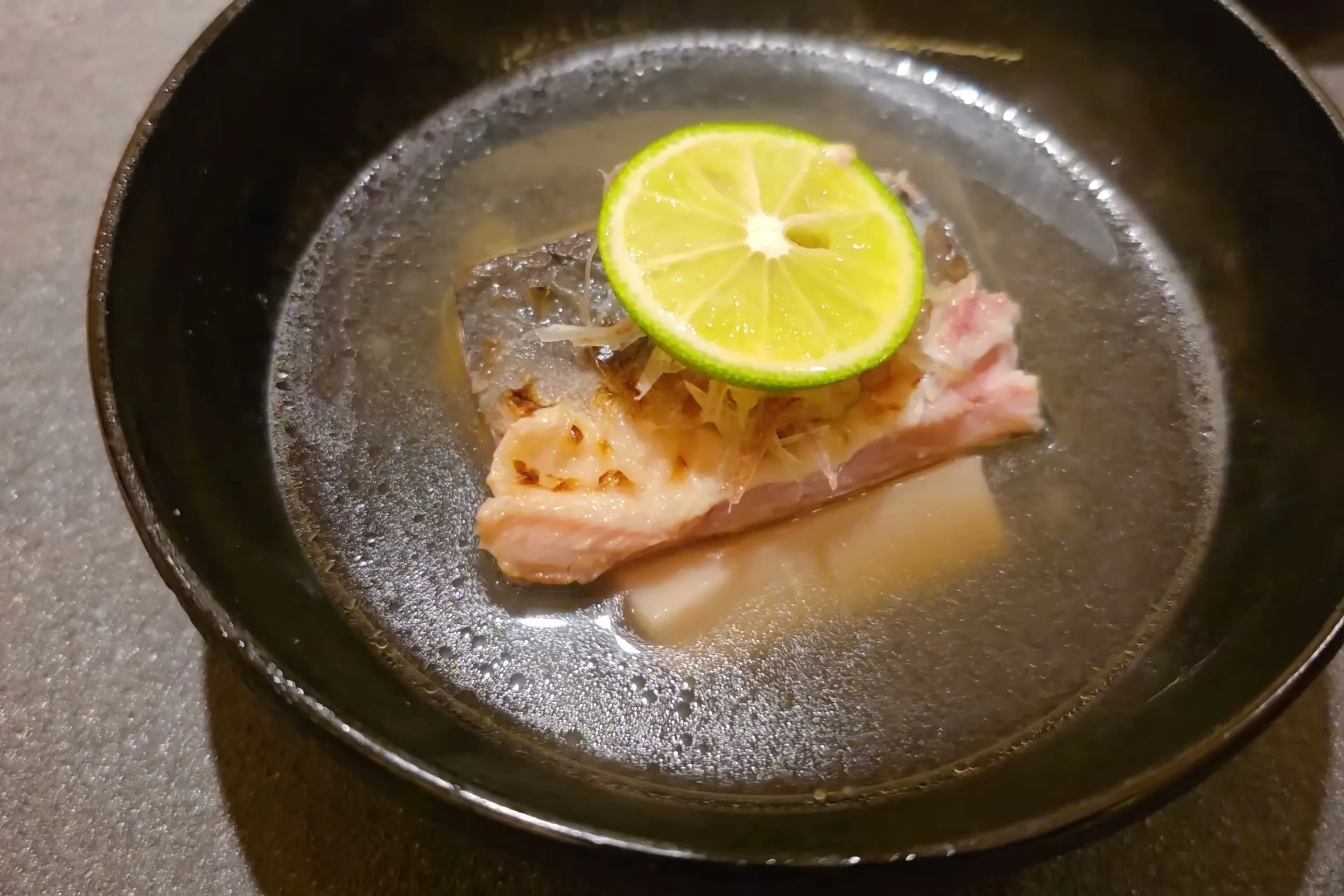
Up to here I’d gone from suspicious to okay, this is good. With the Lake Hamana eel soup I just burst out laughing. It was that delicious.
The broth is very sweet, and not sugar sweet. The eel’s own umami and whatever they did to that broth taste like the sweet kinki dishes some sushi counters serve, where the broth knocks you over with sweetness. Here the oily fish is unagi, and an oily, savory eel with a sweet broth is a perfect fit. Humans are wired for sweetness, Koreans or not.
Ugai’s signature nodoguro, and why it isn’t too much
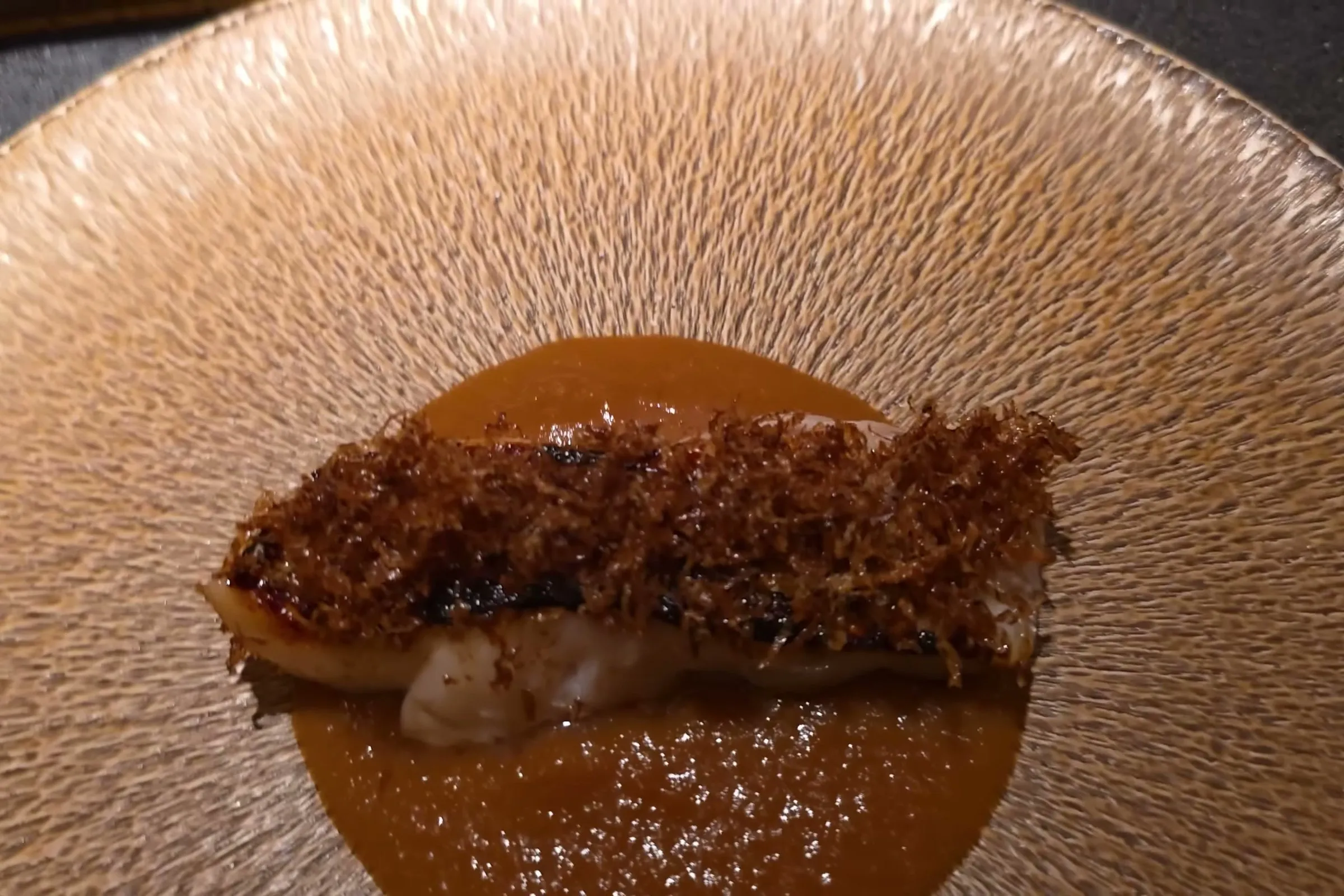
The signature is Goto Island nodoguro, grilled yuan-yaki style. I love glazed and yuan-yaki fish anyway. The sauce is sweet, like a very sweet onion demi-glace, and on top go fried flakes that taste like fried onions, almost like a snack.
Some people say it’s too much. For me the impact is the point. I don’t love kaiseki where everything is pale and quiet. This course is strong all the way, it never tires you out, and it hits harder the further it goes. I love how it’s built.
Western on the plate, Japanese in the pan
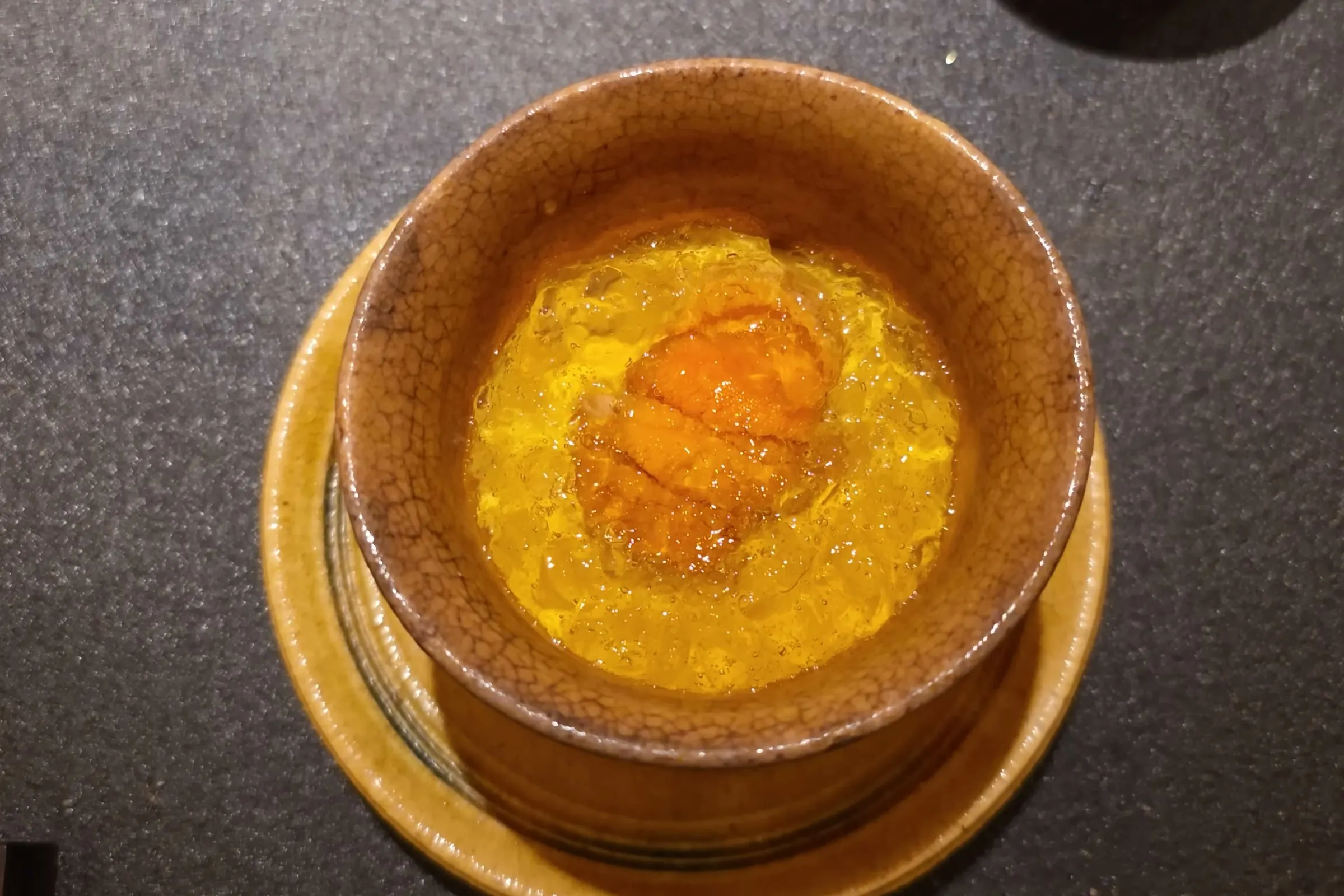
Then something lighter, like a palate cleanser: Hokkaido corn with Hokkaido uni. The corn sits under it like chawanmushi but it’s a corn surinagashi, with a dashi jelly on top. Tasty, and about what you’d imagine.
Next, cold abalone in the mizugai style, served raw in liquid, with Okinawa mozuku and a leaf with an okra-like slipperiness that tasted nutty more than fragrant. I don’t love hard abalone, and lately I haven’t liked any mizugai I’ve been served. This was the best version of it I’ve had, so it stuck with me.
Then Amakusa beef with shiitake, and the shiitake didn’t taste like shiitake. If nobody told me, I’d have guessed burdock or eggplant. Interesting, not my favorite. I’d rather have plain shiitake.
What’s strange about Ugai: the plating and even the flavor feel a little Western, yet there’s no Western technique or ingredient in any of it. He only gives the plating a fusion look. The cooking is all Japanese. That he learned it all at a ryokan makes it stranger.
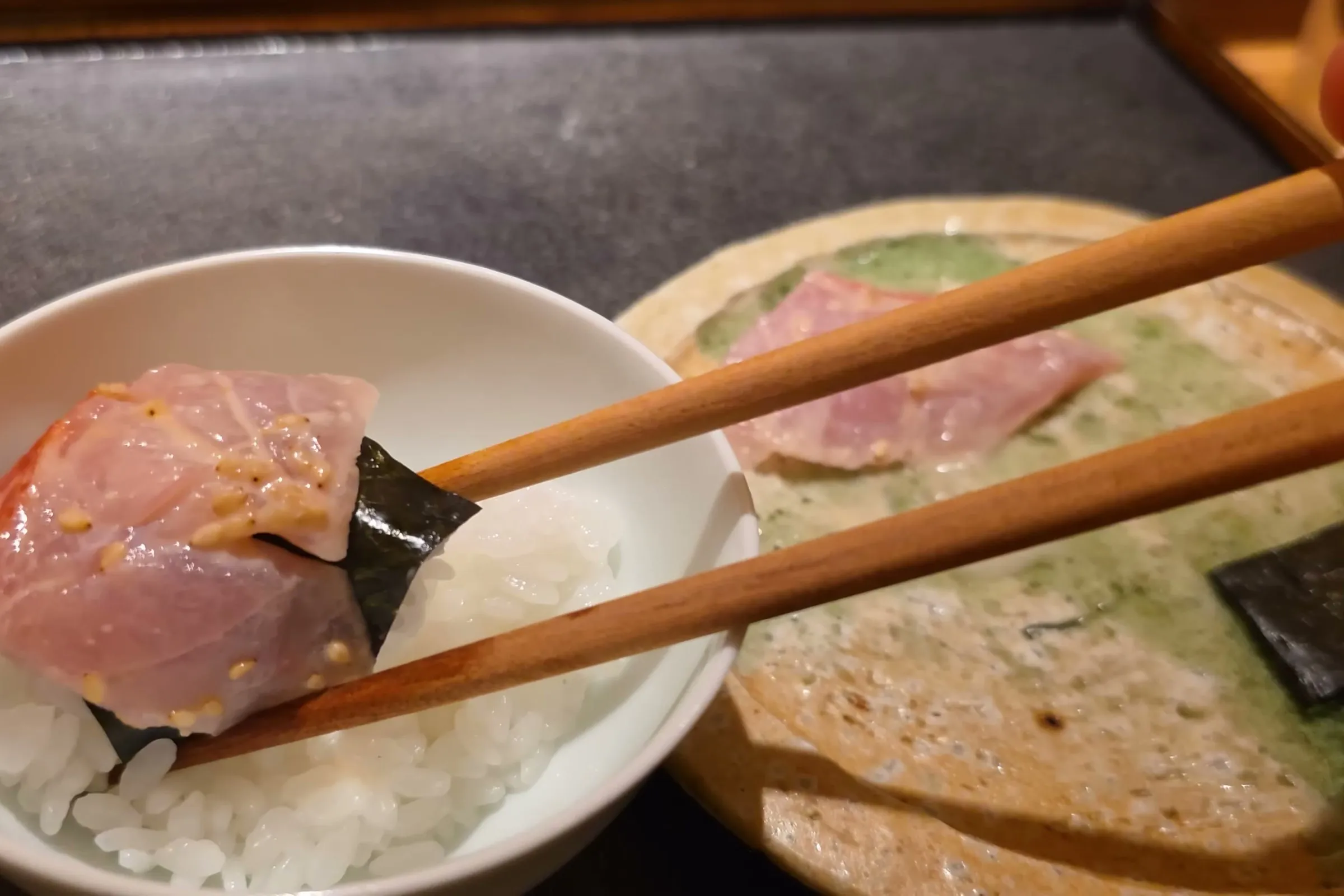
The best nori of my life, on kinmedai and rice
Then the rice part starts, which in Japanese cuisine is the real main course for me. Choshi kinmedai, golden-eye snapper, dressed in sesame sauce, with rice, like tai-chazuke without the tea. You eat it with nori on top.
Kinmedai with sesame and rice is about what you’d expect. The nori was not. I’ve eaten a lot of nori in my life, and this was number one by a mile. Sushi counters brag about their expensive, rare nori all the time and I never cared. With this one I thought, what is this nori, the moment it hit my mouth.
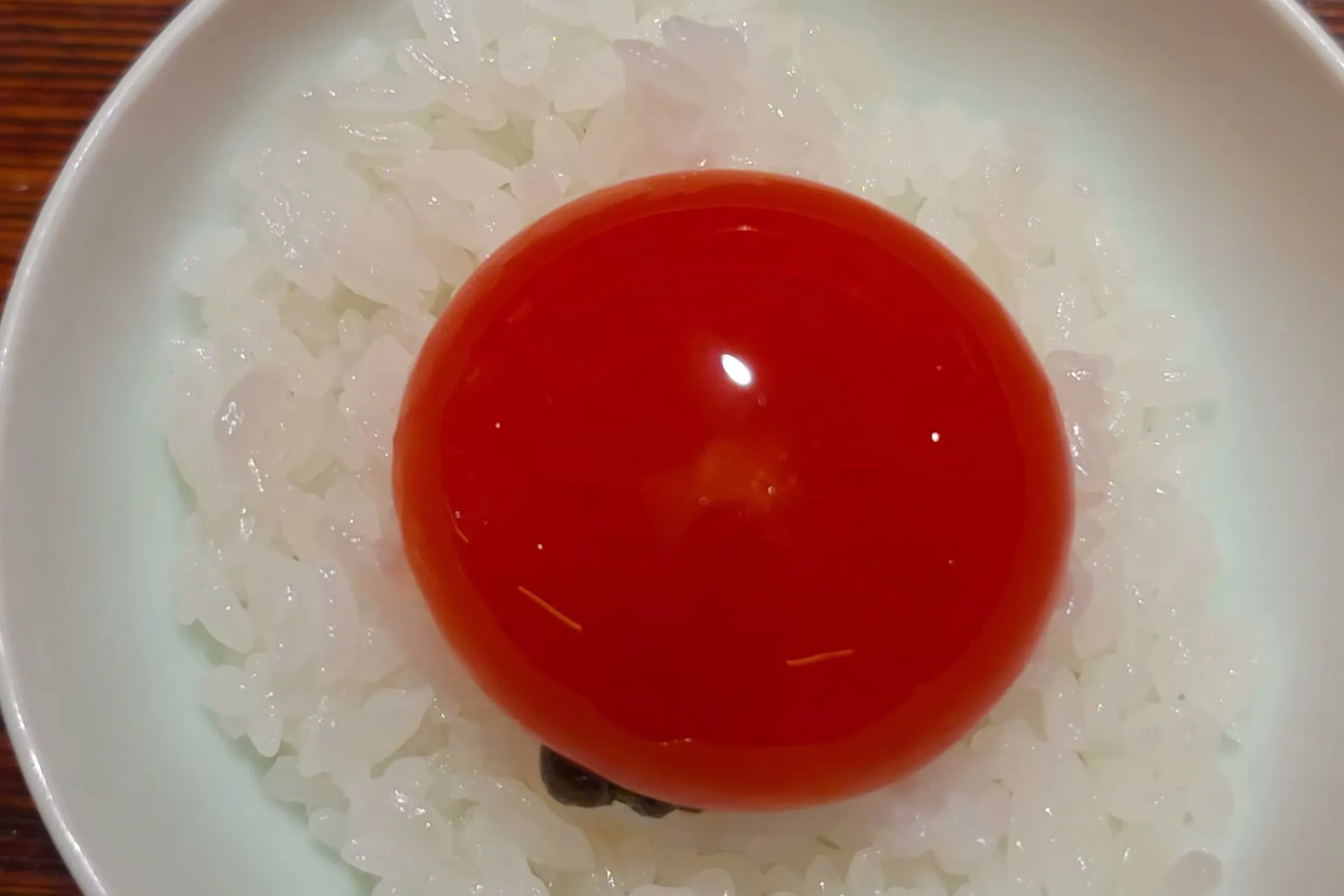
Beltfish rice, and an egg yolk that color
The clay pot is beltfish, galchi in Korean, with zucchini in the rice. The English menu says Amakusa swordfish. Later I saw someone else’s photo of the same course with the same word, so I think the chef believes beltfish is swordfish in English. Beltfish. I’ll tell him next time.
The rice alone is great: a little sweet from the zucchini, with a clear umami. And the beltfish is the best I’ve had, not because of the size or the texture, but because the umami is so strong. It’s seasoned on the salty side and it works.
Then I asked for another bowl, and it came as tamago kake gohan, with an egg yolk of a color that’s honestly crazy, thick and rich, more than a plain yolk. The bottom of the pot had a lot of sansho tsukudani mixed in, the kick. I should have had a third bowl. In 2026/08 I went back and filmed just the egg rice.
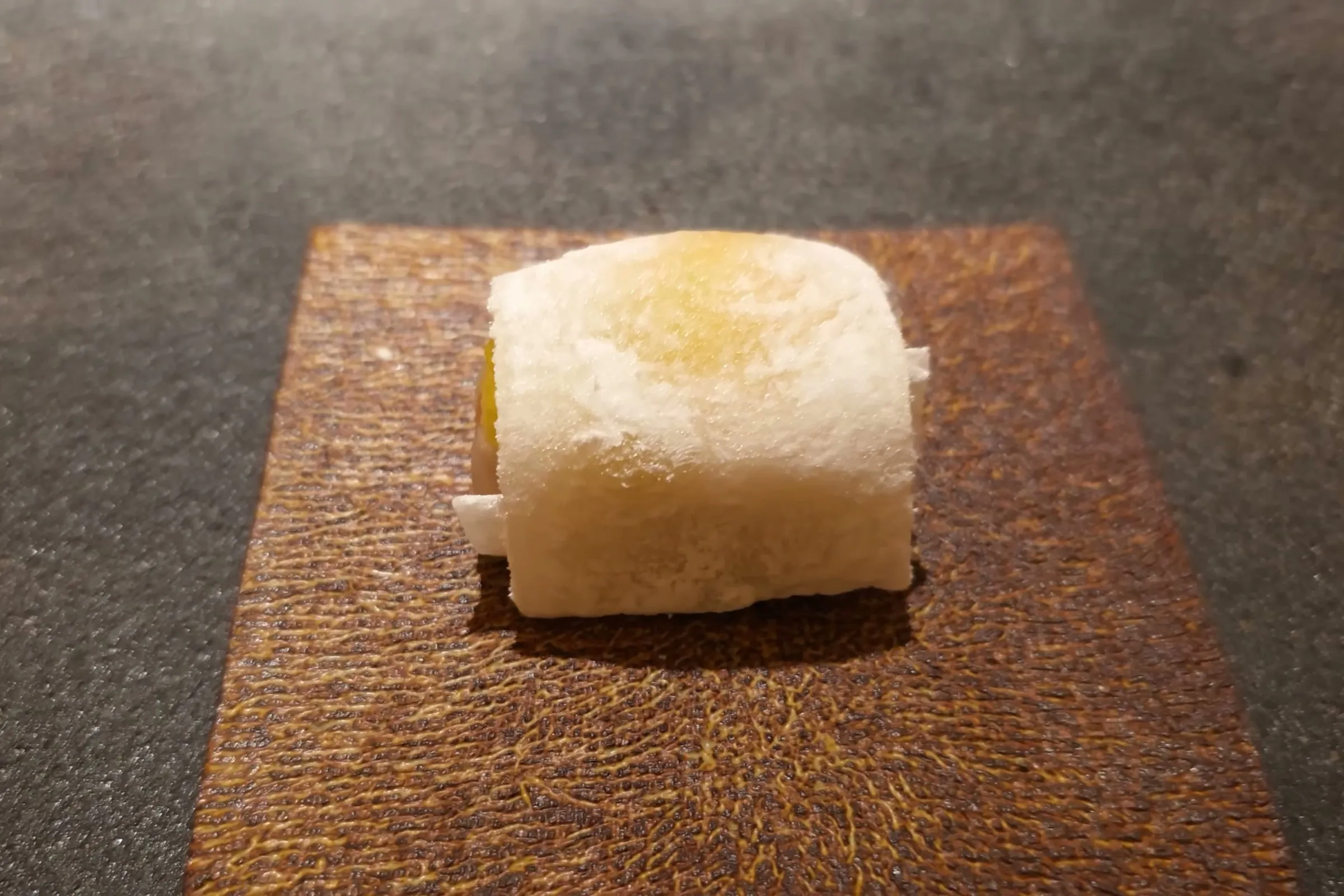
Mango, a fig daifuku, and rice for breakfast
Dessert is the one place with an open Western touch: mango ice cream. Very mango-y, with a texture like you can feel the fiber of the fruit, sweet but not juice sweet.
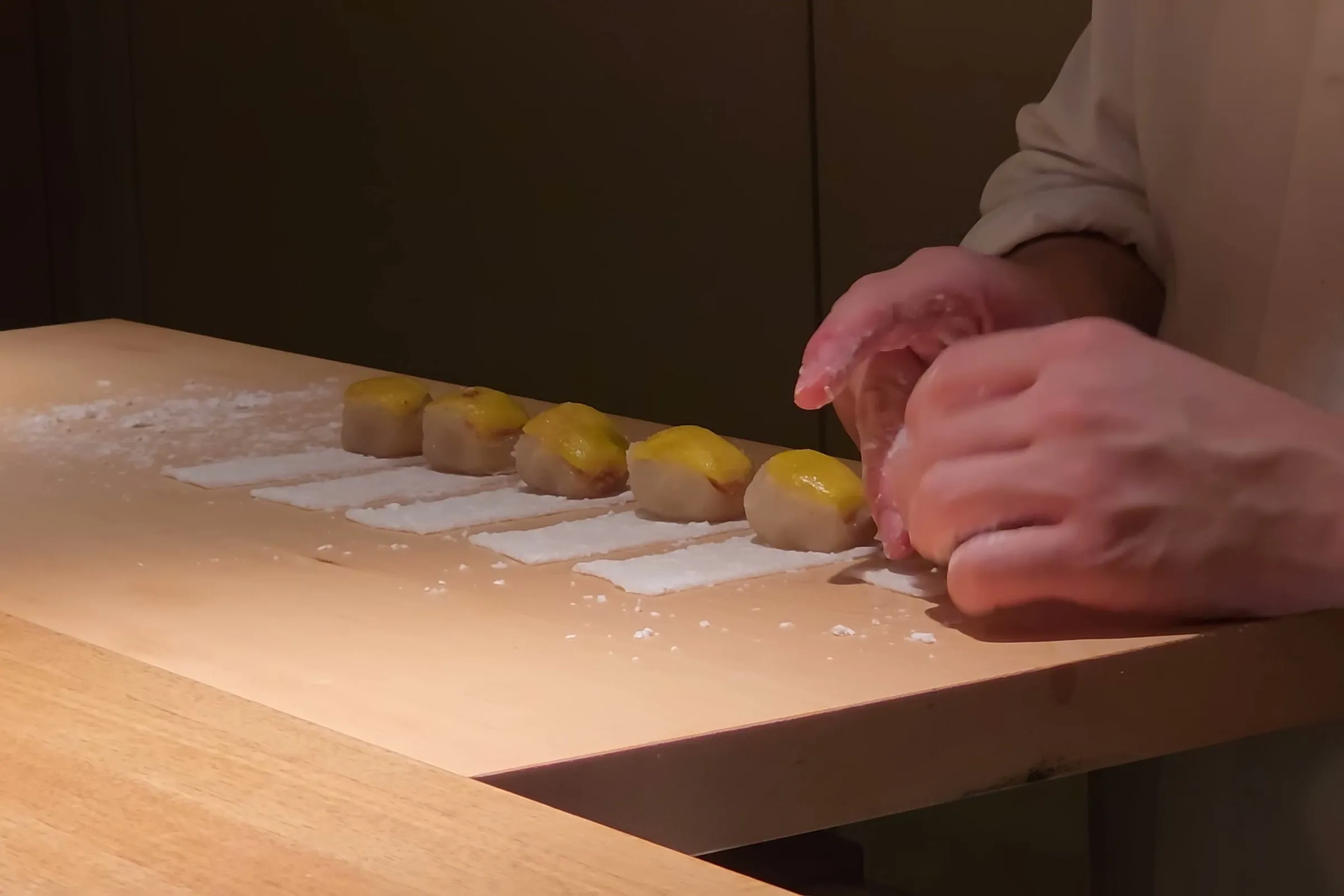
Then the daifuku, made in front of you: mochi around fig and white bean paste. Figs felt early to me, by Korean standards anyway. Watching it made and how pretty it looks count for something too. Good to the last plate.
I asked if he was on his second life, since he cooks like he mastered Western food in a past life and Japanese food in this one. He said he thought the same about my chef friend who recommended the place. On the way out you get the leftover rice as onigiri in a bag. I ate it the next morning at my hotel. Still good cold.
¥39,550 for one, drinks included
2025/09 video
The course was ¥33,000, about US$220 (2025/09). Two ginger ales and an orange juice added ¥2,970, the 10% service charge ¥3,597, and the total was ¥39,550 for one, about US$270. For a Ginza kaiseki counter cooking at this level, that’s kind.
Tabelog listed the dinner budget at ¥40,000 to ¥49,999 when I checked in 2026/11, and it says cards are accepted.
Would I go back
I already did. For taste, price and how easy it still is to book, I recommend it without conditions. If you’re planning Tokyo and couldn’t land the impossible counters, book this one.
How to book
How I booked
When I went it wasn’t a hard booking. I’d still message them about two months ahead rather than hope for a seat.
- Tabelog online booking
Tabelog (checked 2026/11) lists Ugai as reservation only and asks for online booking; the phone line it lists was closed. Google Maps’ booking button also goes to Tabelog. Seven counter seats, dinner from 17:00, closed Wednesdays and Sundays, cards accepted.
Checked 2026/11. Booking rules change, so look at the official page before you go.
Where it is
- Address
- B1F Benisuzume Bldg, 1-4-6 Ginza, Chuo-ku, Tokyo東京都中央区銀座1-4-6 紅雀ビル B1F
- Nearest station
- Ginza-itchome (Yurakucho Line), 1 minute on foot
Plan the Tokyo trip
The boring bits I’d sort before flying, so the eating days stay free.
- Hotels in Tokyo*
Pick the room by where you eat, not by the sights. After a long dinner, a short ride back is the real luxury. This place is in Ginza, Tokyo.
- Japan eSIM*
Data from the moment you land, no counter and no SIM swap. Set it up the night before.
- Keisei Skyliner from Narita*
Narita to Ueno in about 40 minutes. Buy it ahead and walk straight to the platform.
- Haneda airport limousine bus*
Landing at Haneda instead? The limousine bus drops you at the big hotels and stations with no transfers.
- Tsukiji Outer Market food tour*
A market morning with someone who knows which stalls are worth the line.
- Sushi-making class at Tsukiji*
Shape nigiri yourself once and the counter makes a lot more sense.
Links marked * are affiliate links. If you book through them I may earn a small commission, and you pay the same. How it works
More from this restaurant on the channel
- Soy sauce egg rice from the young genius10:002026/08
More places I have eaten at
All of Tokyo →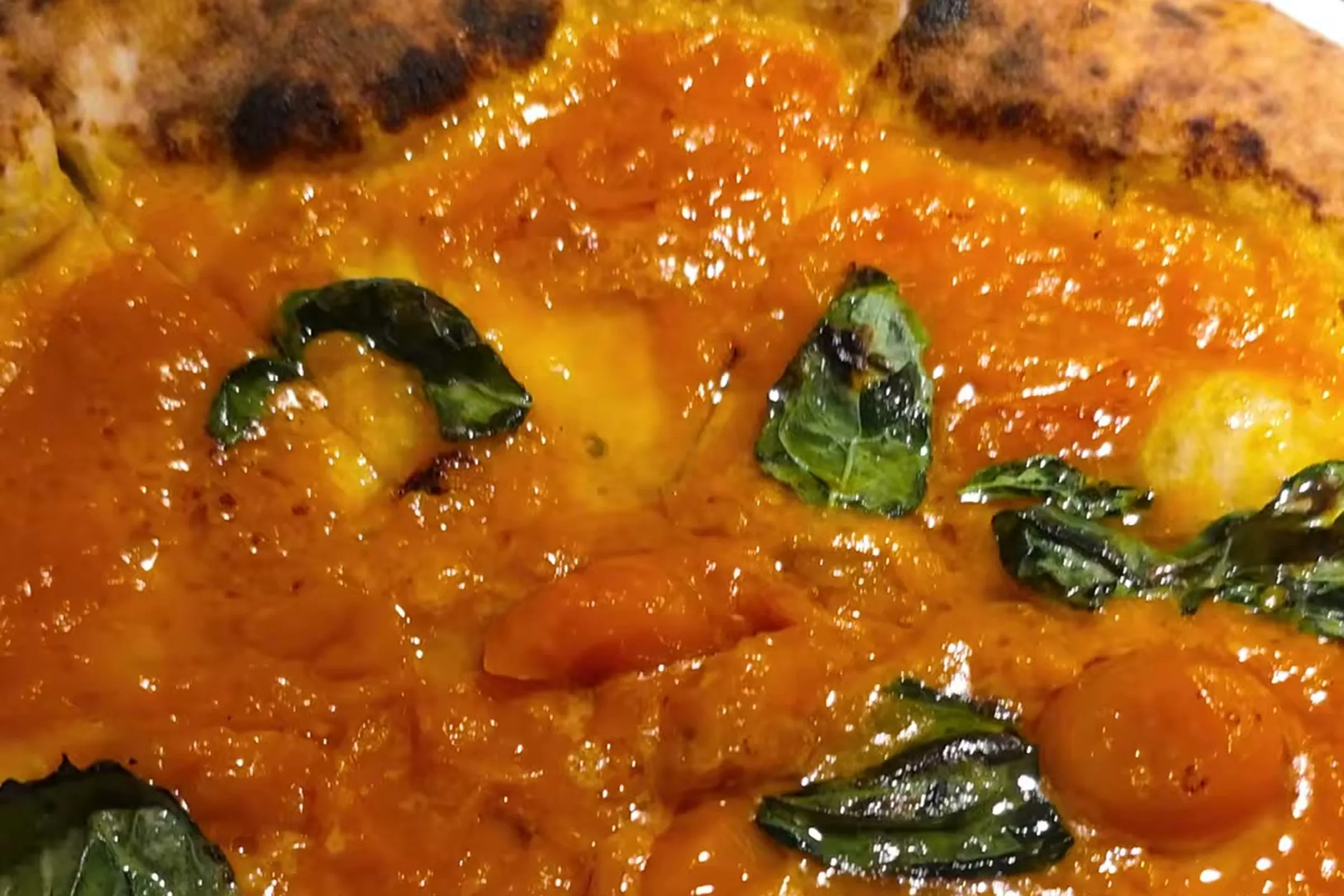 Nihonbashi, Tokyo
Pizzeria Il Tamburello
A yellow tomato sauce that hits harder than any red one, ¥2,600 a pizza (2026/09).
¥2,600 2026/09 video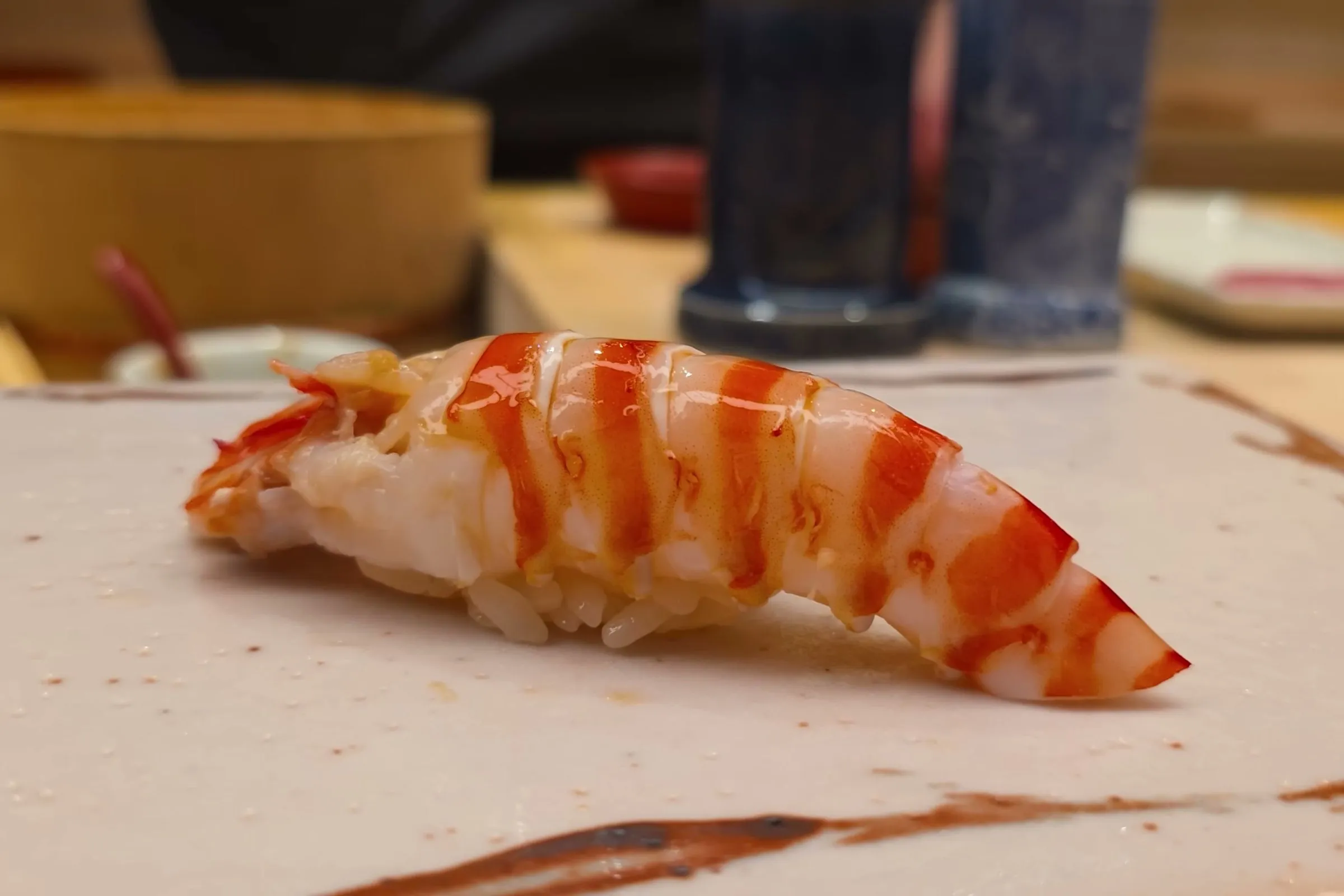 Nishiazabu, Minato, Tokyo
Sushi Riku
Riku Toda’s counter. Sugita’s DNA all over the tsumami, a sweeter rice, a friendlier room.
Under ¥40,000 2025/11 video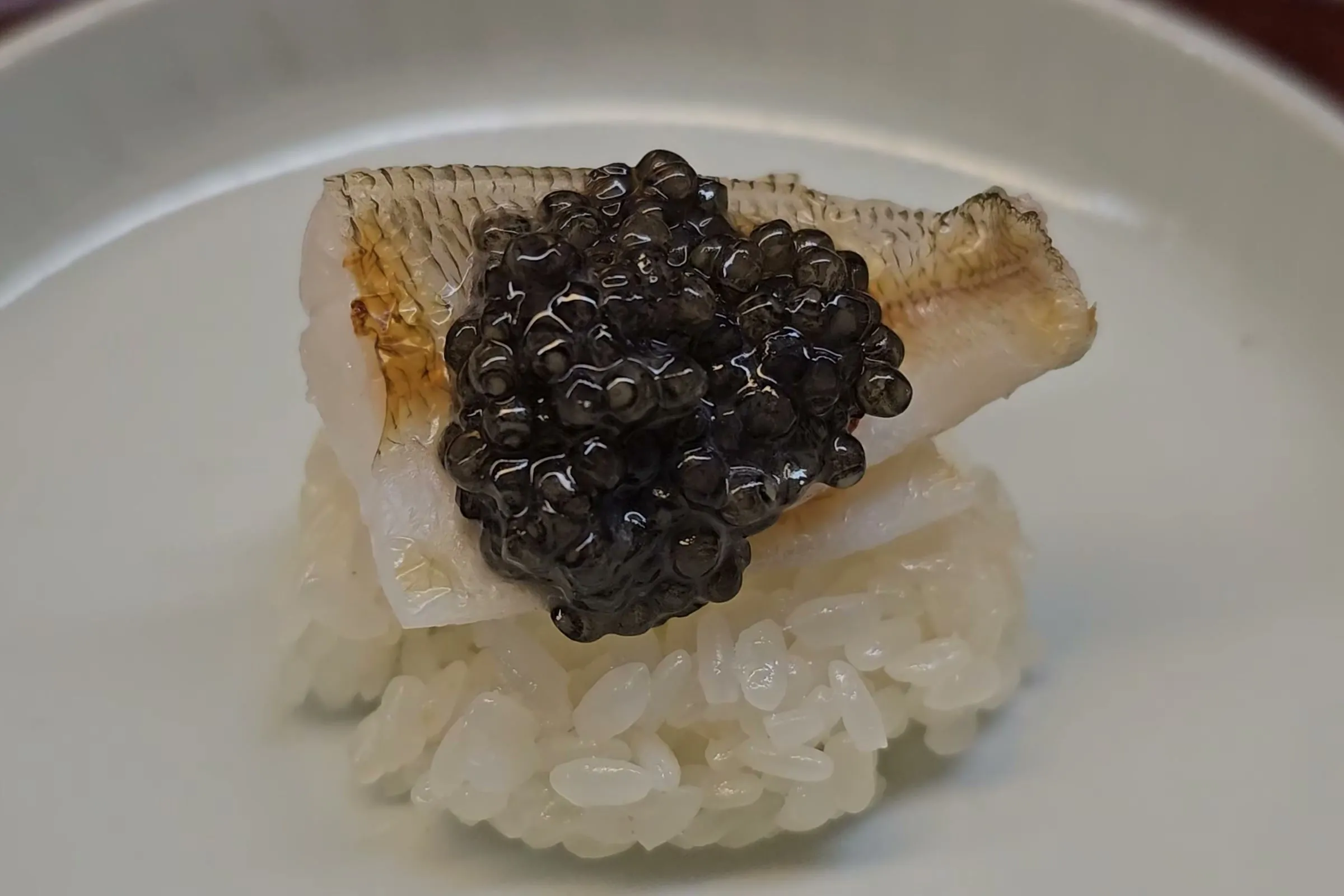 Akasaka, Tokyo
Matsukawa
Kaiseki behind the US Embassy, referral only, cash only, and the best broth I know.
≈ ¥80,000 2024/09 videoSources
- Ginza Ugai (銀座 有涯) Tabelog
- 銀座 有涯 official site Ginza Ugai
- Interview with chef Fujii Ryogo (Japanese) Tabelog Magazine