Sugita’s student came home to Tokyo, so I went
Sushi Riku (鮨 陸) is chef Riku Toda’s eight-seat sushi counter in Tokyo. He trained under Mizutani and Sugita and ran Sushi Ichizu in Bangkok before coming home. It opened in Hiroo in 2024/09 and moved to Nishiazabu in 2026/07, so my meal was at the old Hiroo room and the counter to book now is the Nishiazabu one. It was under ¥40,000 a head, about US$260 (2025/11), and the course is ¥44,000 plus a 10% service charge at the new shop, booked on omakase.in. Would I go back? The tsumami are better than I expected and the rice is far less sweet than in Bangkok. What it really did was make me want to book Sugita again.
monster gourmetFrom my 2025/11 video
- My share
- Under ¥40,000
- about US$260, a head at the old Hiroo shop; ¥44,000 plus service now, 2025/11 video
- Highlight
- The tsumami run, the most Sugita thing outside Sugita
- Skip
- The fried shark fin, if it’s still on
- Video
- 18:19
- 2025/11
- Where
- Nishiazabu, Minato, Tokyo
Sugita’s student, back in Tokyo
Sushi Riku is Riku Toda’s own counter. Toda trained under Hachiro Mizutani at Sushi Mizutani, then worked for Takaaki Sugita, my sushi god, and then spent years cooking abroad, including as the chef of Sushi Ichizu in Bangkok. TableAll says he was born in Tokyo in 1991. He opened Sushi Riku in Hiroo in 2024/09, and that buzz is why I went.
Then it moved. omakase.in lists Sushi Riku at THE LIVRE 2F, 3-13-1 Nishiazabu, from 2026/07, and Google Maps shows the old Hiroo shop as permanently closed. So everything I ate here was at the Hiroo counter, and the map below points to the new one in Nishiazabu.
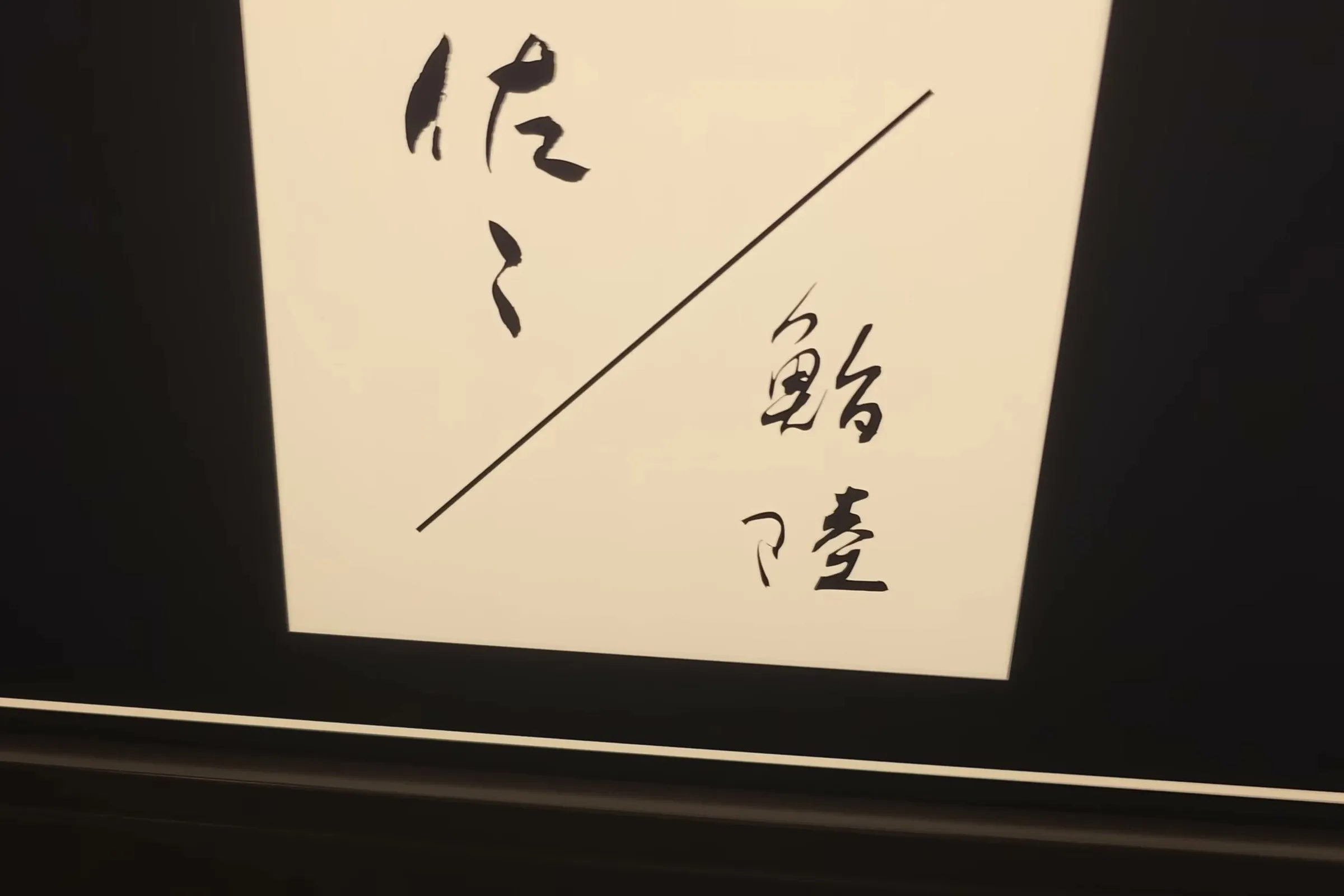
One trap. There’s a different sushi shop with almost the same name in Minami-Aoyama, written すし 陸. omakase.in itself warns about it. Toda’s counter is 鮨 陸, and it’s the one in Nishiazabu.
Under ¥40,000, which is rare in Tokyo now
It was under ¥40,000 a head, about US$260 (2025/11). In won that’s close to ₩400,000 for one dinner. Calling that casual sounds odd, I know. But at Tokyo sushi counters these days, a bill that doesn’t start with a 4 is rare, and next to what Sugita costs now it’s reasonable.
At the new Nishiazabu shop the chef’s course is ¥44,000 a person, tax included, plus a 10% service charge (omakase.in, checked 2026/11). Tabelog has it at ¥40,000 to ¥49,999 a head.
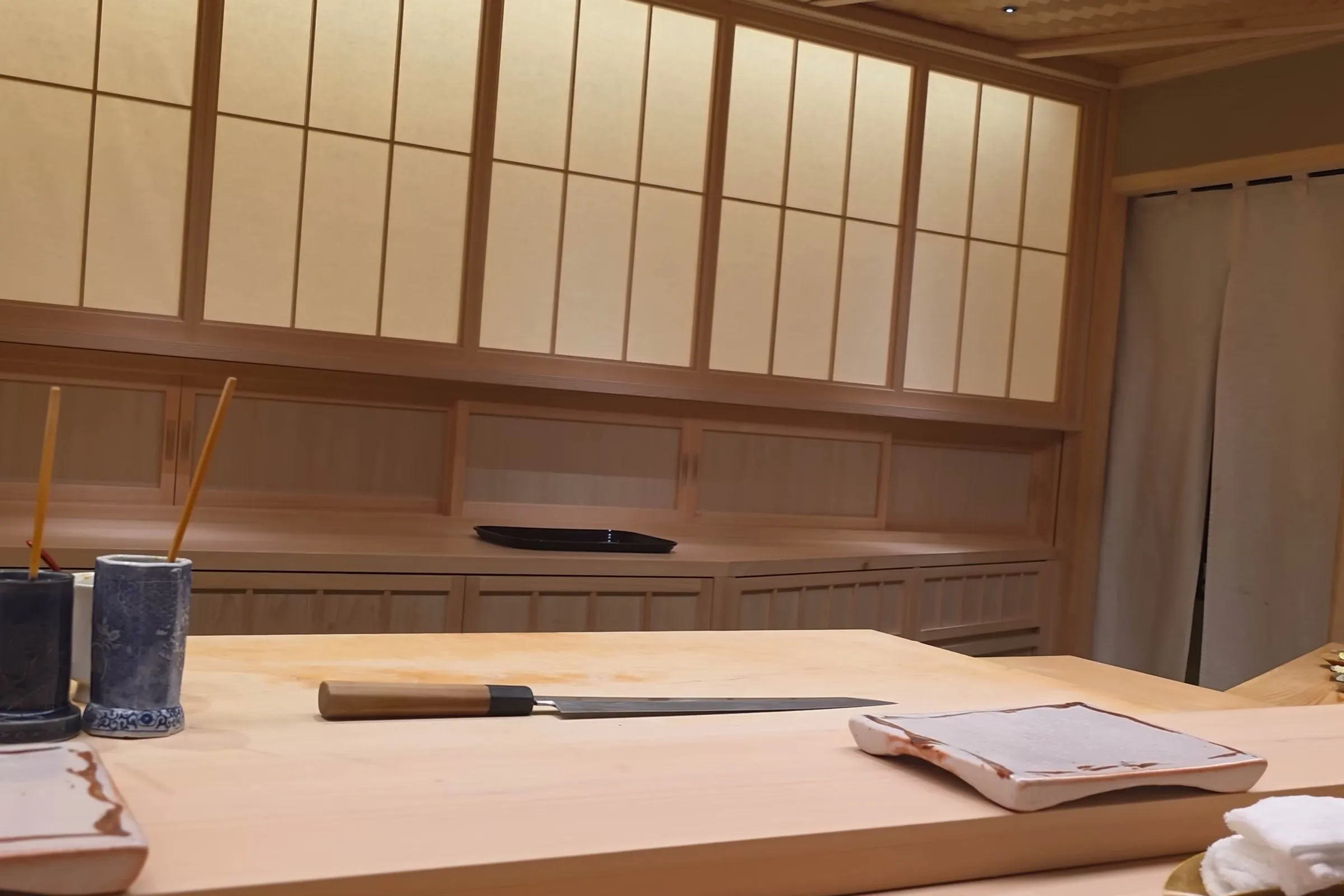
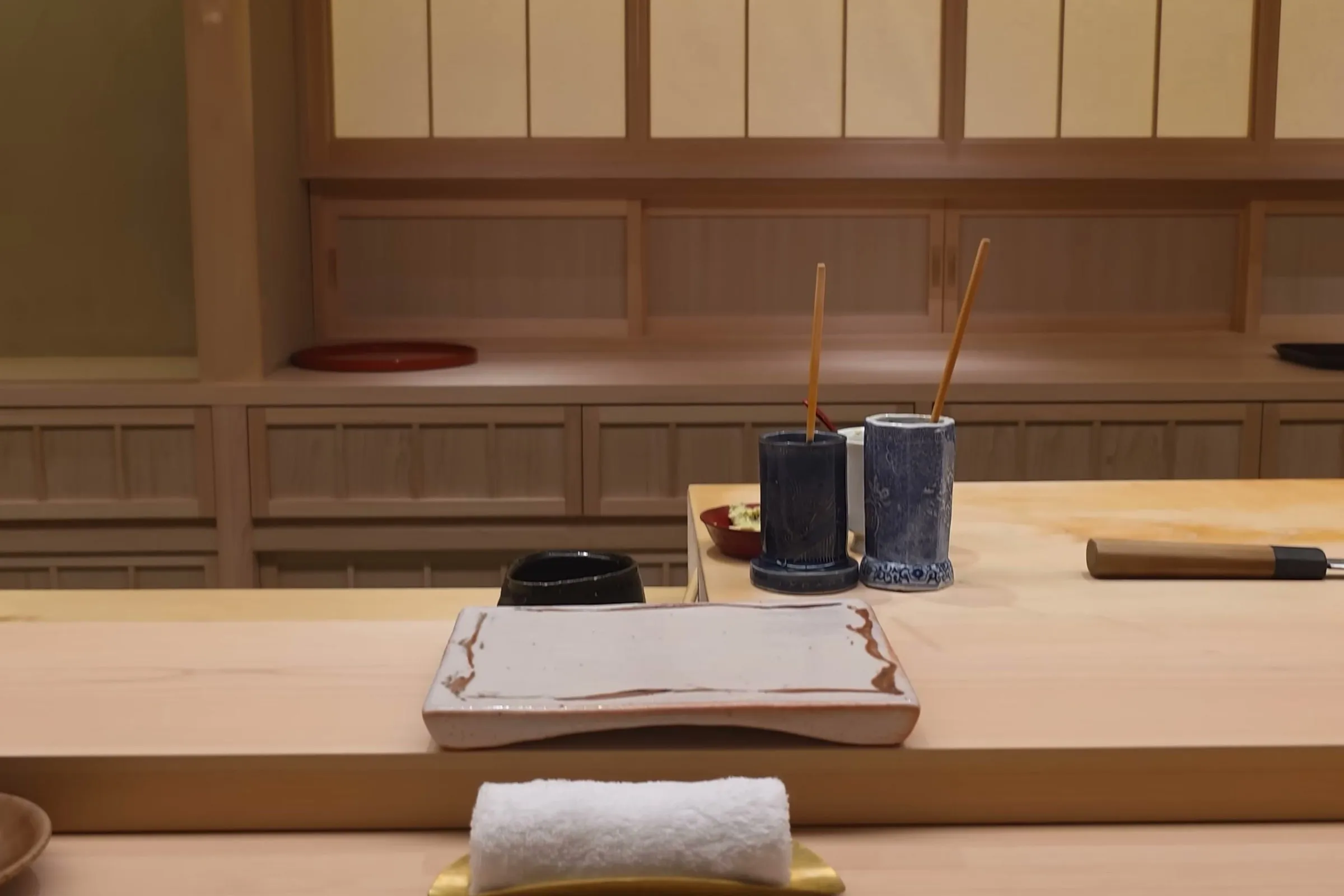
The money in the old Hiroo room went into the space. The interior, the corridor outside, all of it looked expensive. The counter shared its entrance with a Japanese restaurant next door, and the hallway was so crowded I didn’t film it.
How to book Sushi Riku
omakase.in is the way in. Tabelog says reservation only, through OMAKASE. Eight counter seats, two seatings at 5 PM and 8 PM, and seats open in rounds. When I checked in 2026/11 there were no open seats, and the next round was still TBD.
omakase.in charges a ¥390 booking fee per seat. Cancellation charges start as soon as the booking is made, and within seven days it’s the full price. Book only what you’ll show up for.
TableAll also takes requests for the dinner course, at ¥54,000 including an ¥8,000 booking fee (checked 2026/11). Either way, check that the address says Nishiazabu, not Aoyama.
Why my expectations were low
I’d eaten Toda’s sushi before, in Bangkok, at Sushi Ichizu. I was pretty let down then. He’s a student of Sugita and of Mizutani, someone who only ever worked at monster counters, so I expected something huge. It had gone local. The rice was very sweet, sticky and soft.
So when people got excited that Sugita’s student was back in Japan, I kept my expectations low. I’d already had it once. The hope was simple: in Bangkok he’d tuned it to Thai taste, so back in Tokyo maybe it would come back.
Tai, wasabi underneath, and raw abalone
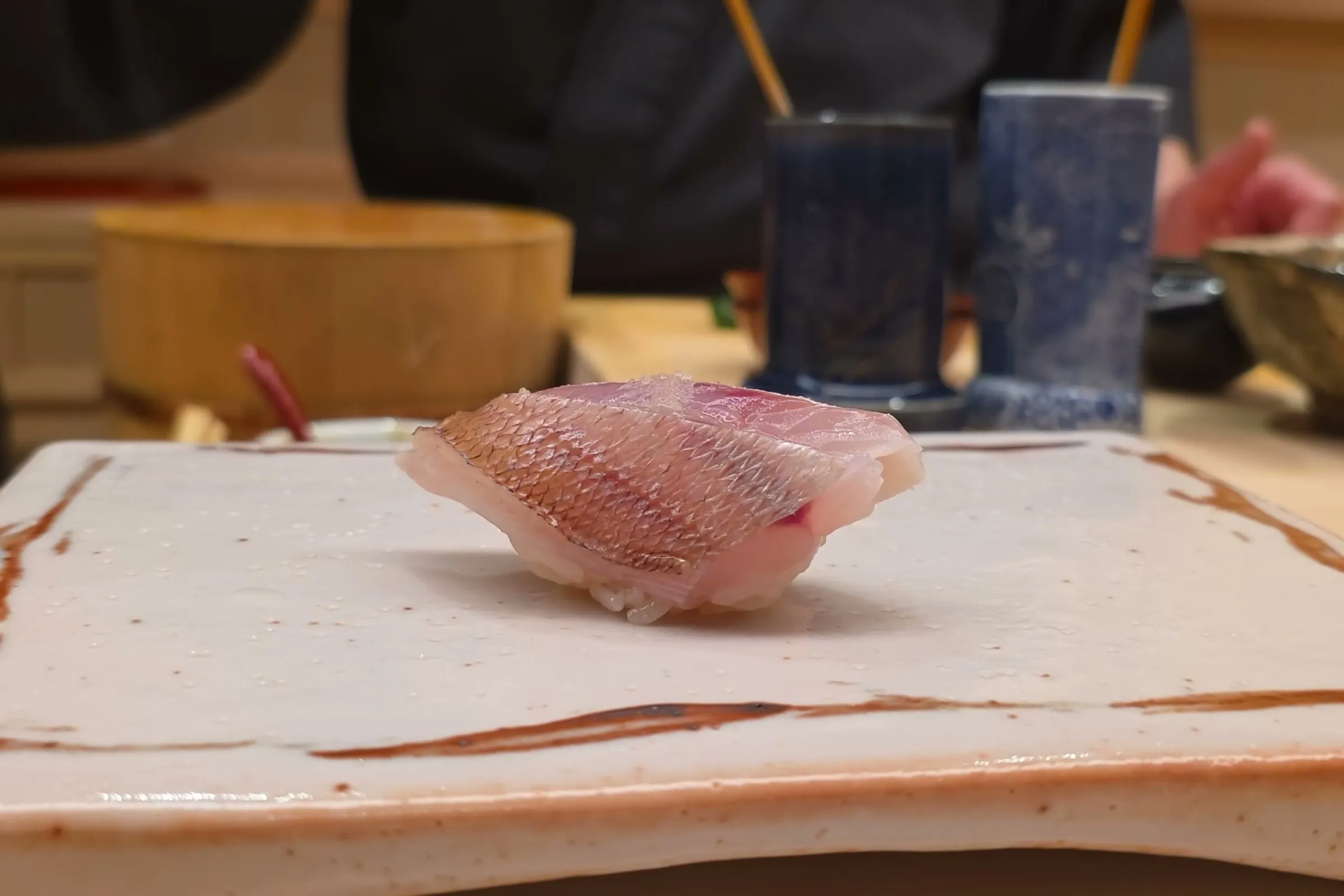
The first thing you notice: it’s casual. Toda shows off the fish a little, starting with the mirugai, giant clam. The first tsumami was tai sashimi with wasabi under it. At this level in Tokyo the wasabi is almost always good, but this one was short on that sweet smell. Soy sauce sits in front of you to pour yourself, the way a few hot counters do it now.
You get salt and soy for the sashimi, and a sudachi too. My hand shook, I squeezed way too much, and the salt wouldn’t stick to the wet fish. At Sugita I always say the first white fish is weirdly good. This one didn’t hit like that. For the price, fair enough.
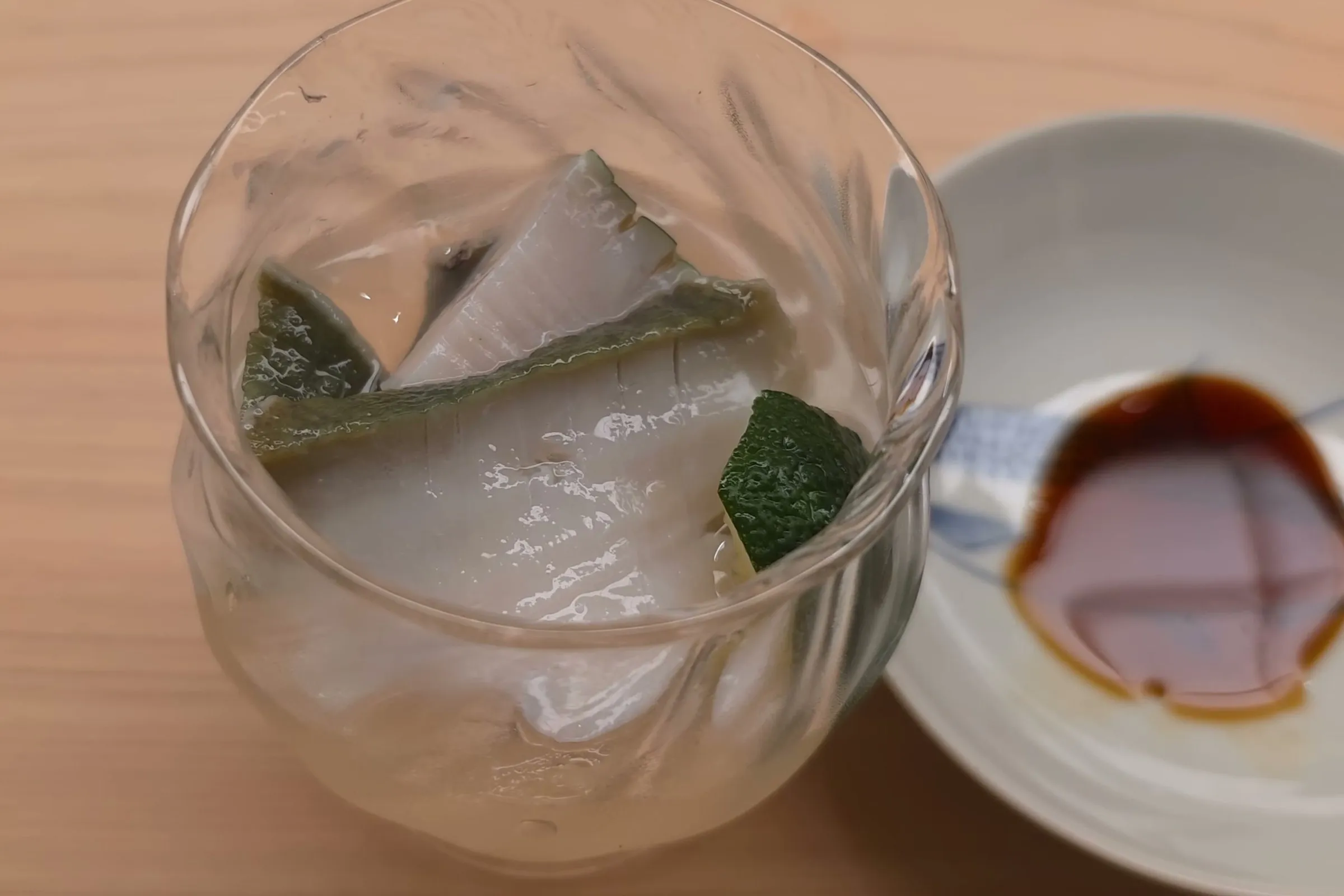
Then raw abalone, scrubbed white and set in a clear dish with dashi. Mizugai, a summer thing. I’ve never understood raw abalone. When I was a kid, Korean sushi places cut it huge and fed it to you raw, and I always thought, just butter-fry it on the griddle. This one was softer than I remember raw abalone being. My teeth didn’t hurt.
The tsumami smell like Sugita
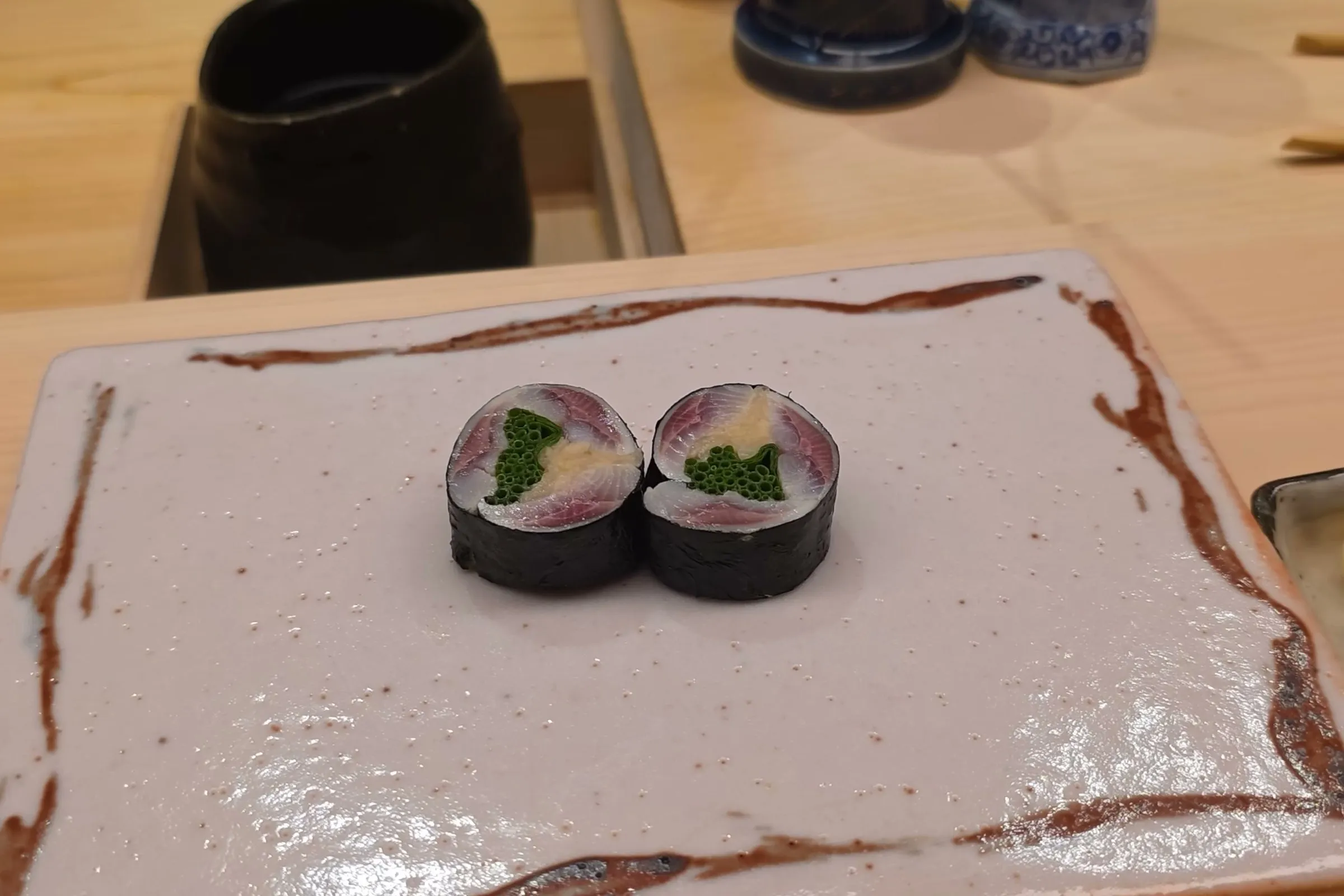
Just from the tsumami line-up, Sugita’s DNA shows far more clearly here than it did in Bangkok. The iwashi roll is one. Looking back, I noticed one roll had only half the shiso. Someone at the counter must not eat it. The careful slicing, the pieces lined up by height, that’s Sugita too.
The ankimo changed. At Ichizu the ankimo was exactly Sugita’s, and I loved it. Here the garnish is different and the seasoning is lighter. I like the original better. Like at Sugita, it comes with a glass of kijoshu to drink alongside, a different brand. I don’t drink, so I skipped it.
A miso-cured grill, a grilled clam adductor, and the kohada being readied behind the counter. You can’t watch this and not think of Sugita. Sugita’s color runs strong in this room.
Grilled ayu, eat it without the sauce
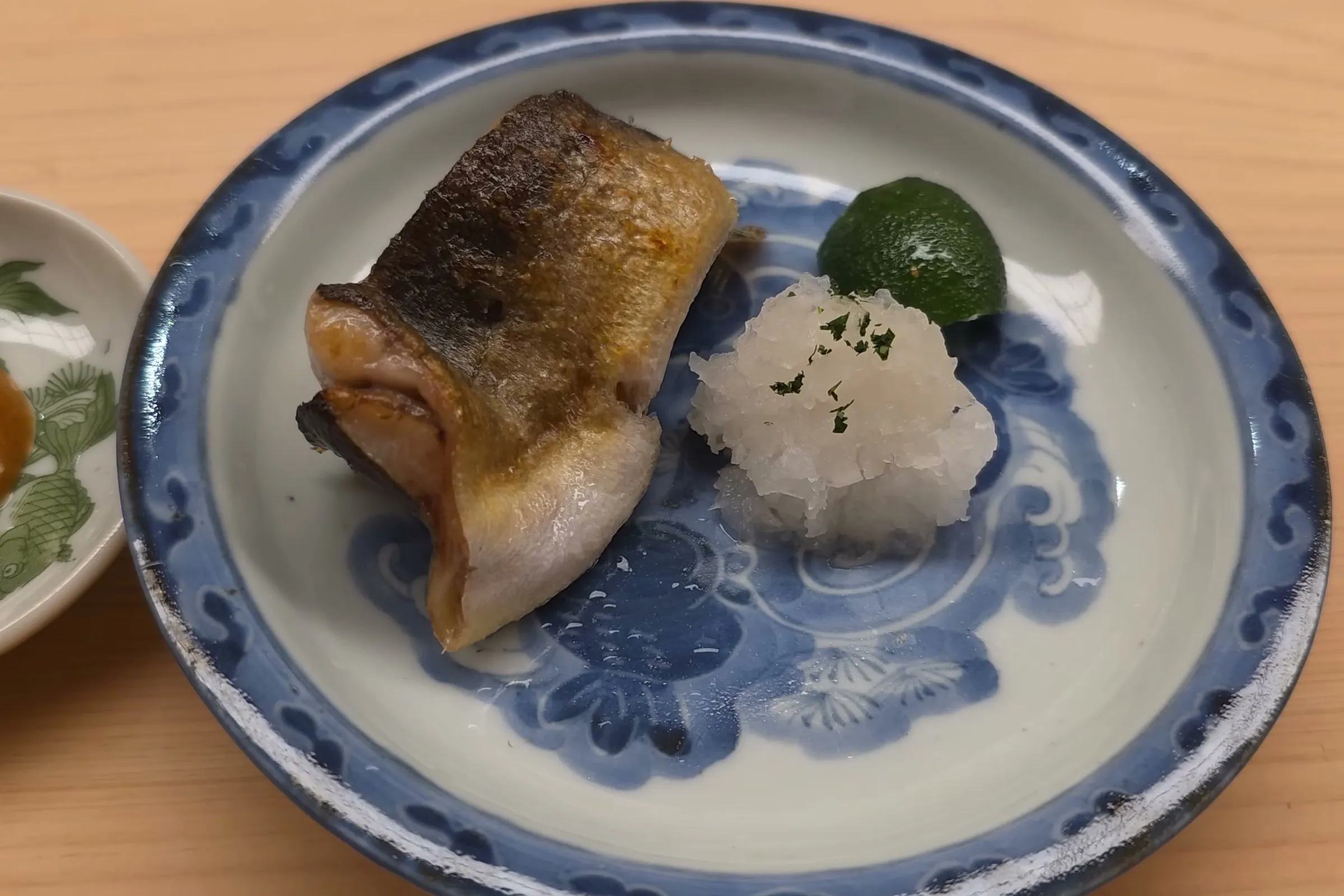
Then grilled ayu, sweetfish. That means summer. As a kid I loved winter fish, fat buri and saba packed with oil. Lately summer fish get me more: ayu, shinko. Ask me for one favorite sushi neta right now and I’d say shinko, the baby kohada.
Ayu usually lives on its liver sauce, that bitter edge. This night the flesh itself was nutty and delicious, and the liver sauce was all bitterness. So I ate the fish plain with the radish and liked it more.
Kohada first, and how sweet the rice is now
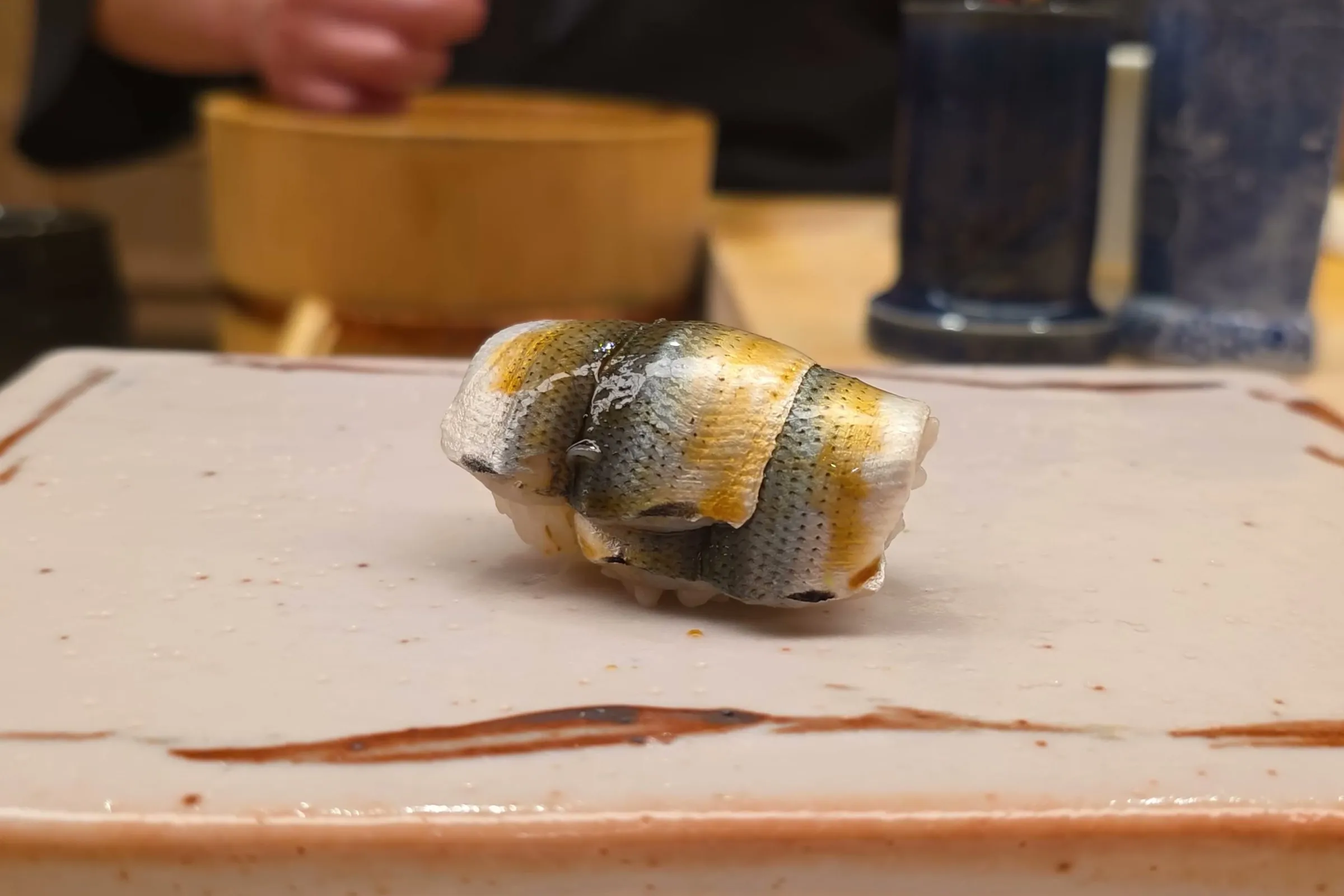
Nigiri opened with the kohada he’d been preparing. I can’t help comparing him with Sugita, sorry. Next to Ichizu the sweetness has dropped a lot. It’s still a little sweeter than Sugita. The vinegar nuance is Sugita’s.
The good news is the texture. It’s better than Sugita’s rice right now, because Sugita’s has gone too soft. It isn’t as good as Sugita’s rice at its peak, though. So the smell and the texture take me back to the Sugita of a few years ago. Nostalgia, basically.
The kohada itself was a step below. I’m not a kohada fan anyway. The shinko had already grown a bit. I like the tiny ones. The kasugo, though, I thought might beat Sugita’s. I’ve had good kasugo so rarely that I called all of it mediocre once.
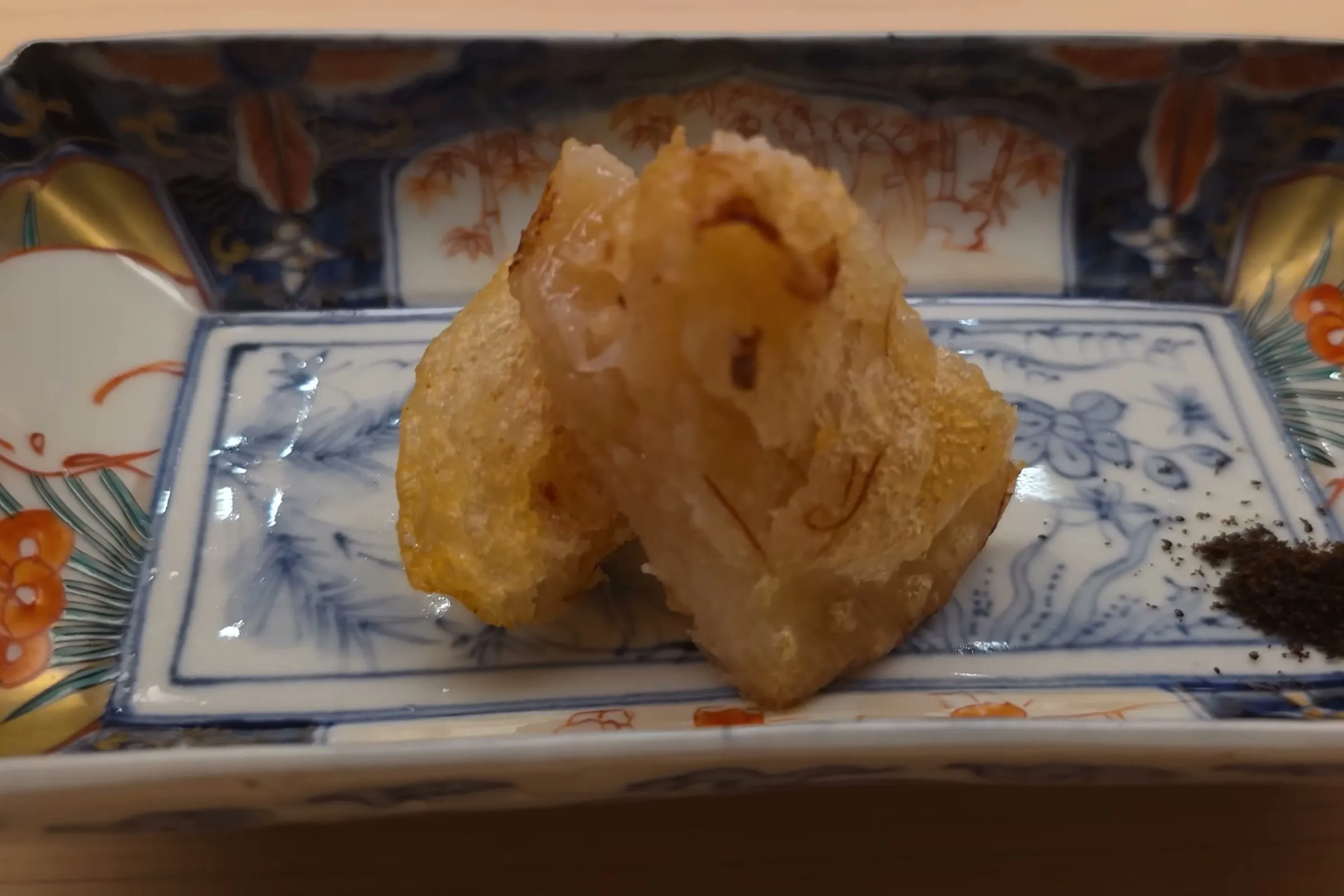
The fried shark fin I don’t get
Toda’s own signature is fried shark fin. I had it at Ichizu too, so it’s a dish he made in Thailand. It works as the hot thing in the middle of a raw run, and shark fin holds heat for a long time. The crunch of the fin inside the crisp batter is fine.
The taste, honestly? Isn’t shark fin something you eat for the soup? They give you black shichimi on the side and it’s not enough. It tasted like fried batter with a different texture inside, and greasy. Shark fin soaked in a thick, sticky chicken broth is delicious. This, I don’t know why it’s served.
Sanma, one piece of tuna, and the prawn
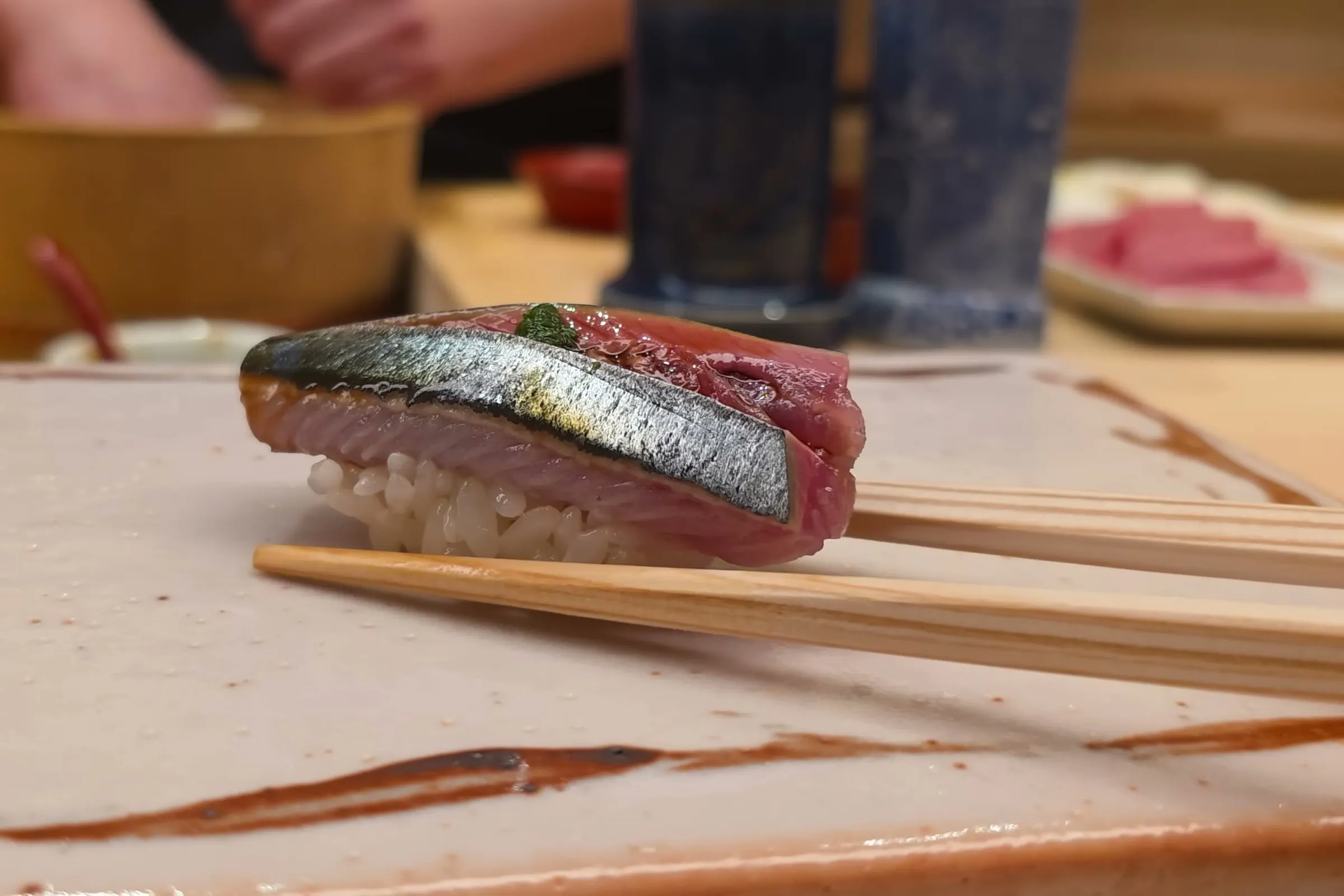
Then sanma, and I take back my shinko answer. Nothing beats sanma as sushi neta. Ten years ago you got it for a short stretch in October and November. Now it shows up in summer and again near winter. Hard to time.
Next to iwashi it isn’t short on fat, and the salty savory side is much deeper. Like the gap between bluefin and katsuo: iwashi is the bluefin, sanma the katsuo.
Then one piece of tuna. Probably the price limit. Sugita did the same back when it was in the ¥20,000s. However pricey the tuna, it was never going to win me over anyway.
The kuruma ebi is Sugita’s: the doneness, the size, how much of the head’s innards goes in with the rice. The rice and the prawn are served warmer here, though. Sugita uses cooler rice for the prawn.
Kinmedai rice, ikura, uni, and a Sugita craving
One thing that has nothing to do with Mizutani or Sugita: the kinmedai rice bowl that was almost a trend for a while. A taste you know. The rice shone on the surface, so I think there’s a fair bit of sugar. Sugita-san says he adds a little sugar for the shine, not the taste.
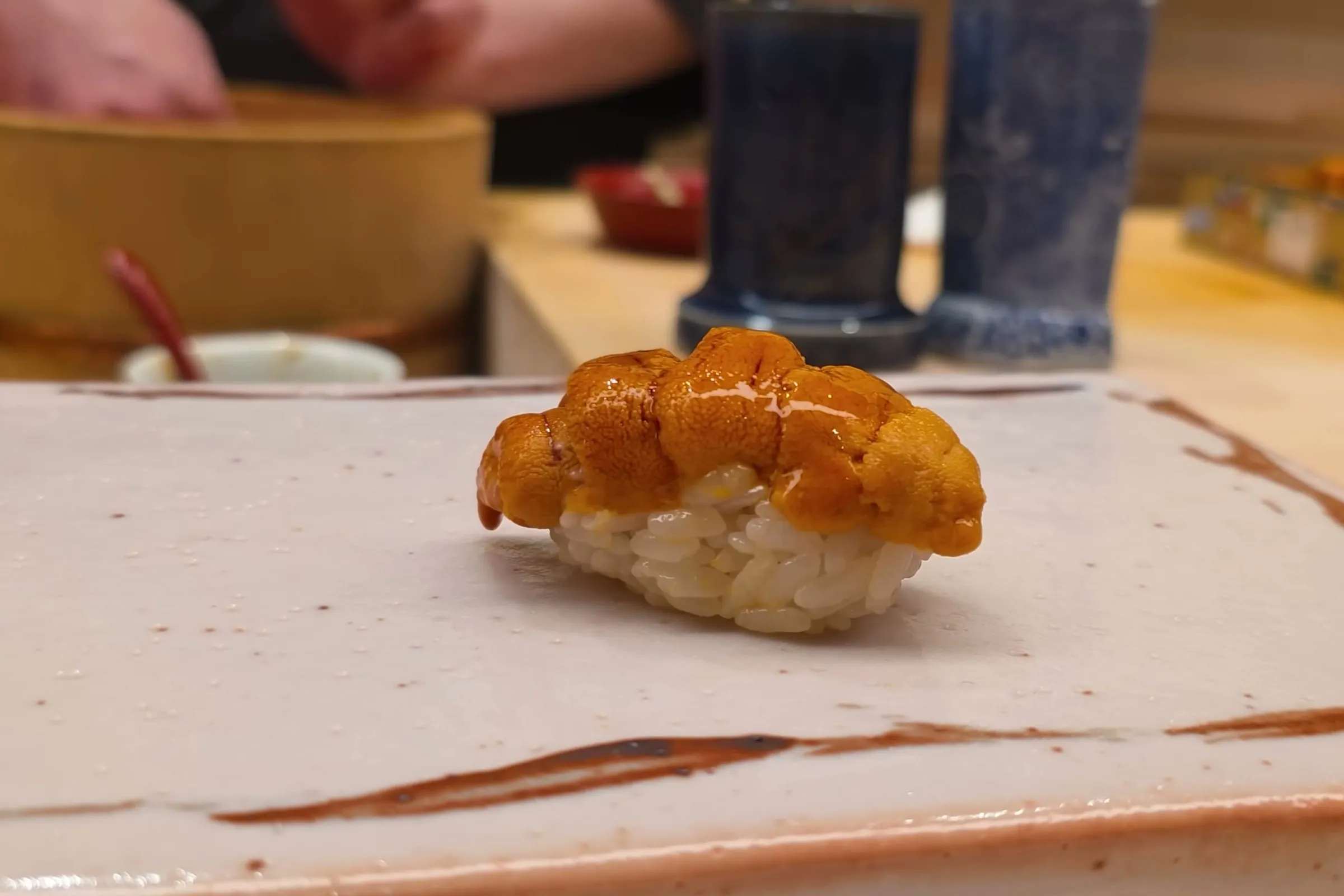
Ikura comes out from July now. The seasons have moved earlier, like the sanma, while shinko, the summer one, seems to come later. And no aka-uni, the red summer uni, on this night.
Then the bafun uni nigiri. Sugita again. I talked about Sugita this whole meal because Toda trained there and the rice tastes of it. Halfway through I was thinking, I should go to Sugita soon.
A loud, happy counter
Toda is fun. The guests that night were all men except one woman, and she was the only one saying oishii. He said that’s why you need women at the counter, men just sit there going mm. So I said oishii right away, and he burst out laughing. I rarely react to food anywhere, so that was for him.
There’s a youngest on the team who gets teased by everyone, even the very young sommelier. It’s all laughing, a wrestling show more than a fight.
I didn’t say much all night. At the end I told him it was my first time at Sushi Riku but not my first time seeing him: about nine years ago at Sugita, then in Bangkok. He said he’d kept looking at me thinking he knew me. He didn’t remember, but he said, wow, that’s a long time.
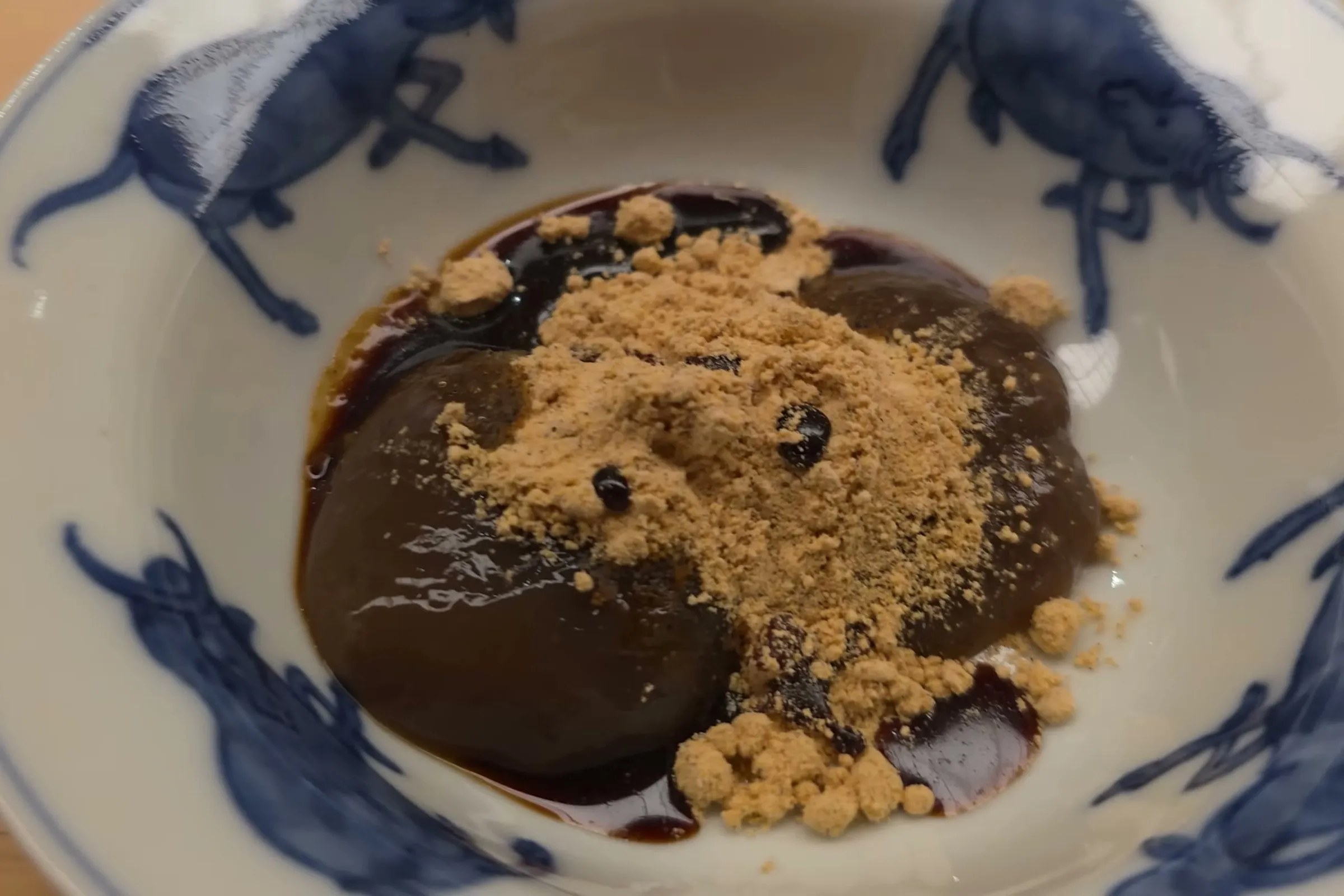
I don’t drink, but word is the sake list is good and cheap, a bit less of a bargain since a recent rise. A solo guest at the far end ordered bottle after bottle and finished on Moutai. Dessert was warabi mochi made in front of you, like a Japanese restaurant.
Under ¥40,000 a head
2025/11 video
Under ¥40,000 a person, about US$260, close to ₩400,000 (2025/11). No drinks on my side.
At the new Nishiazabu shop the course is ¥44,000 plus a 10% service charge (omakase.in, checked 2026/11).
Would I go back
Is it Sugita’s taste? It’s sweeter than Sugita, and the line-up reminds me of Sugita at every turn. The room is happier and more casual, and so is the price.
Mostly it sent me looking for a Sugita booking. If you can’t get into Sugita, you’ll taste a lot of Sugita here, for a lot less money.
How to book
- OMAKASE (omakase.in)
The only route Tabelog names. Chef’s course ¥44,000 a person, tax included, plus 10% service. Eight seats, 5 PM and 8 PM. Seats open in rounds; in 2026/11 none were open and the next round was TBD. ¥390 booking fee per seat, cancellation charges from the moment you book, the full price inside seven days. Make sure it says Nishiazabu: すし 陸 in Aoyama is a different shop.
- TABLEALL
Takes reservation requests for the dinner course at ¥54,000, which includes an ¥8,000 booking fee (checked 2026/11).
Checked 2026/11. Booking rules change, so look at the official page before you go.
Where it is
- Address
- THE LIVRE 2F, 3-13-1 Nishiazabu, Minato-ku, Tokyo東京都港区西麻布3-13-1 THE LIVRE 2F
Plan the Tokyo trip
The boring bits I’d sort before flying, so the eating days stay free.
- Hotels in Tokyo*
Pick the room by where you eat, not by the sights. After a long dinner, a short ride back is the real luxury. This place is in Nishiazabu, Minato, Tokyo.
- Japan eSIM*
Data from the moment you land, no counter and no SIM swap. Set it up the night before.
- Keisei Skyliner from Narita*
Narita to Ueno in about 40 minutes. Buy it ahead and walk straight to the platform.
- Haneda airport limousine bus*
Landing at Haneda instead? The limousine bus drops you at the big hotels and stations with no transfers.
- Tsukiji Outer Market food tour*
A market morning with someone who knows which stalls are worth the line.
- Sushi-making class at Tsukiji*
Shape nigiri yourself once and the counter makes a lot more sense.
Links marked * are affiliate links. If you book through them I may earn a small commission, and you pay the same. How it works
More places I have eaten at
All of Tokyo → Akasaka, Tokyo
Matsukawa
Kaiseki behind the US Embassy, referral only, cash only, and the best broth I know.
≈ ¥80,000 2024/09 video Ginza 6-chome, Tokyo
Tokyo Aburagumi Sohonten Ginza (Tokyo Abura Soba)
Soupless ramen in Ginza, same price for every size, open till 4 a.m.
¥760 2019/06 video Azabu-Juban, Tokyo
Sushi Meino
Chef Mei came up behind Arai. Her tsumami beat her rice.
¥66,700 2026/11 videoSources
- Sushi Riku (Nishiazabu) OMAKASE
- Sushi Riku (鮨 陸) Tabelog
- Sushi Riku TABLEALL