Guide
Tuna cuts at a sushi counter, from akami to otoro and the ones nobody explains
People kept asking which tuna piece is which, so I once took a tuna model apart on camera. This guide starts there and adds what years of tuna at Sushi Arai, Shimazu and Sugita taught me about the cuts, the rice and the sheet of paper with the fish’s weight on it.
monster gourmetFrom 13 of my videos, 2019/10 to 2025/09
The short version
- A tuna splits into back (se) and belly (hara), then head end (kami), middle (naka) and tail end (shimo).
- Akami is the lean red inside. Chutoro is the middle fat, on the back as well as the belly. Otoro is the belly wall around the guts.
- The better the tuna, the more the fatty cuts show it. Akami hides the gap.
- Chiai-gishi, wakaremi and kama toro are the cuts worth asking about.
- Akami soaked in soy (zuke) usually beats plain akami.
- Negitoro today is mostly chopped toro and green onion.
- Season and origin matter. How the chef picks and ages the fish matters more.
- Tuna needs rice strong enough to carry its oil.
How a tuna gets cut up
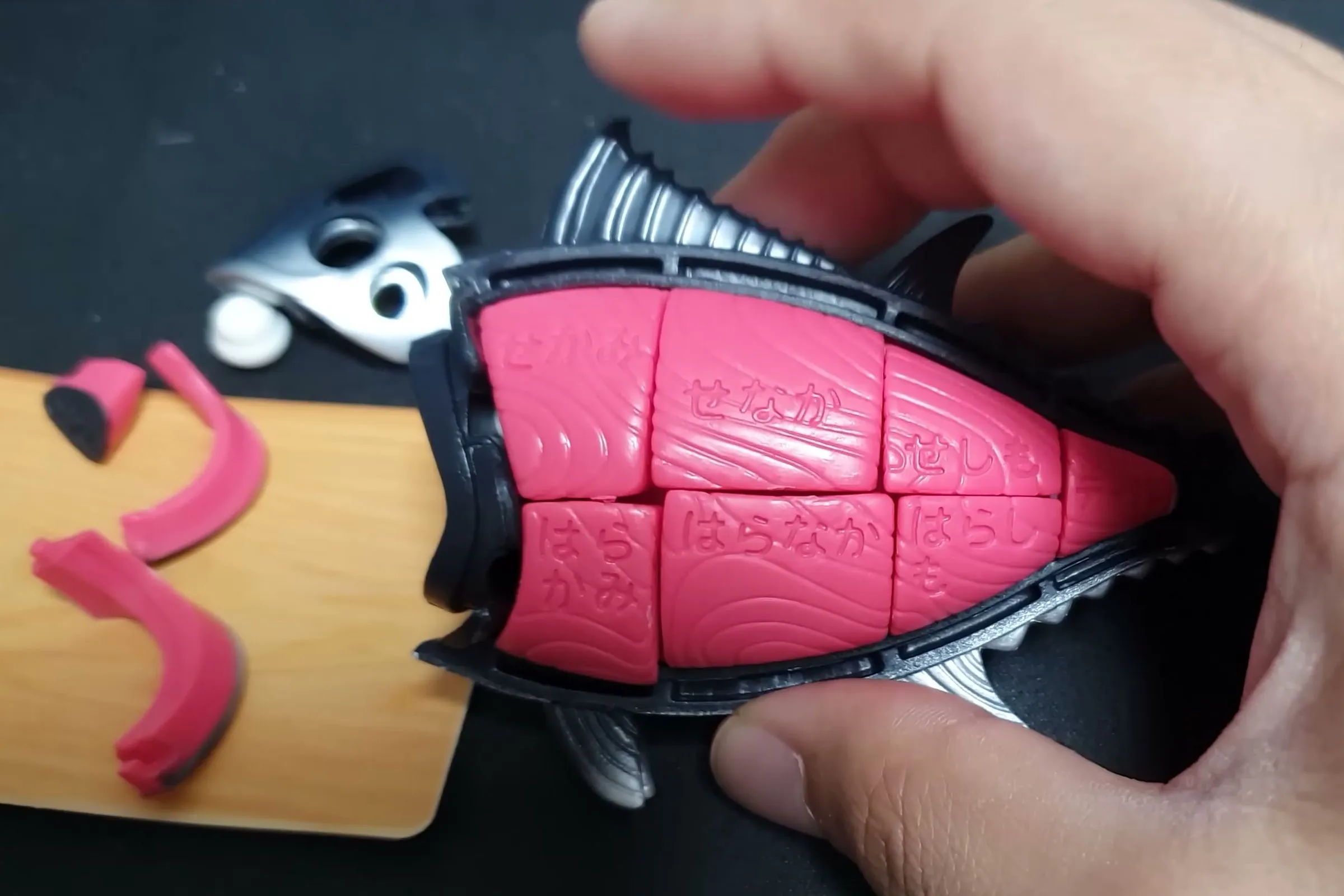
People kept asking about tuna cuts in the comments. Then a lady who turns up in my videos now and then lent me a tuna model with every part labeled, so in 2019/11 I took it apart on camera before I had to give it back.
The first split is top and bottom. The back is se (背) and the belly is hara (腹). Then front to back in three: kami (上) by the head, naka (中) in the middle, shimo (下) toward the tail. Harakami is the belly right behind the head, seshimo is the back near the tail.
Harakami ichiban, a name you hear at expensive counters, is the first block of belly behind the head, where the fat sits thickest. Sugaya in Tokyo served me Yamayuki’s harakami ichiban in 2019/10.
In old Tsukiji market footage you see buyers staring at a cut tail. That cross section is how they judge a fish before they bid.
Strip the back and belly off the model and what’s left along the spine is the lean red meat, akami. Every name in the table below is a slice of one of these blocks.
| Cut | Where it sits | What it’s like |
|---|---|---|
| Akami 赤身 | Inner meat along the spine | Lean, iron, a little acid |
| Tenmi 天身 | The strip of akami against the backbone | The deepest, bloodiest aroma |
| Chutoro 中トロ | Between akami and the outer fat, back and belly | Fat and acid in balance |
| Otoro 大トロ | Belly wall around the guts | The most fat, the highest price |
| Sunazuri, jabara | The very bottom of the belly | Otoro with stripes of sinew |
| Chiai-gishi 血合い岸 | Next to the dark blood line | A gradient from akami to toro |
| Wakaremi, setoro | Under the dorsal fin bones | The softest toro |
| Kama toro カマトロ | The collar, by the pectoral fin | Very fatty and chewy, usually cooked |
Akami, the red inside
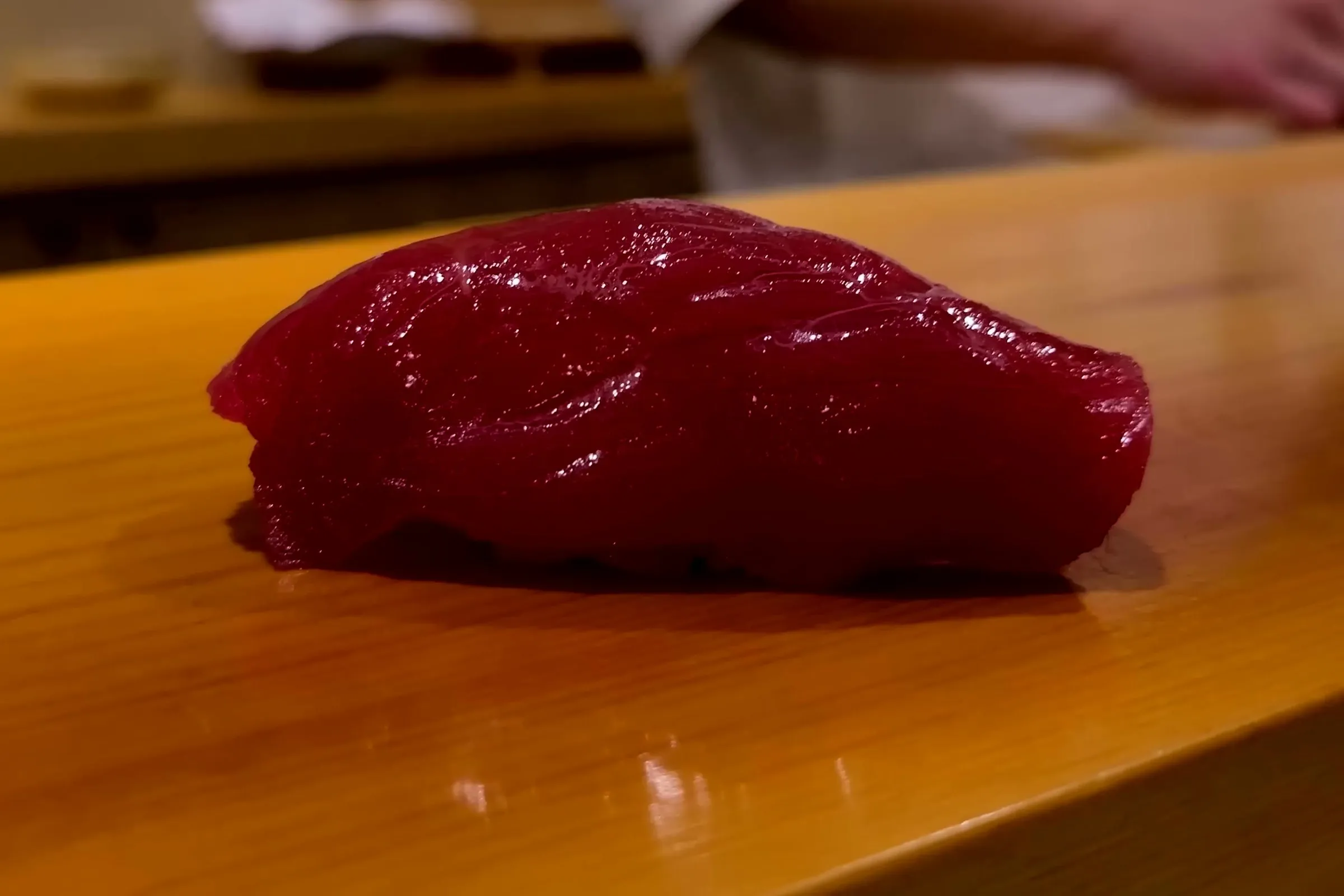
Akami (赤身) just means red body. It’s the inner meat around the spine with almost no fat, so the red shows. It tastes of iron and a little acid, and good akami has a sweetness only lean meat has.
Akami splits further. The strip right against the backbone sits on top when the block lies on the board, so it’s called tenmi (天身), heaven body. It’s the bloodiest-tasting part, with the strongest aroma. Sugita, my favorite counter in Tokyo, likes to use it.
The akami most people mean sits a bit further out, between tenmi and the fatty layers.
Where this happenedSushi Sugita→Sushi Arai→
Soy-soaked akami usually wins
Zuke means soaking the fish in soy for a while. It firms the texture, seasons it all the way through and pulls the sweetness forward.
Some chefs known for tuna, in Japan and in Korea, like to say really good tuna doesn’t need zuke. Every time one of them said it and handed me plain akami, the same line was on the tip of my tongue: chef, this akami needed zuke.
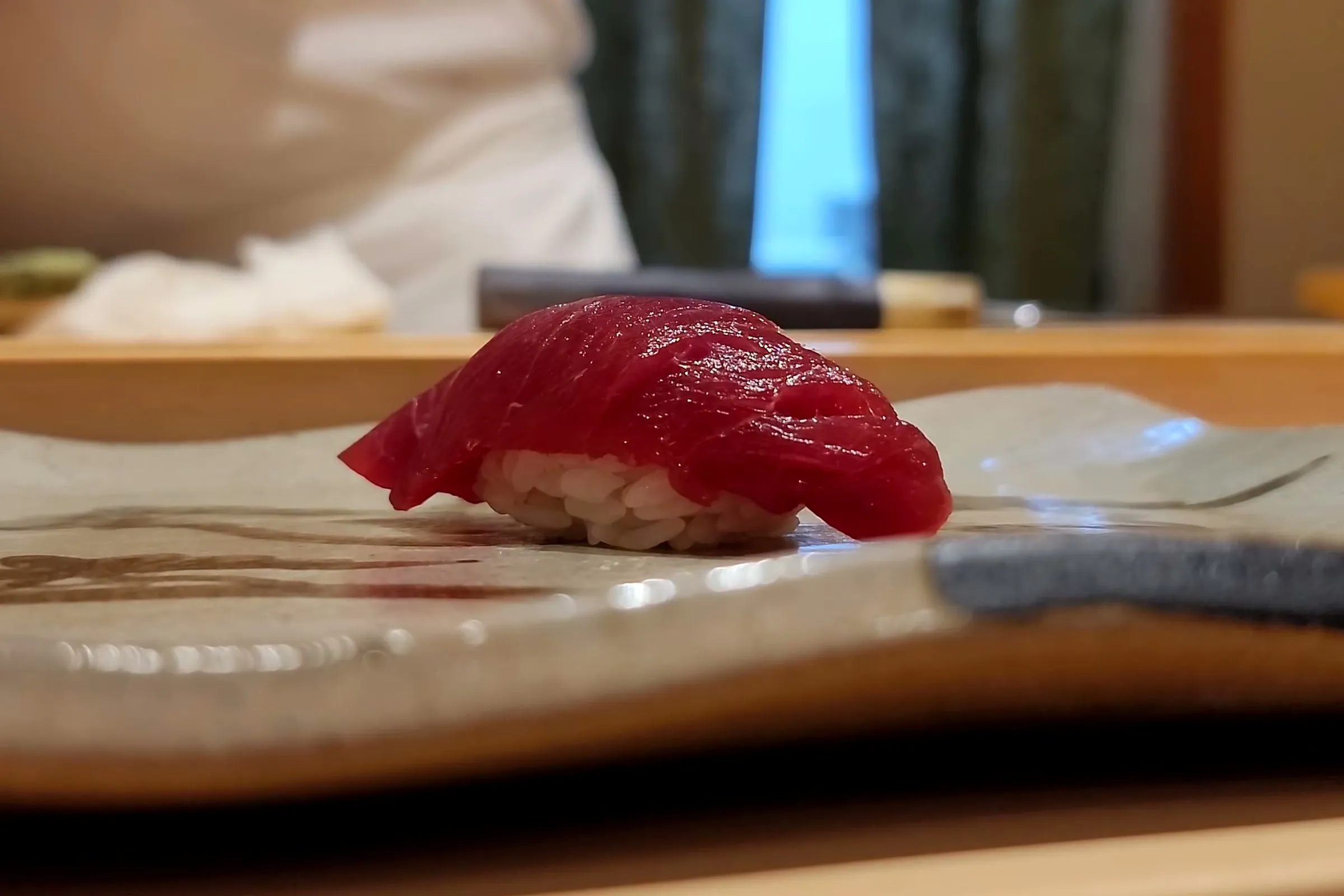
Sushi Arai is the one place that made me understand what they meant. Arai serves akami without soy, and it stands on its own. That’s how far ahead the tuna is there.
Most places, zuke wins. At Sushiya in Bundang, just south of Seoul, the akami zuke was the best piece of the night in 2021/03. The chew, the seasoning and the sweetness all lined up. Plain, I might not have noticed it.
Where this happenedSushi Arai→
Chutoro sits on the back too
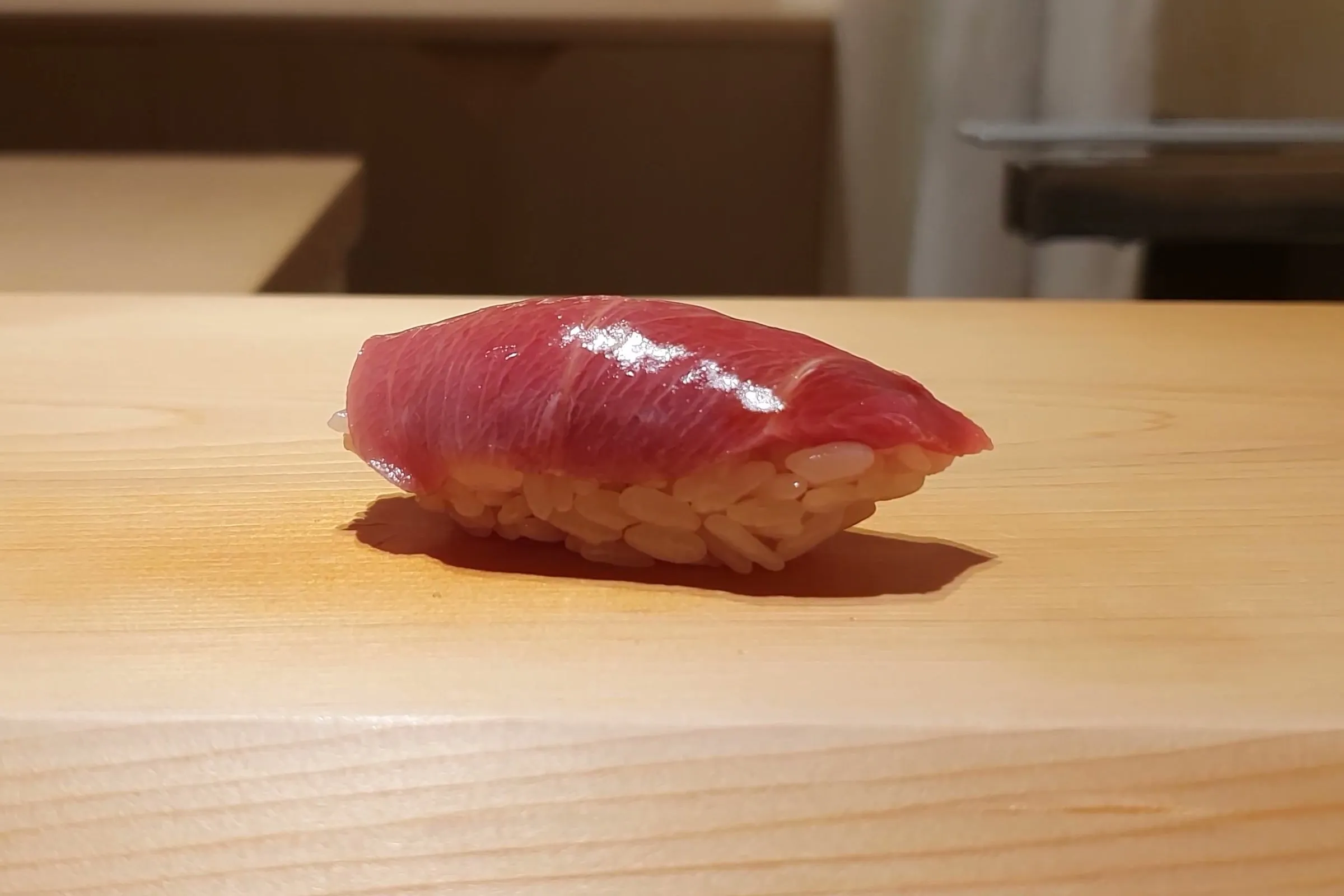
Chutoro (中トロ) is medium-fat meat, between akami and otoro. In Korea it’s often called middle belly, a name that came from a comic book. It’s wrong, because chutoro runs along the back as well as the belly.
At Sugaya in Tokyo, in 2019/10, the tuna came as four pieces in a row. The chutoro was excellent, as you’d expect from a counter known for its tuna. The rice was the problem, which comes up again further down.
Where this happenedSushi Sugaya→
Otoro vs chutoro, and why the best tuna shows in the fat
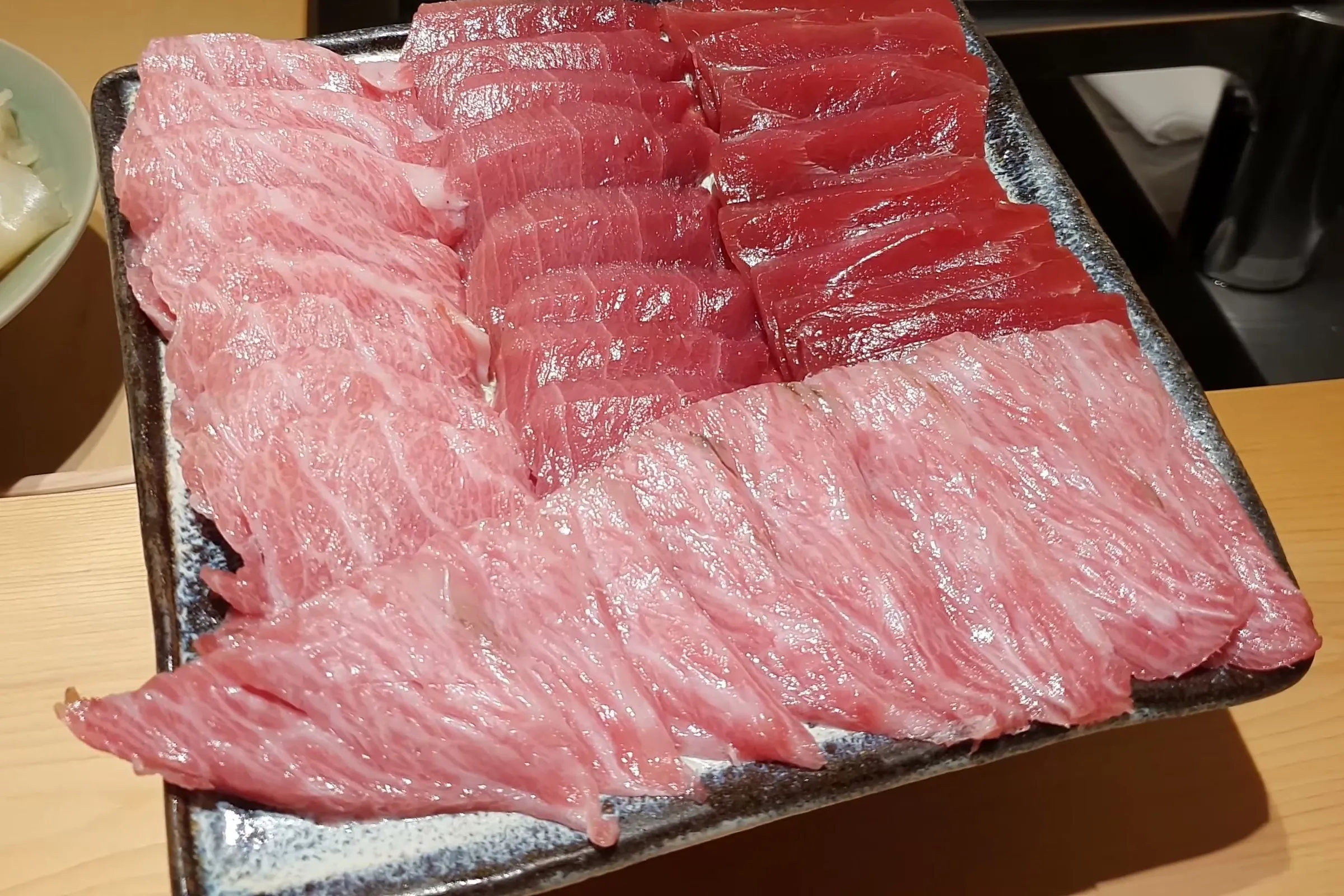
Otoro (大トロ), big toro, is the thin wall of belly wrapped around the guts. It has the most fat of any cut, around 40% by Wikipedia’s count, and it costs the most. Chutoro is the step below, fat with the acid of lean meat still in it, and cheaper. At a counter with great tuna, my pick is otoro.
I say this every time. The better the tuna, the more the fatty cuts show it. Fat picks up a faint funk, and cheap otoro leaves it behind after you swallow. Expensive otoro leaves something clean, or nothing at all.
At Sushi Arai in 2020/03 the belly had an edge that cut through the fat. Lean meat has its own sweetness, acid and a slightly bloody note, and fat usually covers them. Great tuna pushes them through the fat, like something poking through a thin film.
That tuna is also why dinner at Arai costs what it does. Four of us paid about ¥244,000 there (about US$1,850, 2023/02), with a bottle of wine and one extra negitoro roll.
Where this happenedSushi Arai→Sushi Sugaya→
Shimofuri, sunazuri, jabara
Counters slice the otoro block further, and three names come up a lot.
Shimofuri (霜降り) means frost-fallen, the marbled look. It’s mostly a beef word, used for well-marbled tuna too.
Sunazuri (砂ずり) is written with sand and rub. It’s the very bottom of the belly, named for the idea that it brushes the sea floor.
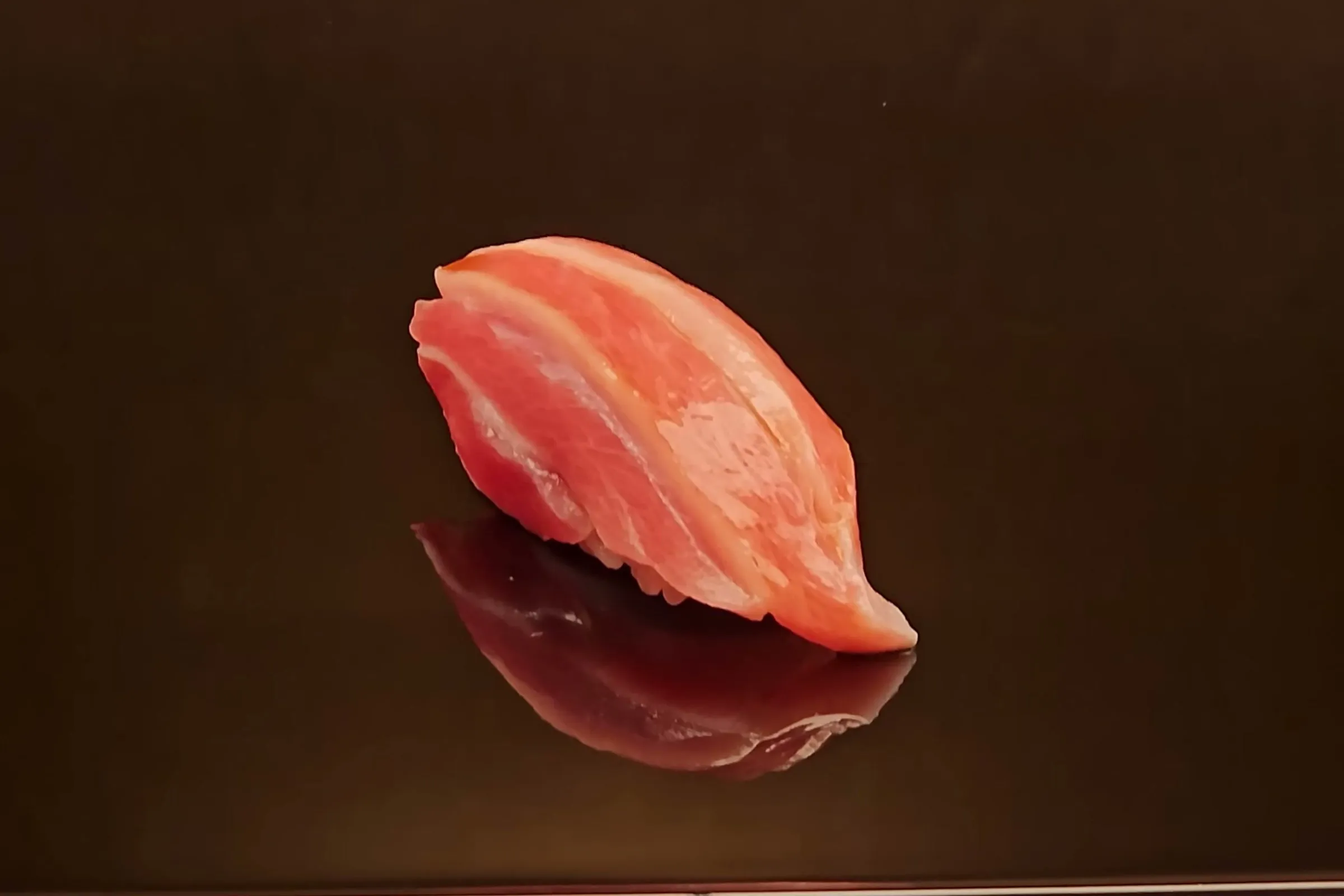
Jabara (蛇腹) is the word for accordion pleats. Near the sunazuri the belly is layered with thin sheets of sinew, and once it’s sliced and pressed onto rice they show as stripes. That’s jabara otoro.
At Sushi In in Seoul, in 2022/12, the sunazuri came with nothing on it, no nori and no yuzu kosho, and it still tasted like someone had grated yuzu over it. At Sushi Arai in 2023/09 the jabara, or sunazuri if you like, was so good I ordered another. Sweet fat, nutty fat, acid and aroma, and not one of them sticking out.
Where this happenedSushi Arai→
Chiai-gishi, the piece chefs love
Chiai (血合い) is the dark, blood-red meat around the spine. Every fish has it. On sea bream or flounder it’s the red streak. Kishi means edge, so chiai-gishi is the meat at the edge of that dark band.
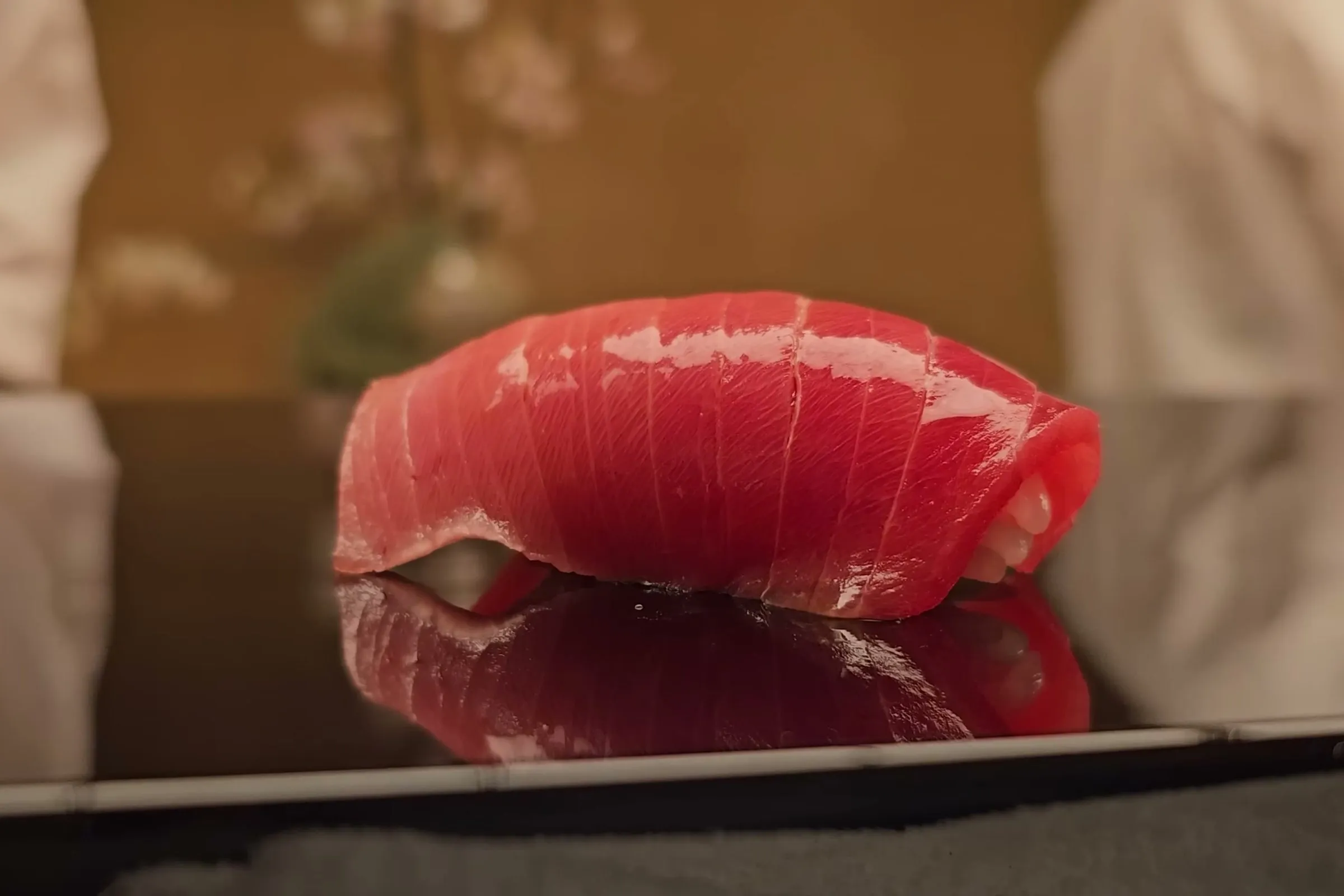
Cut wide around the band and the slice crosses akami and chutoro at once, so the piece shows a gradient of color. One bite has the acid of akami and the richness of toro. Plenty of chefs say it has everything, and it’s their favorite.
The one at Sushi Arai in 2024/03 looked unreal, and in person it was even prettier than on camera.
Where this happenedSushi Arai→
Wakaremi, the softest toro
Setoro (背トロ) can mean any fatty meat on the back, but the cut people usually mean is the strip just under the dorsal fin bones. Some counters call it wakaremi.
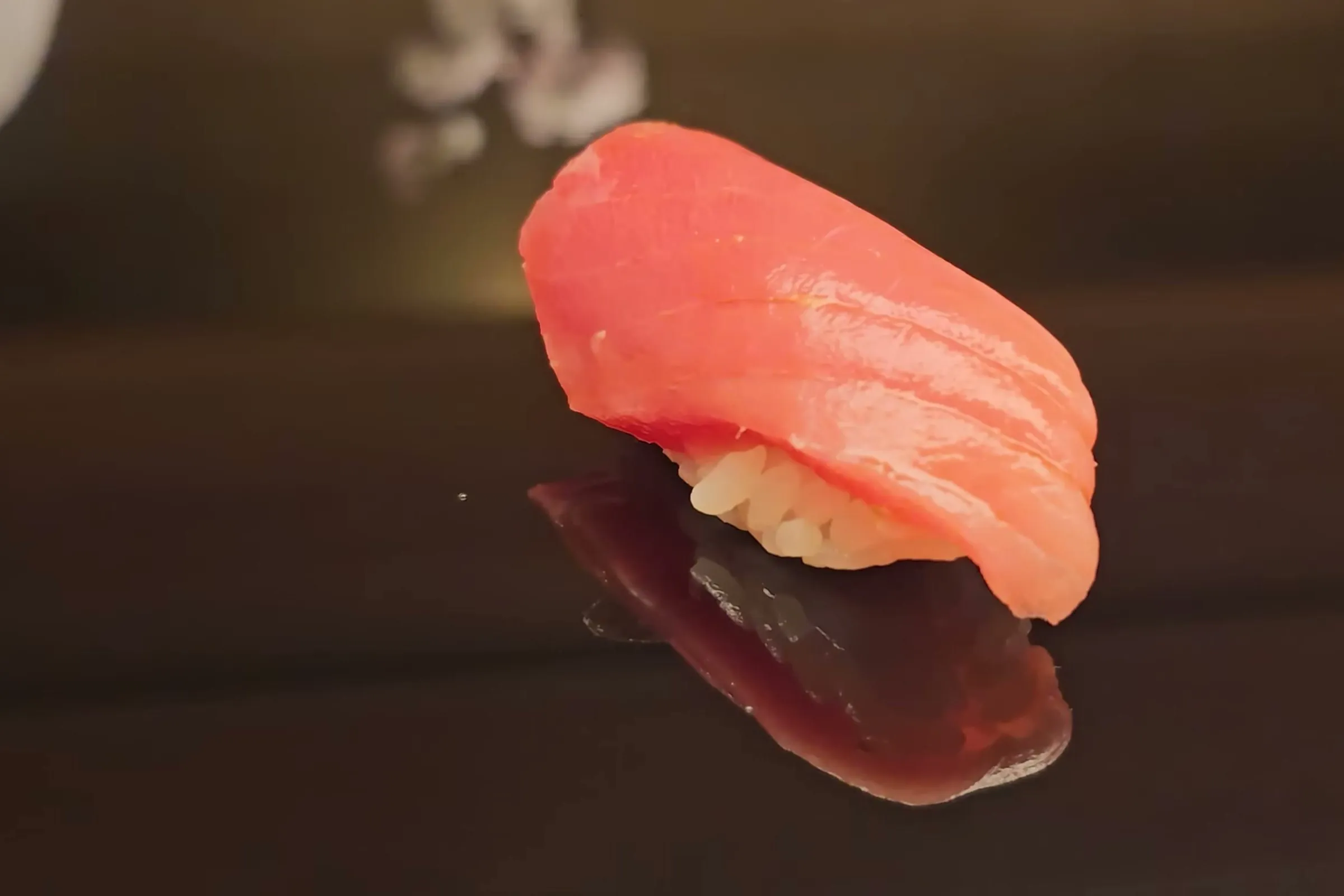
Toro doesn’t have to mean belly. The word comes from torokeru, to melt, that soft melting feel. Wakaremi is the softest toro of all. Press it with your tongue and it falls apart.
Not every counter serves it, and the ones that do tend to be proud of their fish. At Sushi Obana, outside Tokyo, in 2025/09 the wakaremi beat both the chiai-gishi and the otoro, with acid and sweet fat in better balance.
Where this happenedSushi Arai→
Kamatoro vs otoro, which is fattier and which I’d order
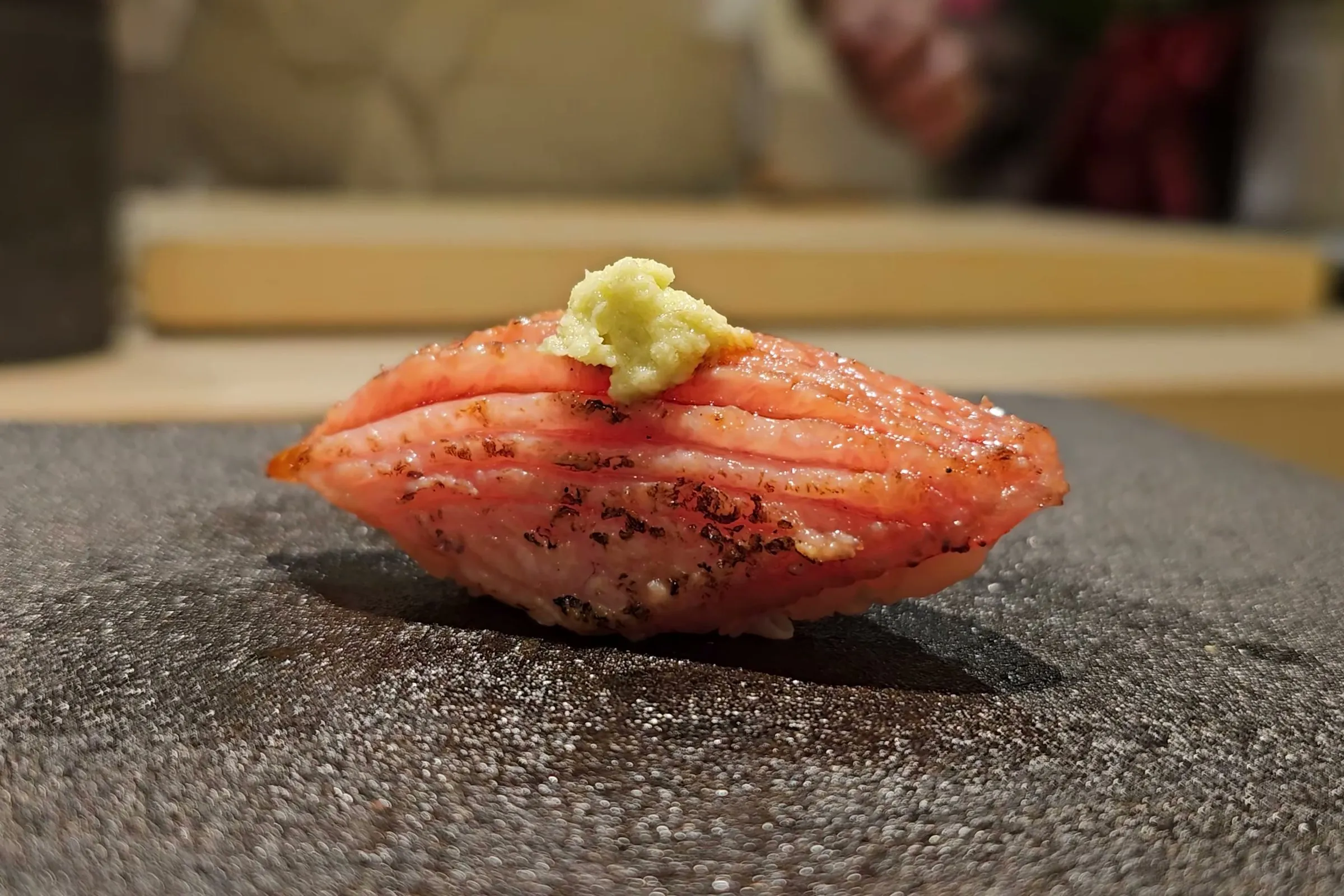
Otoro is the belly wall around the guts, the fattiest cut on the fish, and it’s soft. Kamatoro, or kama toro, is the collar behind the gills, very fatty too, but threaded with fibers that take real chewing. I never saw a per-piece price for either at the counters in this guide: otoro came in the course at Arai and Sugaya, Sugaya put kamatoro in the course too in 2019/10, seasoned and grilled the Arai way, and at Shimazu the kama was an extra I ordered. On rice, I pick otoro. Kamatoro I order grilled, and only on a day the tuna is great.
Kama (カマ) is the collar, behind the gills by the pectoral fin. Kama toro is the very fatty meat there. It looks like beef or whale, with the fat and the fibers right there to see.
Raw, it rarely comes as nigiri. It needs a lot of chewing, so the rice is gone long before the fish, and the balance falls apart.
So chefs cook it. At Shimazu in late 2024 the tuna was so good I ordered the kama as an extra. It came sliced thin and scored all over, brushed with sauce and lightly grilled. All those cuts are there because the texture is so firm. It was great.
The head has its own names you’ll see on market labels: ago-niku (jaw), hoho-niku (cheek) and noten (the crown). You meet them at tuna specialists more than at sushi counters.
Where this happenedSushi Shimazu→Sushi Sugaya→
Negitoro vs toro, and why negitoro isn’t a cut
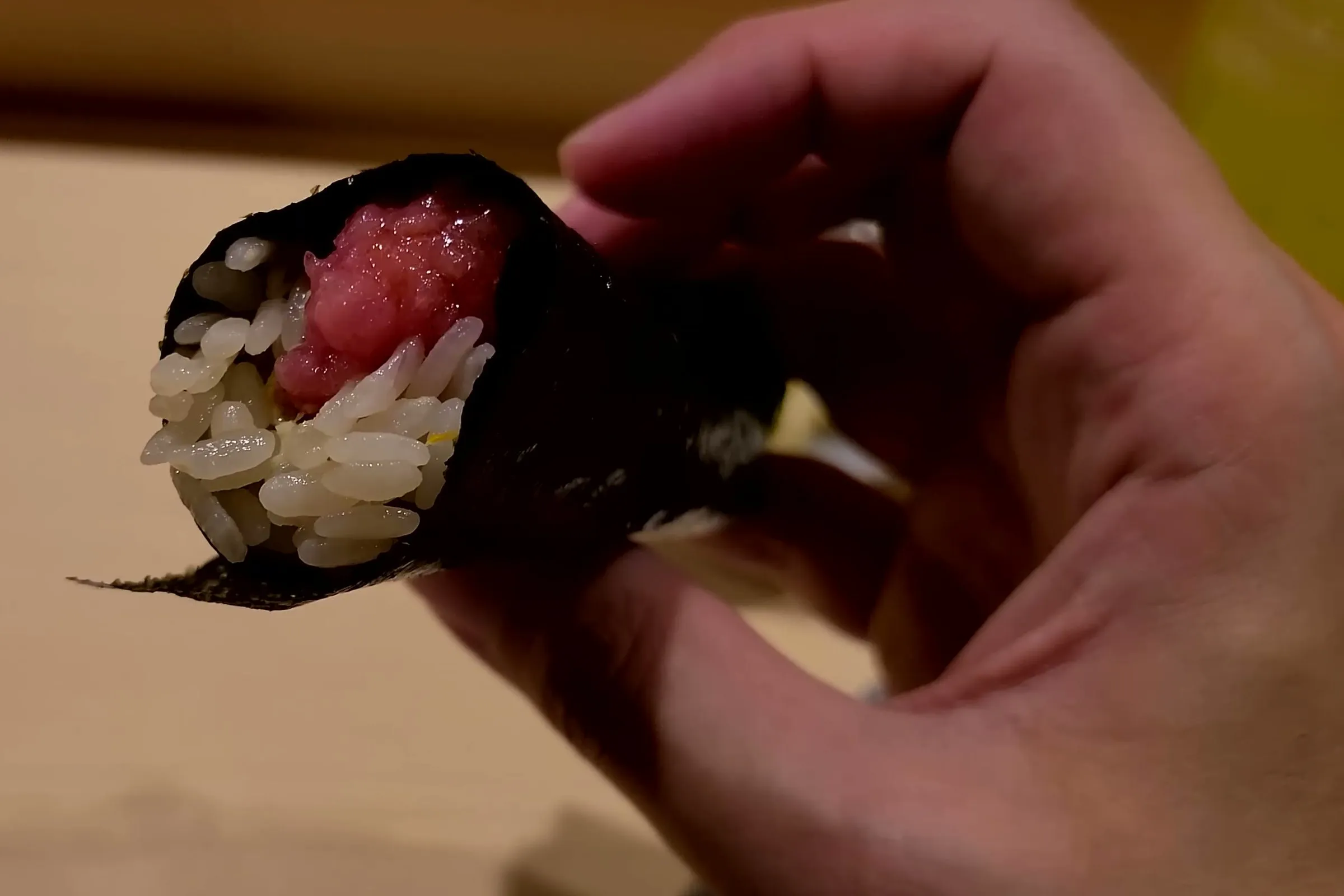
Toro is a cut, the fatty meat. Negitoro is a preparation: fatty tuna chopped fine and mixed with green onion, negi, then rolled in nori or piled on rice. Toro-taku rolls chopped toro with chopped takuan, yellow pickled daikon, in place of the green onion. With fatty farmed tuna I like one of the two mixed in, because their aroma and the sweet, sour taste cover a lot of the farmed smell I don’t like.
Between the ribs there’s meat called nakaochi (中落ち). The old story says scraping it off the bones with a spoon was called negitoru, and that’s where negitoro got its name.
I asked craftsmen in Japan about it, Sugita among them. These days fewer than half make negitoro from nakaochi. Most chop up toro, chutoro and the like, and mix in green onion (negi). So negi plus toro is exactly what it is now, and Japanese Wikipedia gives the same as the usual explanation.
At Arai in 2020/03 I wanted a second round of tuna and was told to eat the negitoro roll first, then decide.
Where this happenedSushi Arai→
The paper with the tuna’s weight on it
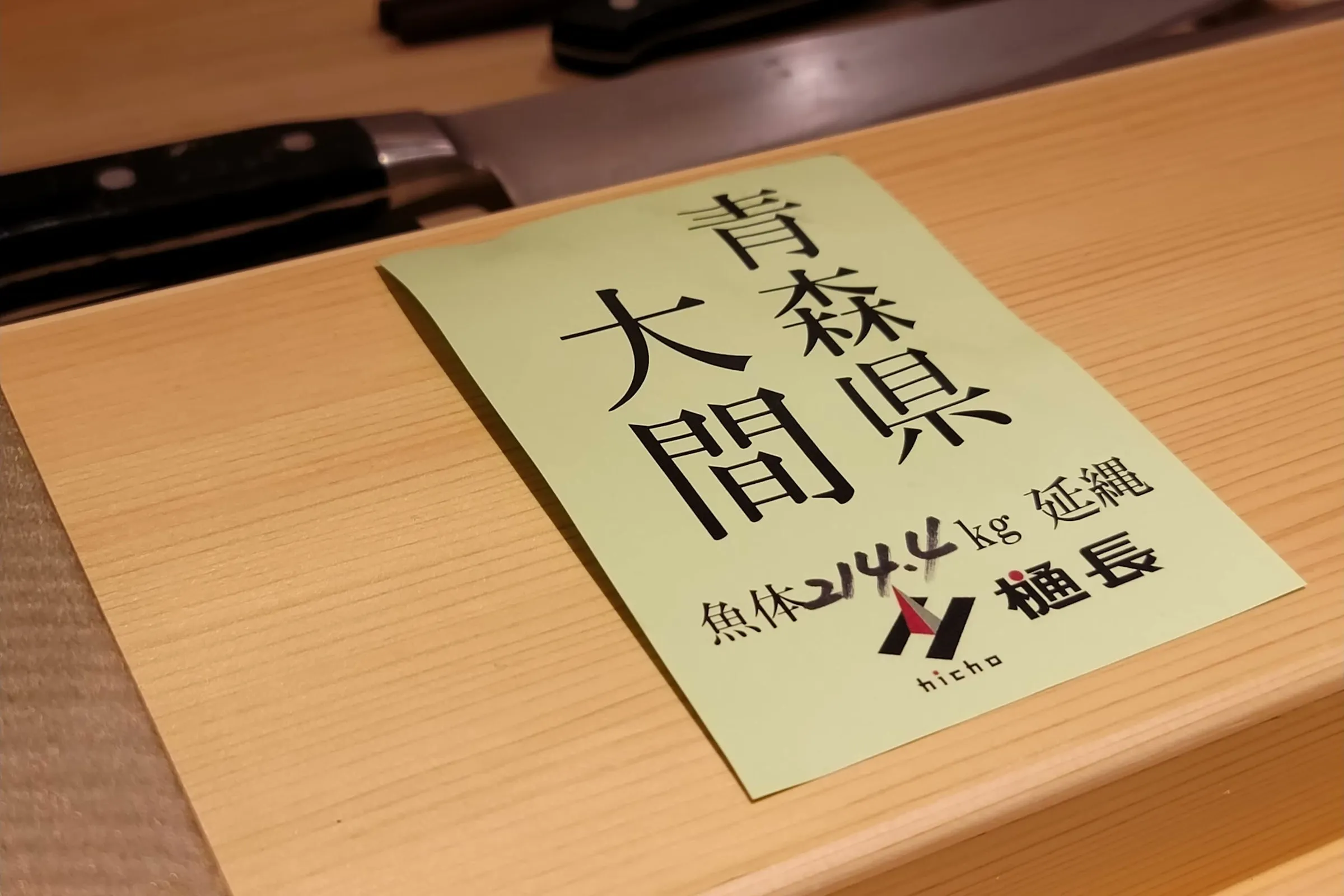
A lot of counters in Japan show you a sheet about the day’s tuna. The one at Sushi Komari said Oma, Aomori, 214.4kg, with the broker’s name, Hicho.
Brokers matter. Yamayuki is the biggest, the one people call the king of tuna. Sugaya, Saito, Nanba and Arai have all used its fish, and so has Sushi In in Seoul. Ishiji is one of the oldest brokers from the Tsukiji days, and Sugita gets its tuna there.
Then I learned the broker isn’t everything. In 2023/05 I ate at Shimazu, Nakajo and Arai on three days in a row, and I’m fairly sure all three had the same fish. Shimazu’s label said Sado, 79-something kg, and I heard the same at the other two. Shimazu’s tasted best, then Nakajo, then Arai. Same tuna, different hands.
Where this happenedSushi Shimazu→Sushi Arai→Sushi Sugaya→
Nakajo, where the best tuna goes
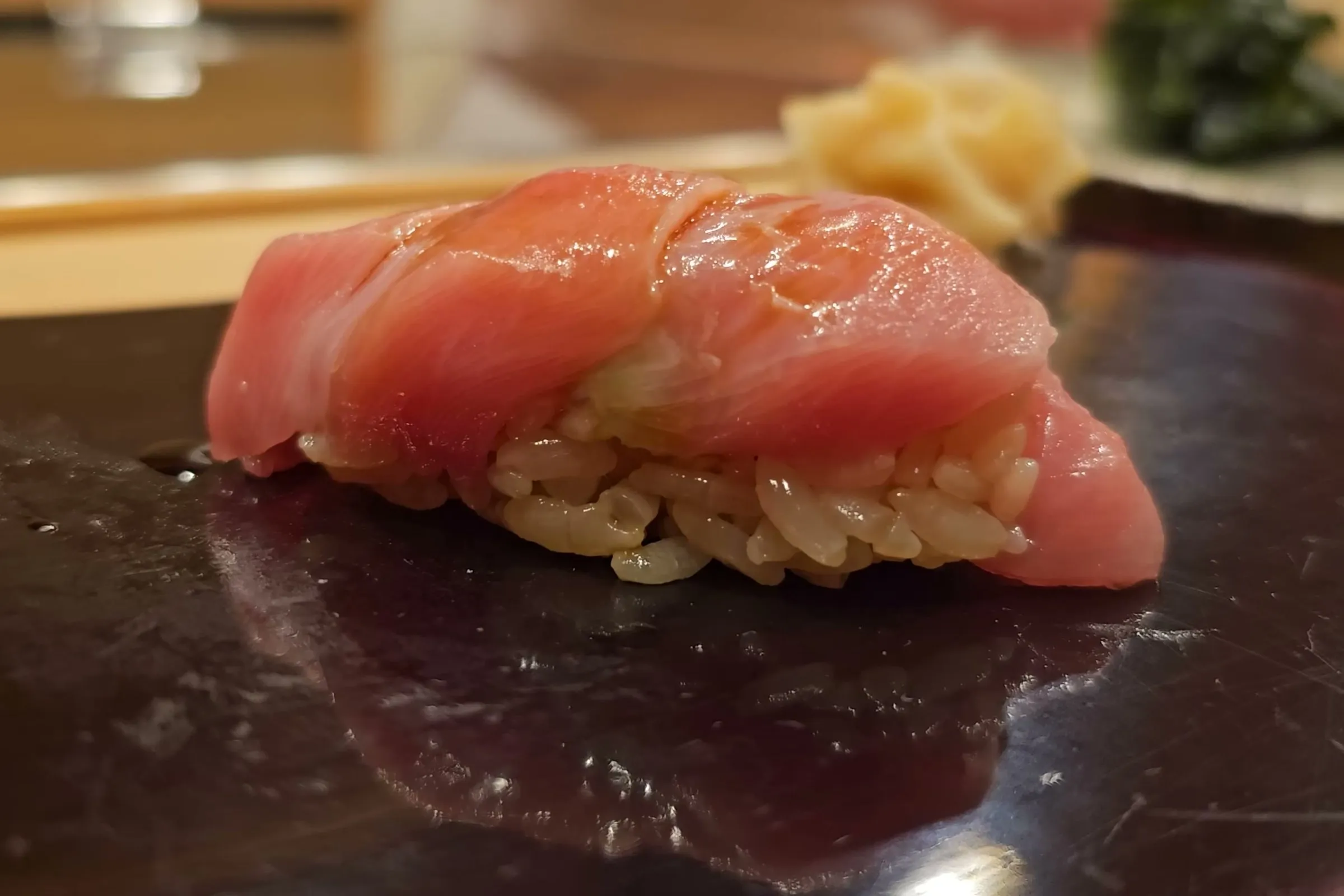
So where does Yamayuki’s very best tuna end up? I used to guess one of the famous names, Jiro, Saito or Arai. Years ago a foreign foodie on Instagram gave me the answer: Nakajo, a counter in Yokohama, not even in Tokyo. I booked once and had to cancel. In 2023/04 I finally went.
Chefs know Nakajo better than people like me who just eat sushi. At Toyosu market, everyone knows the chef as the man who spends the most money there, and traders say the best fish in Japan each day ends up at Nakajo. He never says it himself. It’s the market talking, which is why I believe it.
He doesn’t show off, either. No Yamayuki paper on the counter, no holding fish up for photos. Show some interest and he gets excited and talks. The main tuna was from Sado, 70-something kg. I’d had Yamayuki’s Sado tuna at Shimazu the night before, so I told him it was probably the same fish. He said that couldn’t be. He’s proud of what he buys.
Tuna came early too. A tekkamaki arrived as one of the first tsumami, made with older stock from Maizuru in Kyoto rather than the day’s main fish. Whenever he bought it, it was the best tuna on the day he bought it, and it tasted like it. For the nigiri he keeps two rices. The tuna and the saba got the one with red vinegar, a shade darker than the rest.
Two of us paid ¥75,000 (2023/04), about ¥37,500 each. For the fish everyone in the market calls the best, that’s cheap. Yokohama is awkward to fit into a food trip, but I promise nobody walks out thinking the money was wasted, and booking wasn’t hard. When I checked in 2026/10, Tabelog put the budget at ¥60,000 to ¥79,999.
Season matters, the chef matters more
Wild tuna is seasonal. Oma’s boats go out from about August to January, and the cold months are the peak, when the fish carries the most fat.
Chefs still don’t agree on when tuna is best, or even when Oma tuna is. Every counter has its own season.
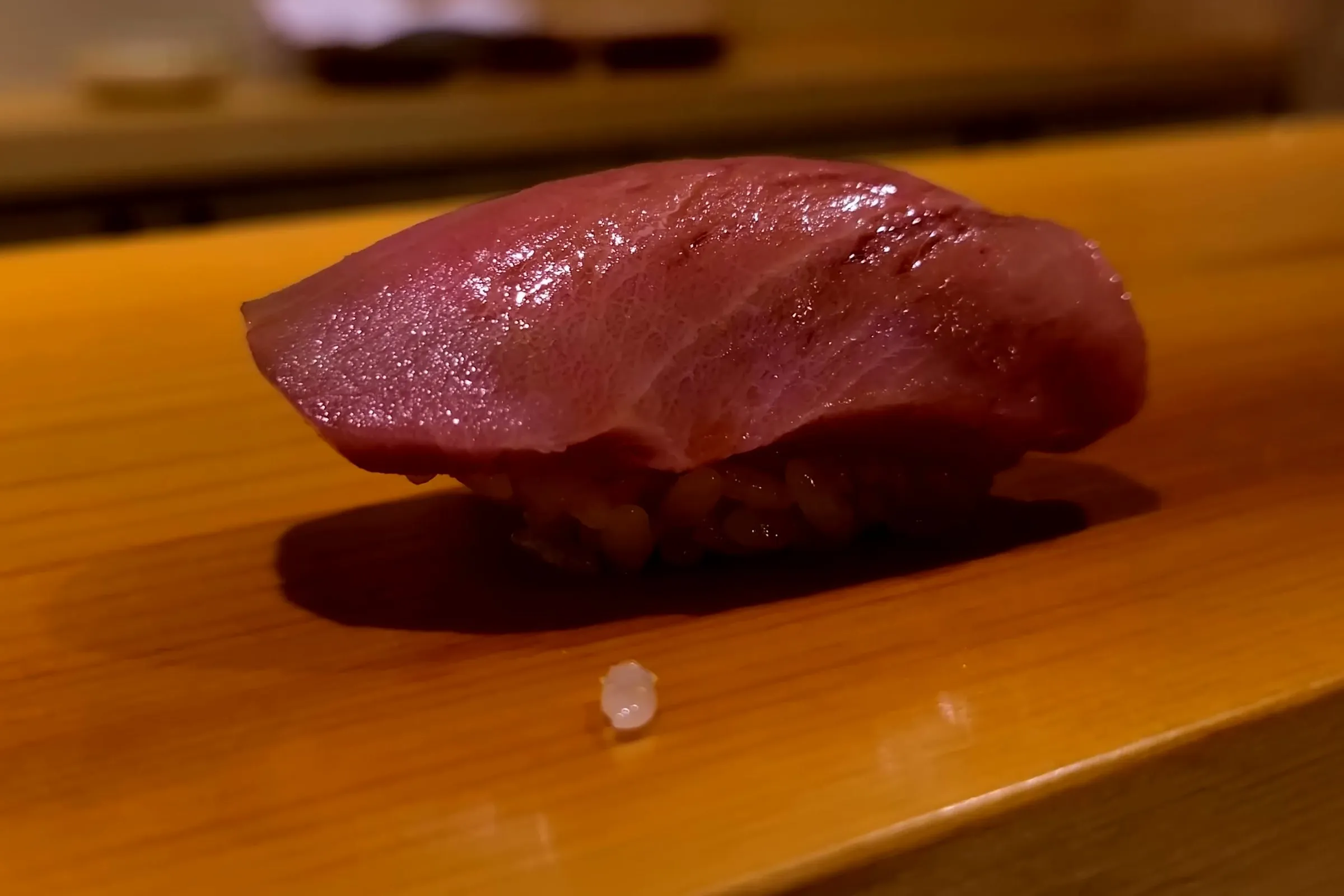
My best tuna at Arai, in 2020/03, came at the end of February, when Oma tuna was long finished. It was from Nagasaki. Picking the right fish and aging it well beat the calendar. Even an off day at Arai beat the best tuna I’d had anywhere else.
In 2023/09 Arai’s tuna was so good I asked where it was from, which I almost never do. Hachinohe, Aomori. The acid didn’t jump out, but it was clear, and the meaty aroma pressed down slow and heavy.
Where this happenedSushi Arai→
Tuna needs rice that can take it
What I love about tuna nigiri is the oil coating every grain of rice. The rice has to be strong enough for that. Plenty of vinegar and salt suits tuna better than squid or white fish.
It can go too far. At Sugaya in 2019/10 the vinegar hadn’t settled into the rice yet, and the sour smell flattened even very good chutoro.
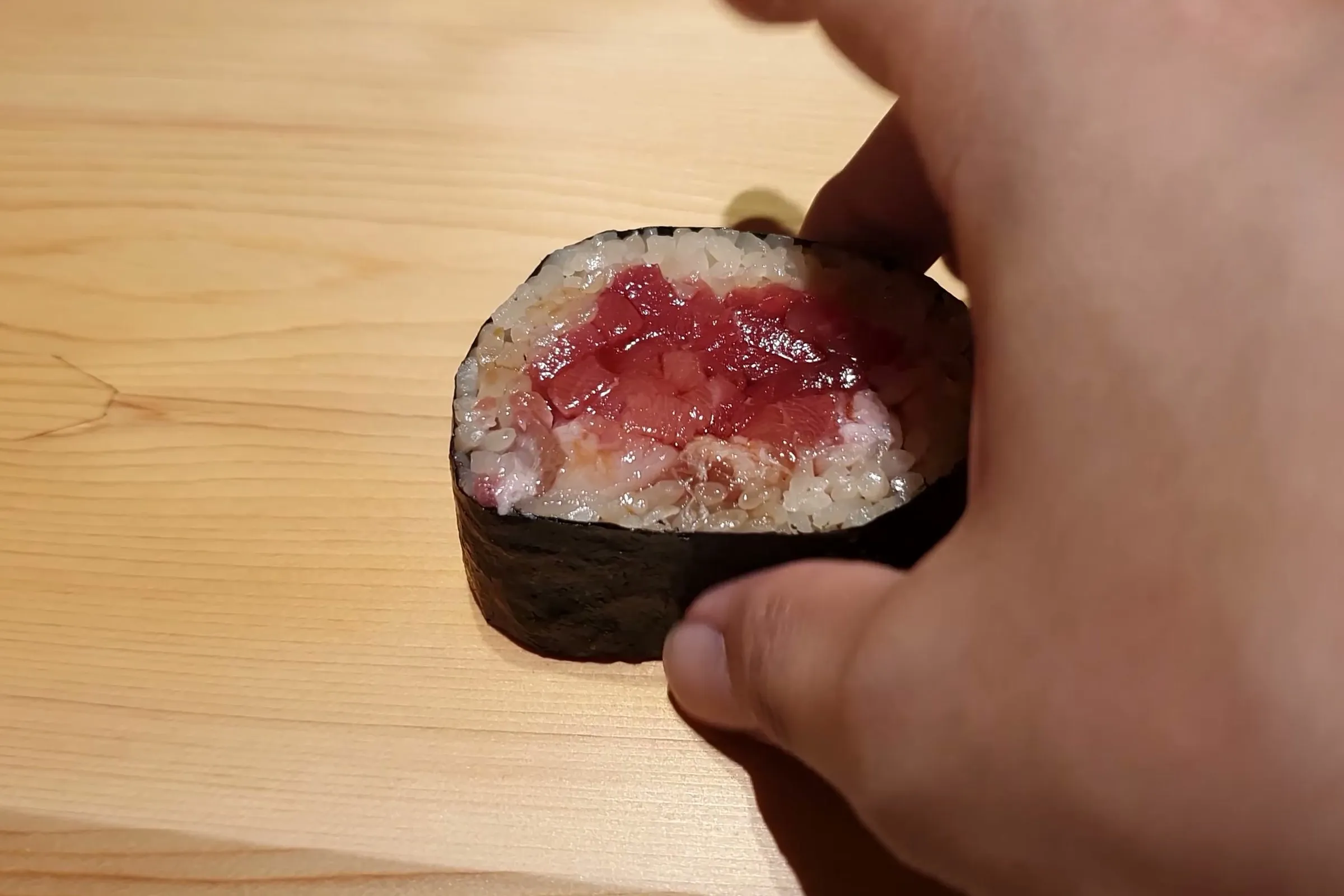
Sugaya also makes a giant tuna roll, packed with fatty tuna and rice. Fun to see, but the oil never reaches each grain the way it does on nigiri, so however good the tuna is, I’ll take the nigiri.
Where this happenedSushi Sugaya→
Plan the Tokyo trip
The boring bits I’d sort before flying, so the eating days stay free.
- Hotels in Tokyo*
Pick the room by where you eat, not by the sights. After a long dinner, a short ride back is the real luxury.
- Japan eSIM*
Data from the moment you land, no counter and no SIM swap. Set it up the night before.
- Keisei Skyliner from Narita*
Narita to Ueno in about 40 minutes. Buy it ahead and walk straight to the platform.
- Haneda airport limousine bus*
Landing at Haneda instead? The limousine bus drops you at the big hotels and stations with no transfers.
- Tsukiji Outer Market food tour*
A market morning with someone who knows which stalls are worth the line.
- Sushi-making class at Tsukiji*
Shape nigiri yourself once and the counter makes a lot more sense.
Links marked * are affiliate links. If you book through them I may earn a small commission, and you pay the same. How it works
The videos this guide comes from
- You can Try the Best Tuna Sushi in the World Here [Sushi Arai]15:392020/03
- Tuna anatomy for Sushi lover!!12:172019/11
- Incredible Bluefin Tuna sushi place in Tokyo13:392019/10
- The Tuna King Returns6:462023/09
- This Is How Tuna Should Be!5:502024/03
- The Tuna Throne. When will upcycling come?6:392023/05
- A Deep Dive into Tuna Sushi10:222023/02
- Pretty and Tasty Tuna15:522024/12
- Best tuna restaurants outside Tokyo15:472025/09
- This is what well-made tuna sushi tastes like.8:242021/03
- Oh Tae-sik x Yamayuki Tuna o You’re back?!10:302022/12
- A sushi restaurant using the world’s finest ingredients11:242023/04
- This sushi joint made me their regular | Sushi Sumire12:212020/02
Sources
- Toro (sushi) Wikipedia
- ネギトロ Wikipedia (Japanese)
- 大間まぐろ Wikipedia (Japanese)
- やま幸グループ|豊洲市場のマグロ・鮮魚の仲卸 Yamayuki
- なか條 Tabelog
- What Is Torotaku Sushi? Its Charm, Restaurants, and Recipes Sushi Walker