Sushi Sugaya has great tuna. I’m still not going back
Sushi Sugaya is an eight-seat counter in Higashi-Azabu, Tokyo, and the chef was the sous-chef at Sushi Arai, so the tuna is the best thing here, Yamayuki’s harakami ichiban, four cuts in a row. My lunch came to about ₩400,000, roughly ¥37,000 or US$340 (2019/10), booked through TABLEALL. Short tsumami, small nigiri and loud rice for that money, when Arai costs about the same, so I’m not going back. Great tuna, not worth the price for me.
monster gourmetFrom my 2019/10 video
- My share
- ≈ ₩400,000
- about US$340, lunch, booked through TABLEALL, as I said it in won (≈ ¥37,000), 2019/10 video
- Highlight
- Yamayuki tuna, the otoro most of all
- Skip
- Paying Arai money for a shorter meal
- Video
- 13:39
- 2019/10
- Where
- Higashi-Azabu, Tokyo
- Akabanebashi (Toei Oedo Line), 2 minutes from the Nakanohashi exit
Arai’s sous-chef, so you come for the tuna
Sushi Sugaya is an eight-seat counter in Higashi-Azabu, two minutes on foot from Akabanebashi Station. The chef, Sugaya Takayuki, was the sous-chef at Sushi Arai in Ginza, and he opened his own place in December 2018.
My favorite sushi place in Japan is Sugita, with Sushi Arai right after it. I pick Arai for its rice. But Arai’s image is the tuna king of Ginza, the counter with the best tuna and the best handling of it. So people expect tuna from Sugaya, its former sous-chef, too. If Arai is the king of tuna, Sugaya is the prince.
I booked through TABLEALL, and lunch came to about ₩400,000 (about US$340, 2019/10). When I checked in 2026/10, Tabelog had given it a Bronze award every year from 2021 to 2026.
Late, and straight into the madai
I was running really late, so I couldn’t film much of the walk, and I got there a little after my booking time. The meal started almost as soon as I sat down.
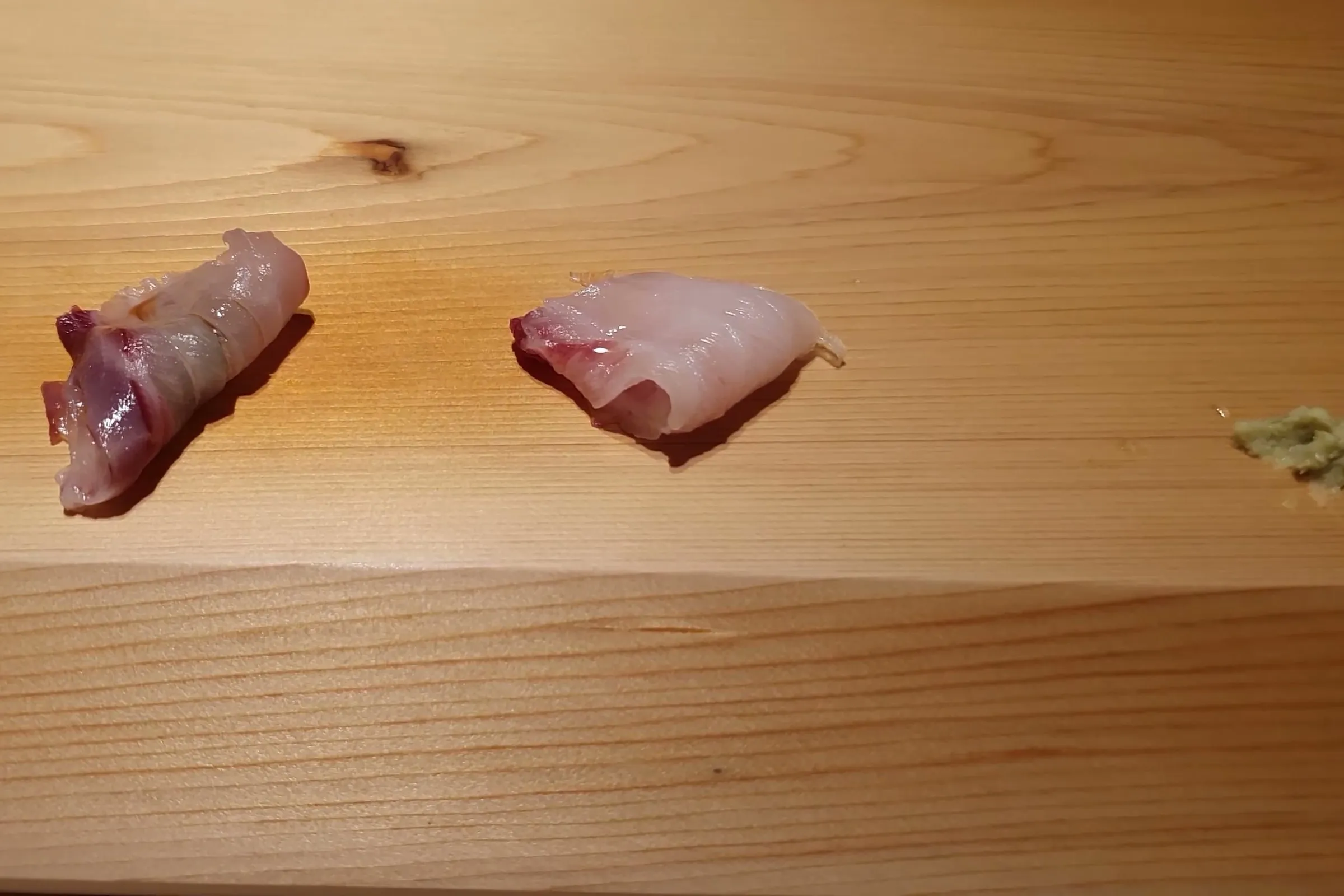
No plate on the counter here either. They put the food straight down on the wood. That tiny, cute bit of wasabi isn’t for the whole meal. The tsumami, the small dishes before the nigiri, are short here, and it was only for this one.
Wild madai, red sea bream, two ways. The piece on the right had a little salt on top. Familiar taste, but surprisingly fatty, and the aging made it soft and fluffy instead of the crisp bite I expected.
The left one had shio-konbu, salted kelp, inside. A little salty, good umami. I learned later it had kinome too, the young leaves of sansho, which I compared to the pepper in mala. Apparently that’s Kyoto style, putting things inside white-fish sashimi. I’m not from Kyoto, so I can’t fact-check that.
A Choco Pie on the side
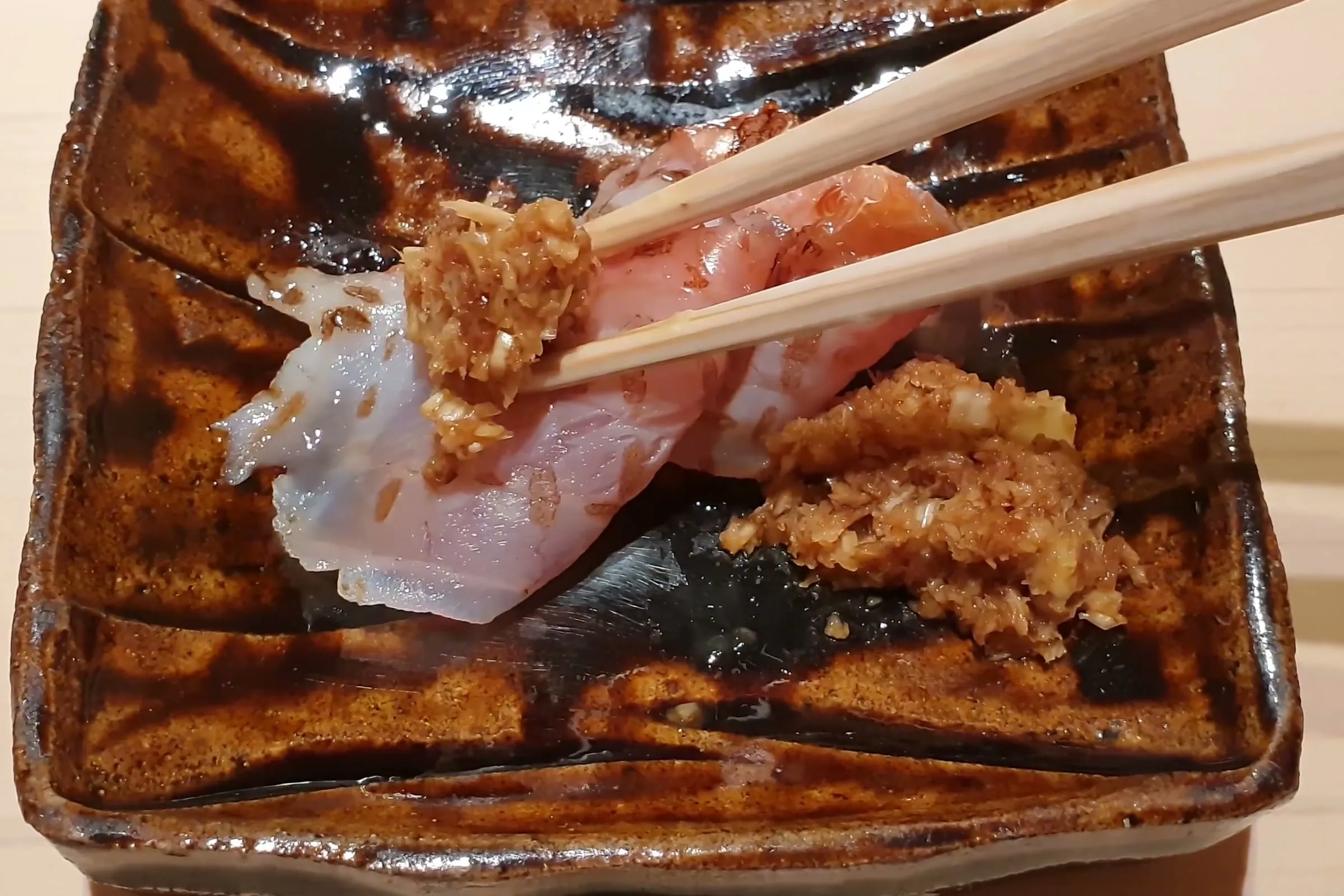
You can guess what’s next. Kinmedai, golden-eye snapper, the skin lightly grilled. See that lump beside it? It looks like someone made a fake poop out of a Choco Pie.
Sugaya doesn’t serve many tsumami, and most of them are lightly cooked sashimi with something on the side to eat with it. This one was surprisingly tasty.
The lump is horseradish, what you’d call Western wasabi, mixed with the white part of scallions. It went with the fish much better than wasabi does.
Buri two ways, and the raw one was salty
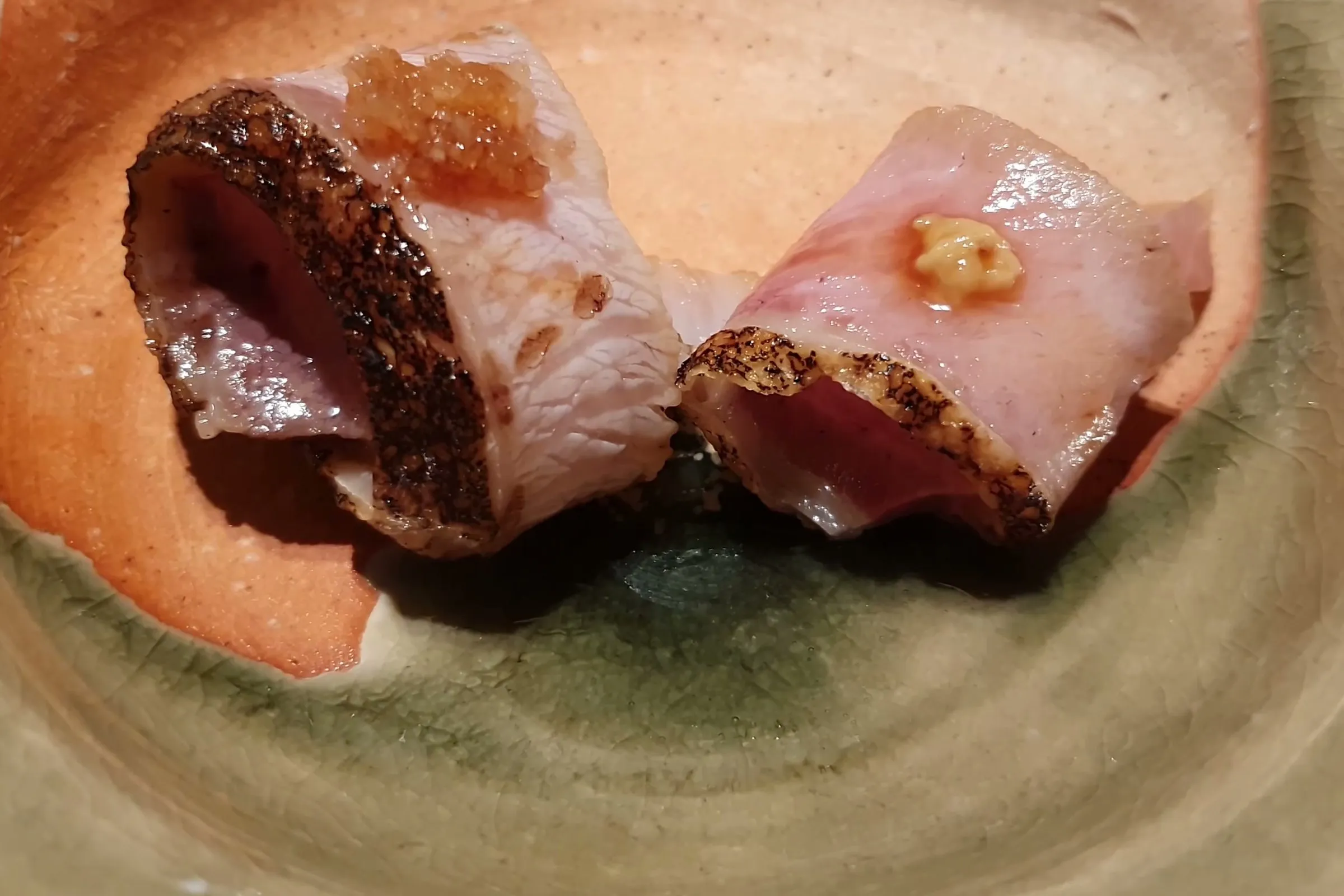
This one’s obvious. Buri, yellowtail, skin lightly grilled, cut thick and rolled up. Both pieces had been marinated in soy sauce.
The right one was raw, with mustard on top and nothing inside. Very fatty, you can see it’s almost white, and pretty salty. The left one was cooked a little too, with a scallion oroshi on top. Oroshi means grated, or anyway, extremely finely chopped. Then something like ponzu over it.
Maybe because of all that fat, I liked the left one better. Lip-coating fat, and something fresh and sour on top taking the edge off it. The raw one with mustard was too salty for me. Cooking it made it taste less salty.
Something smells like feet
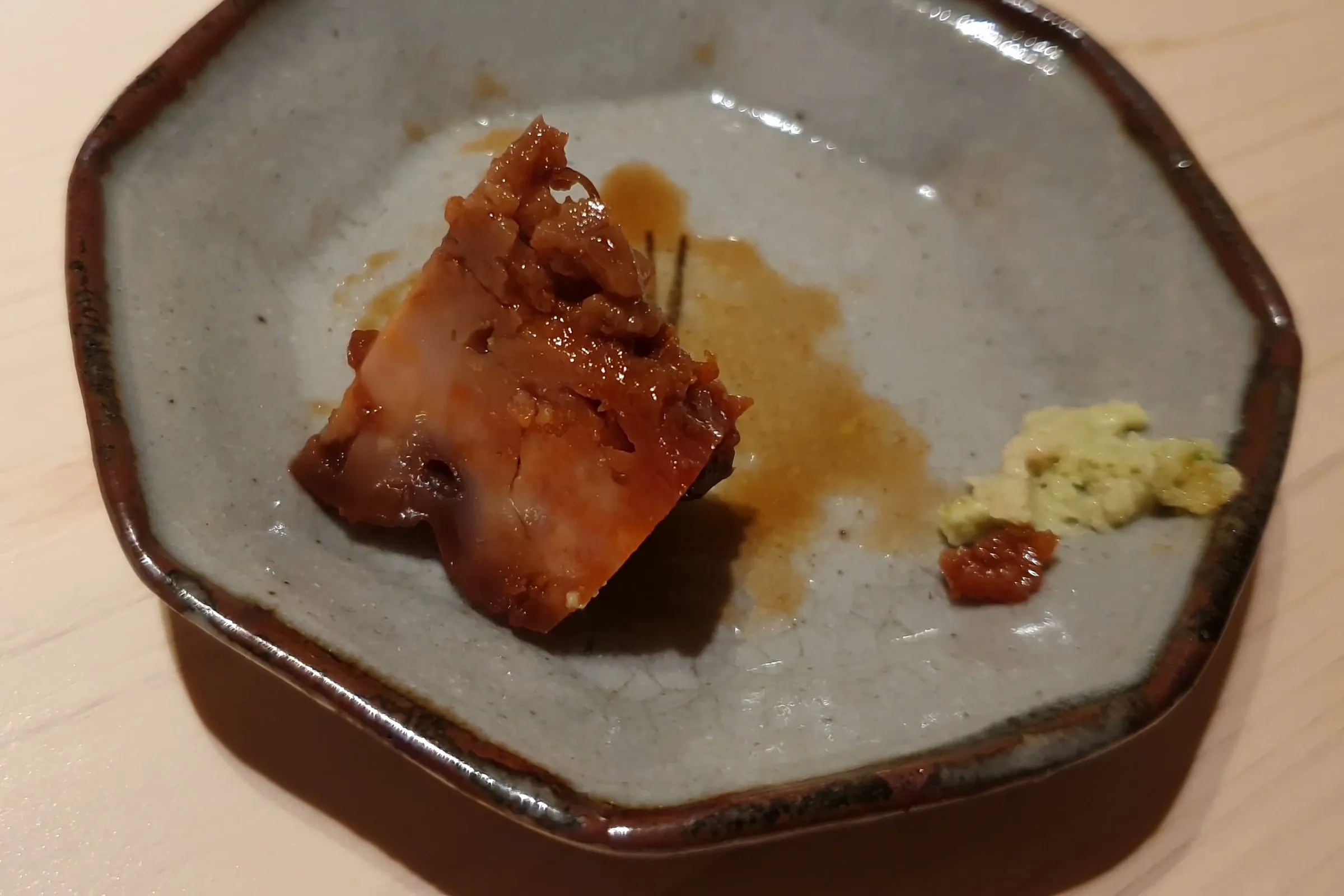
Then, while I was eating, I suddenly smelled something like feet. He was preparing ankimo, monkfish liver.
One of Arai’s signatures is ankimo with narazuke, melon pickled in sake lees. The chef came from Arai, so I figured that was it and the smell came from a pickle. No. It was the seasoning on the ankimo itself. The smell was intense.
Eating it, the flavor wasn’t like that at all. Strong sweetness, lovely richness, but far too salty.
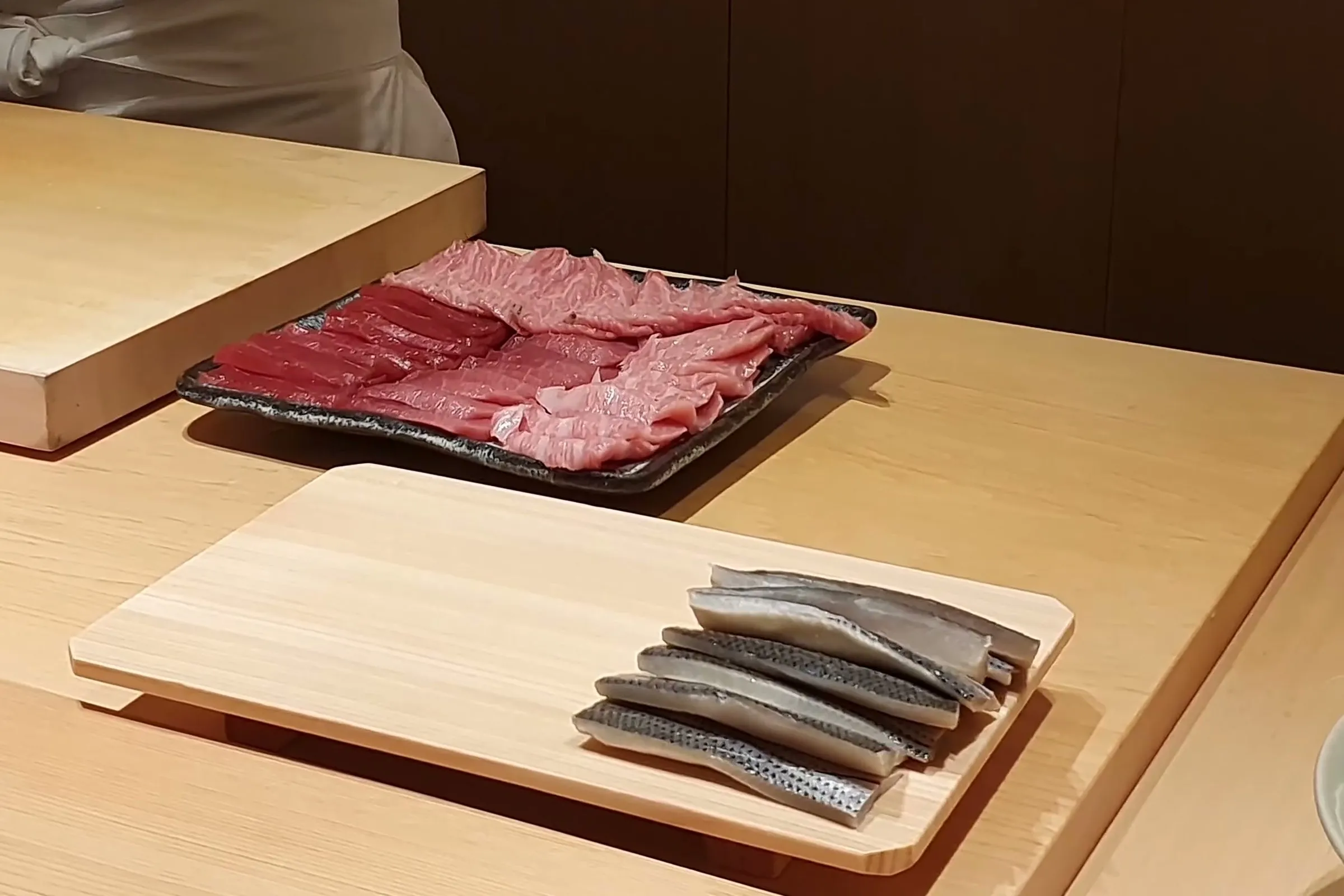
Harakami ichiban from Yamayuki
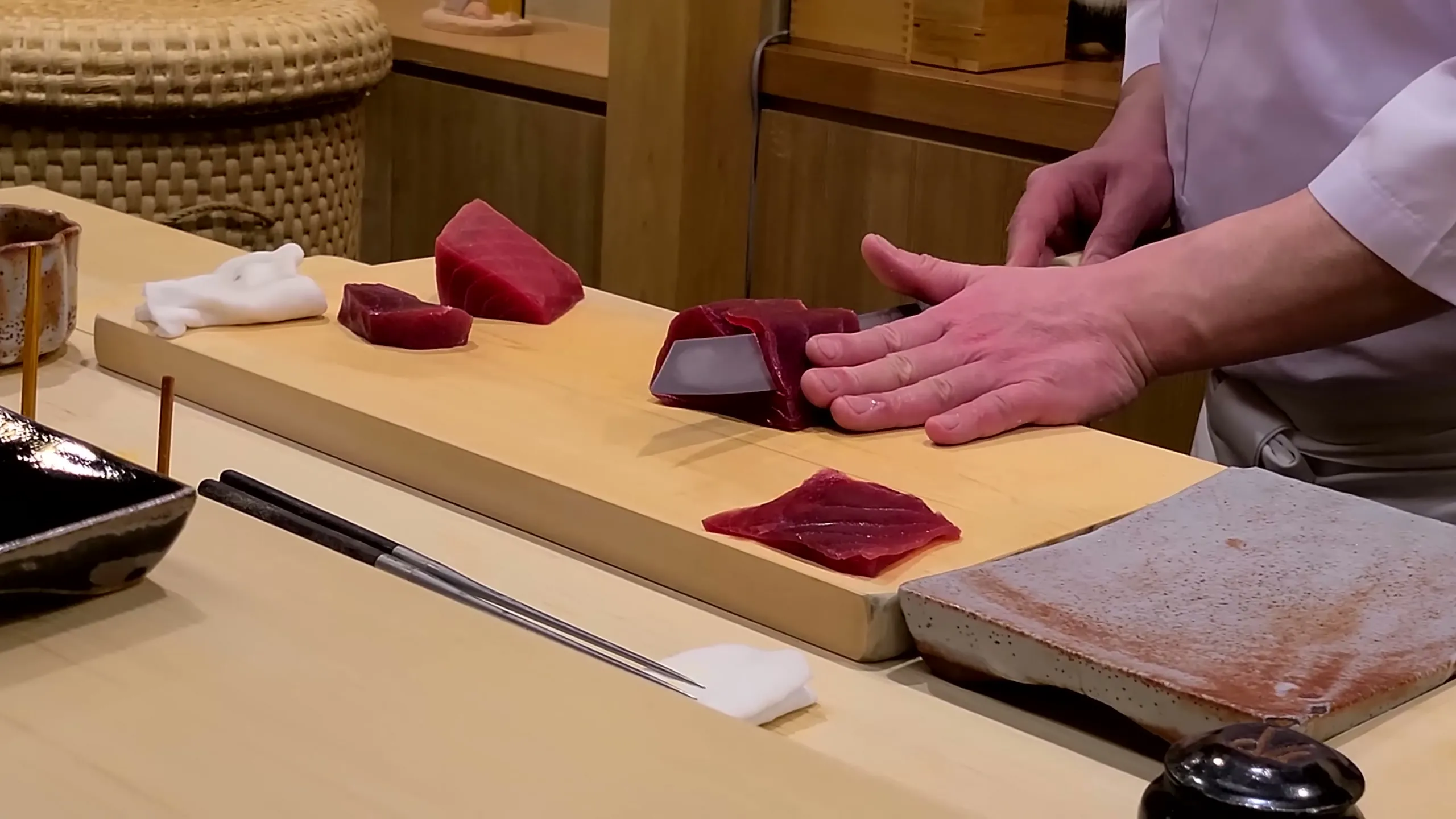
I asked later. The tuna was harakami ichiban from Yamayuki, Japan’s biggest tuna wholesaler.
You’ve probably heard harakami ichiban without knowing what it means. I’d love to explain with a diagram, but I don’t have that much editing enthusiasm. So imagine a whole tuna in front of you, head at one end, tail at the other.
Cut it roughly in thirds from head to tail. The front is kami, the middle naka, the back shimo. Split it top from bottom too. The back is se, the belly hara. So harakami is the front of the belly, by the head and gills, and ichiban is the very first block of that. There, lesson learned.
Tuna has so many other cuts and names that I’m not going through them all. Four tuna cuts as nigiri that day. Just look at them.
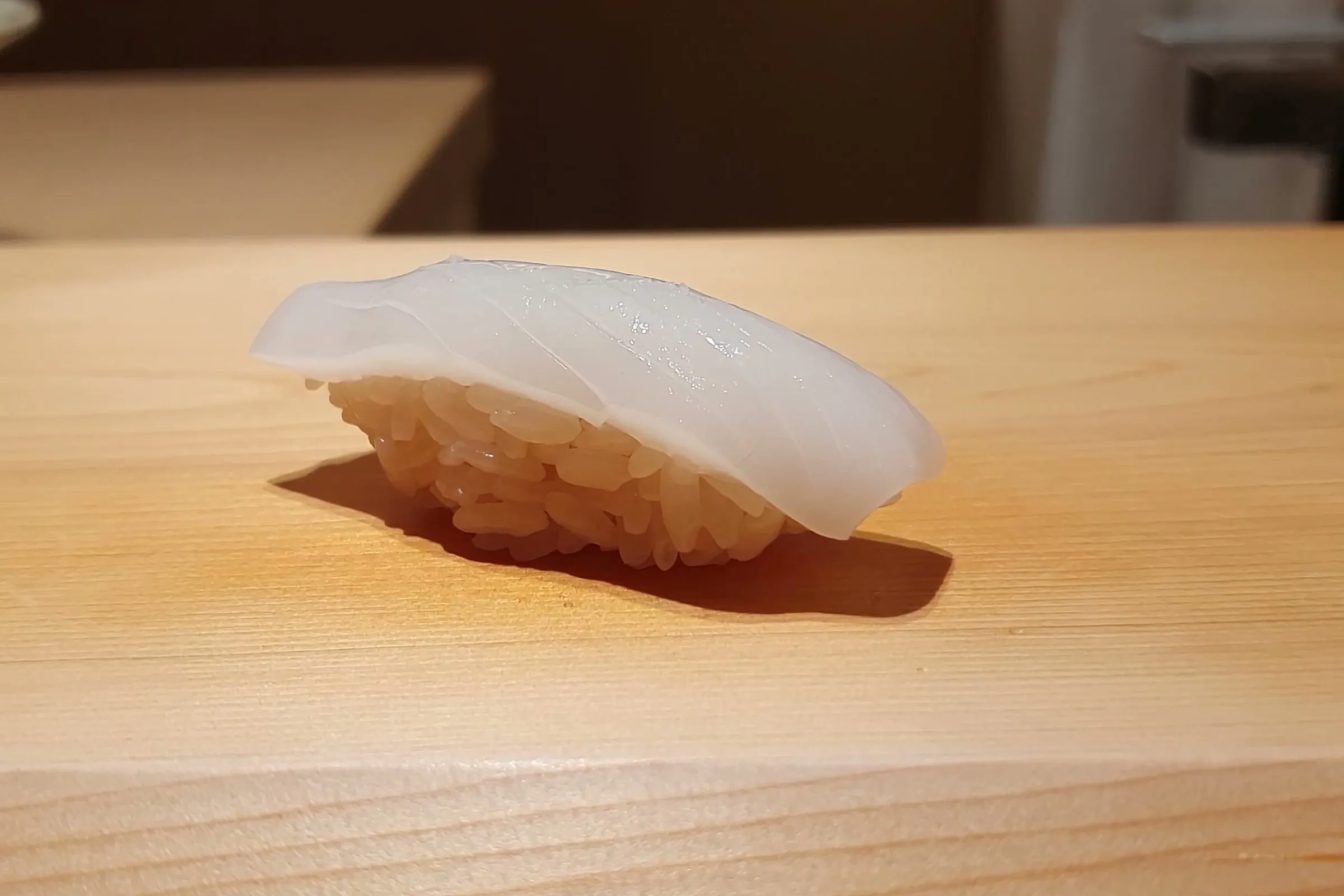
Rice that wasn’t ready yet
Unusually, the first nigiri was sawara, Spanish mackerel. But more than the fish, I noticed the rice. After it was mixed, the vinegar hadn’t had time to mellow, so the aroma and acidity were far too strong, as if they hadn’t blended with the rice. Sharp sourness and smell coming off the outside of each grain.
Then sumi-ika, cuttlefish. The rice recipe itself felt close to Arai’s, with noticeable salt, so it suits squid.
I’ve criticized the rice a lot, so to be fair, the texture and the way it falls apart were good. You could watch the nigiri settle nicely on the counter.
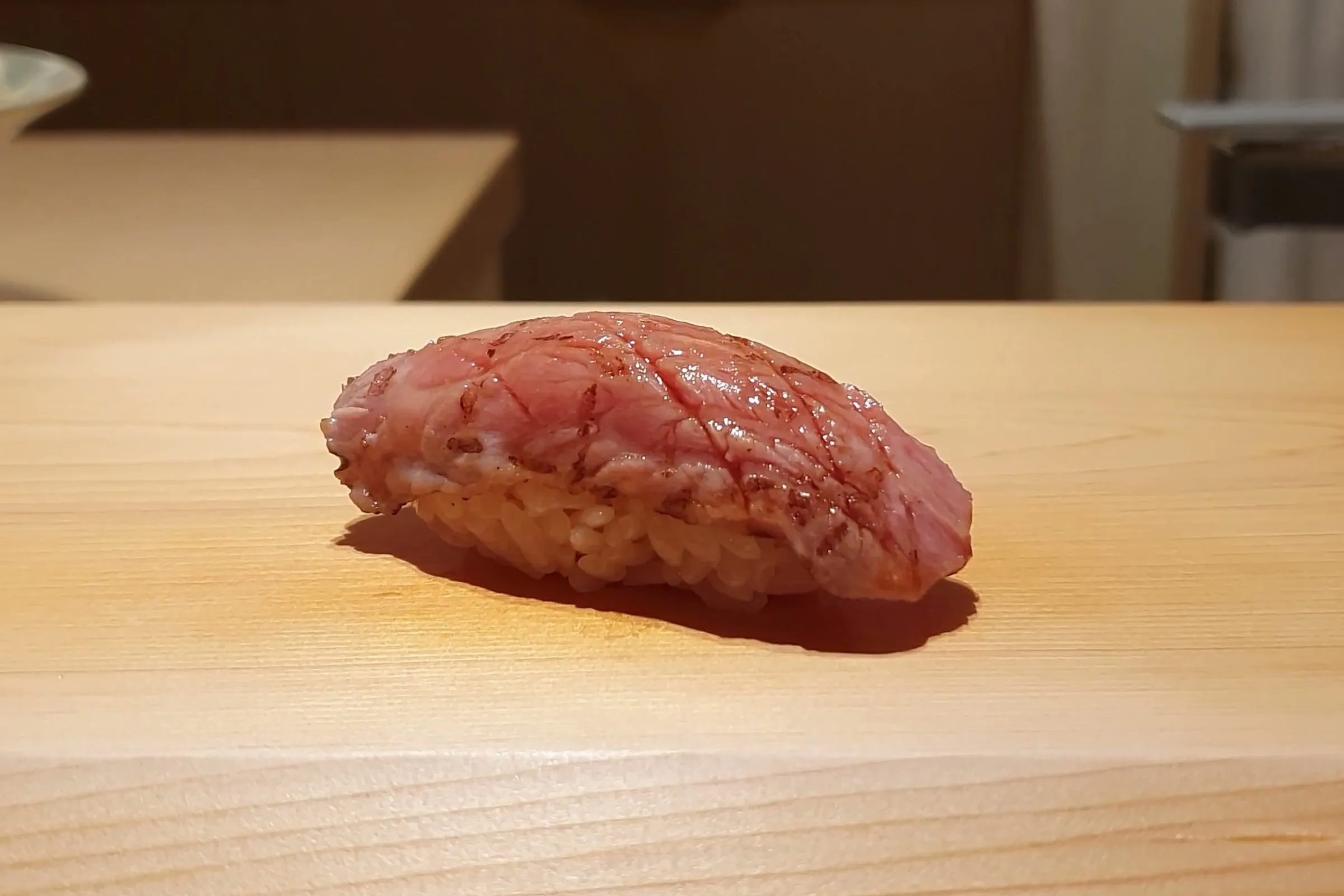
Four tuna in a row
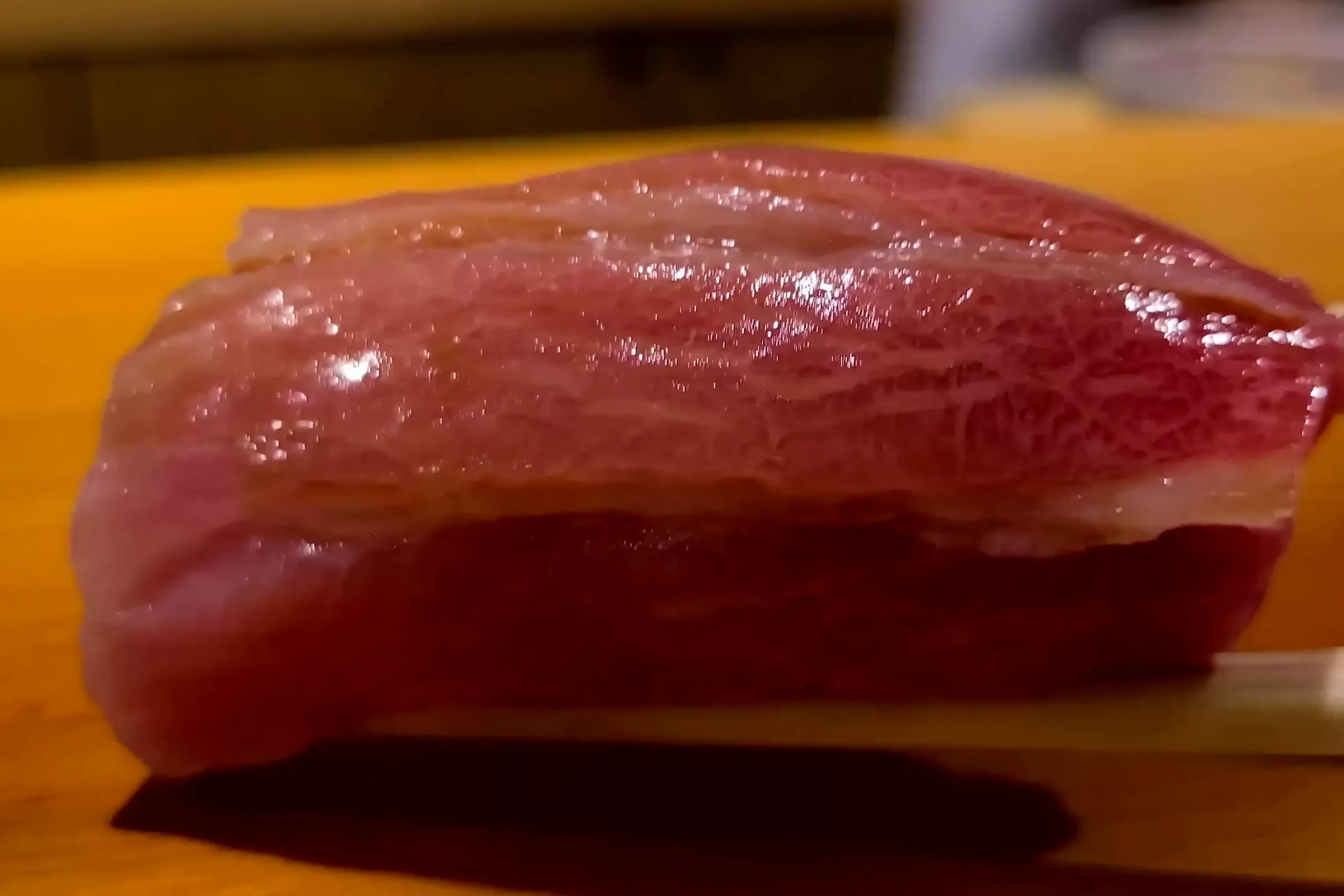
Look at that beautiful tuna. Even the camera lost focus. But the vinegar still needed time, and the rice pressed the chutoro flat. The tuna itself was excellent, naturally. Sugaya buys the kind of tuna that doesn’t come second to anyone’s.
One big difference from Arai, though. Sugaya’s nigiri are very small. Arai’s are bigger.
The tuna kept coming, one piece after another. My rule is that the more expensive and better the tuna, the bigger the difference in the fattier cuts. Fat can leave a slightly murky after-aroma. I’m not talking about akami. With very fatty otoro, good tuna leaves a fresh, clean finish, or almost nothing at all. This piece showed how good Sugaya’s tuna is.
Then kamatoro, very fatty meat from near the gills, seasoned and grilled, the way Arai does it. Sushi In in Seoul serves it this way too.
Kohada that tastes like Arai’s
Next, kohada, and that surprised me a little, because it tasted so much like Arai’s. I’ve said before that I don’t particularly like kohada, but Arai’s and Sugaya’s are quite good, even if they’re not at Sugita’s level.
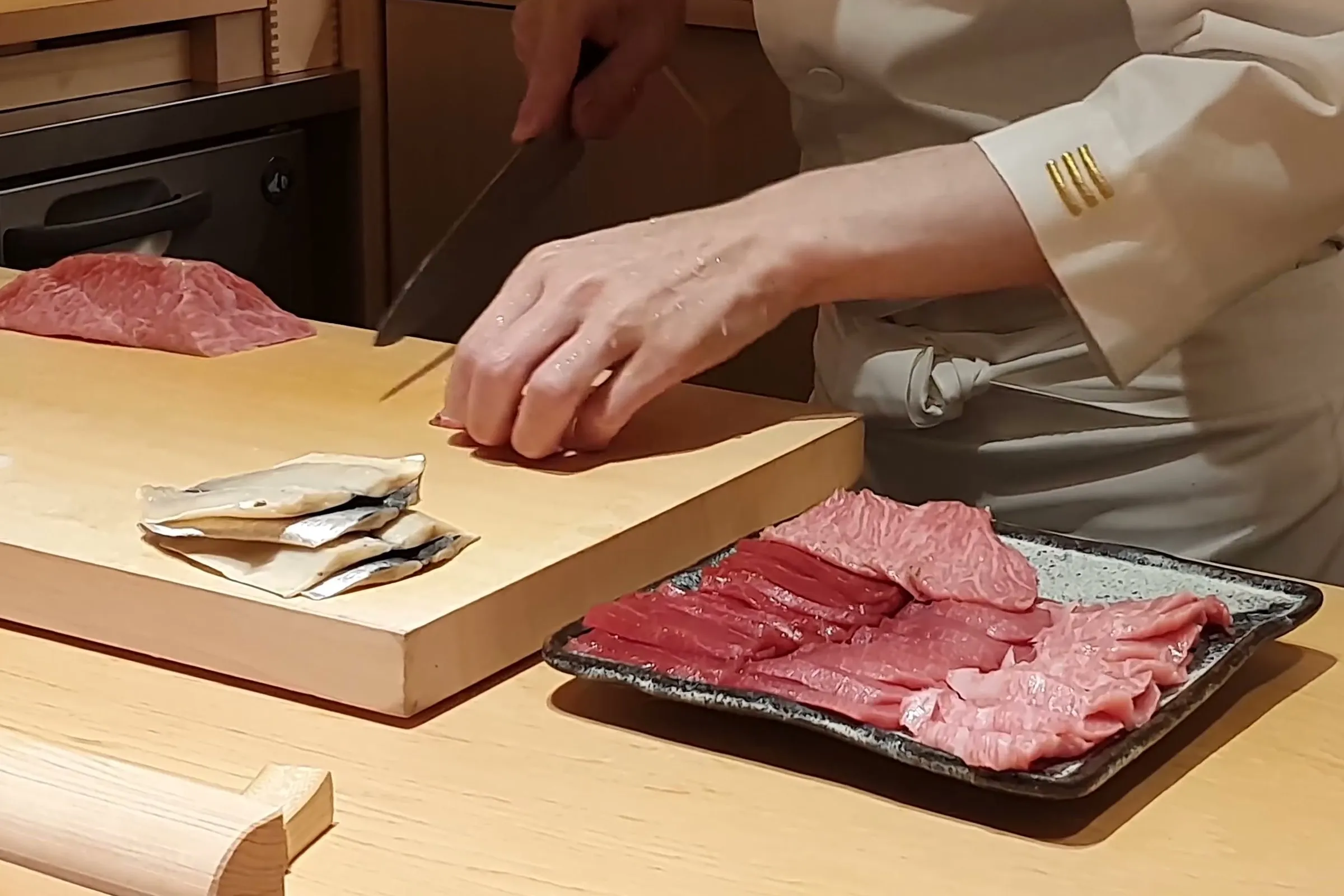
Then he trimmed another fish I like. Same as Arai, he cuts away so much it almost hurts to watch. That pile on the board may look like food waste, but I’d happily tip all of it into my mouth.
The nigiri technique is unusual too. He does the gripping with his left hand, not his right. In Korea, Morita at Ariake is the well-known example of that style.
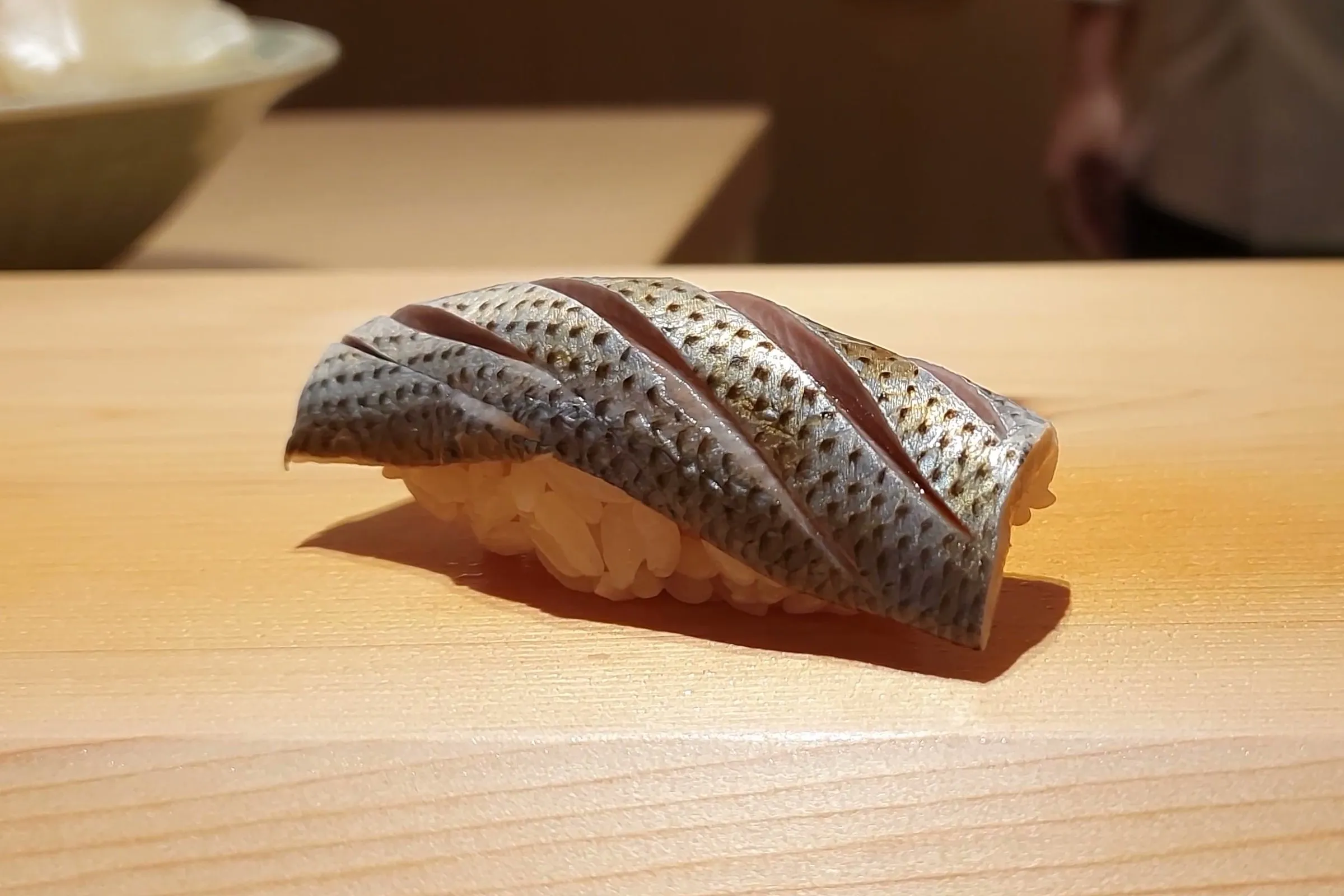
New ikura, Nozomi uni and a Yamayuki theory
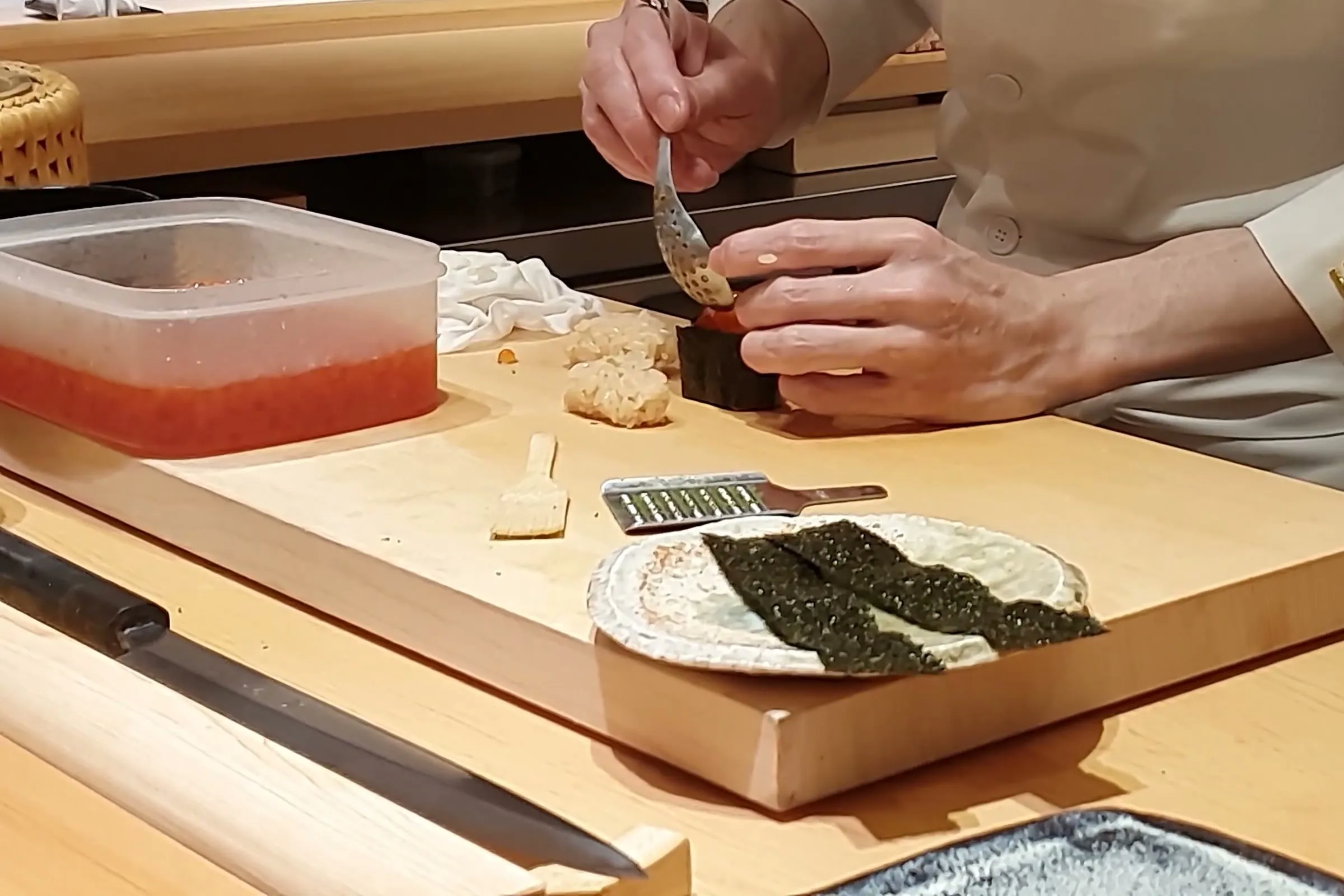
There was a typhoon on this trip, but the season was great, with all the good stuff starting to come in, so I got new-season ikura, salmon roe, at every place I went.
By now the unsettled vinegar I mentioned had calmed down. Even so, the rice’s basic seasoning is just strong here. Salty, and pretty sour too. Next to it the ikura tasted rather bland.
Seems everyone uses Nozomi uni lately, and Nozomi is Yamayuki’s uni brand. Good tuna is so hard to get these days that I half imagined Yamayuki flexing its supply. No uni order, no tuna! That’s only my imagination. Luckily it tasted good. Nozomi uni is generally pretty decent.
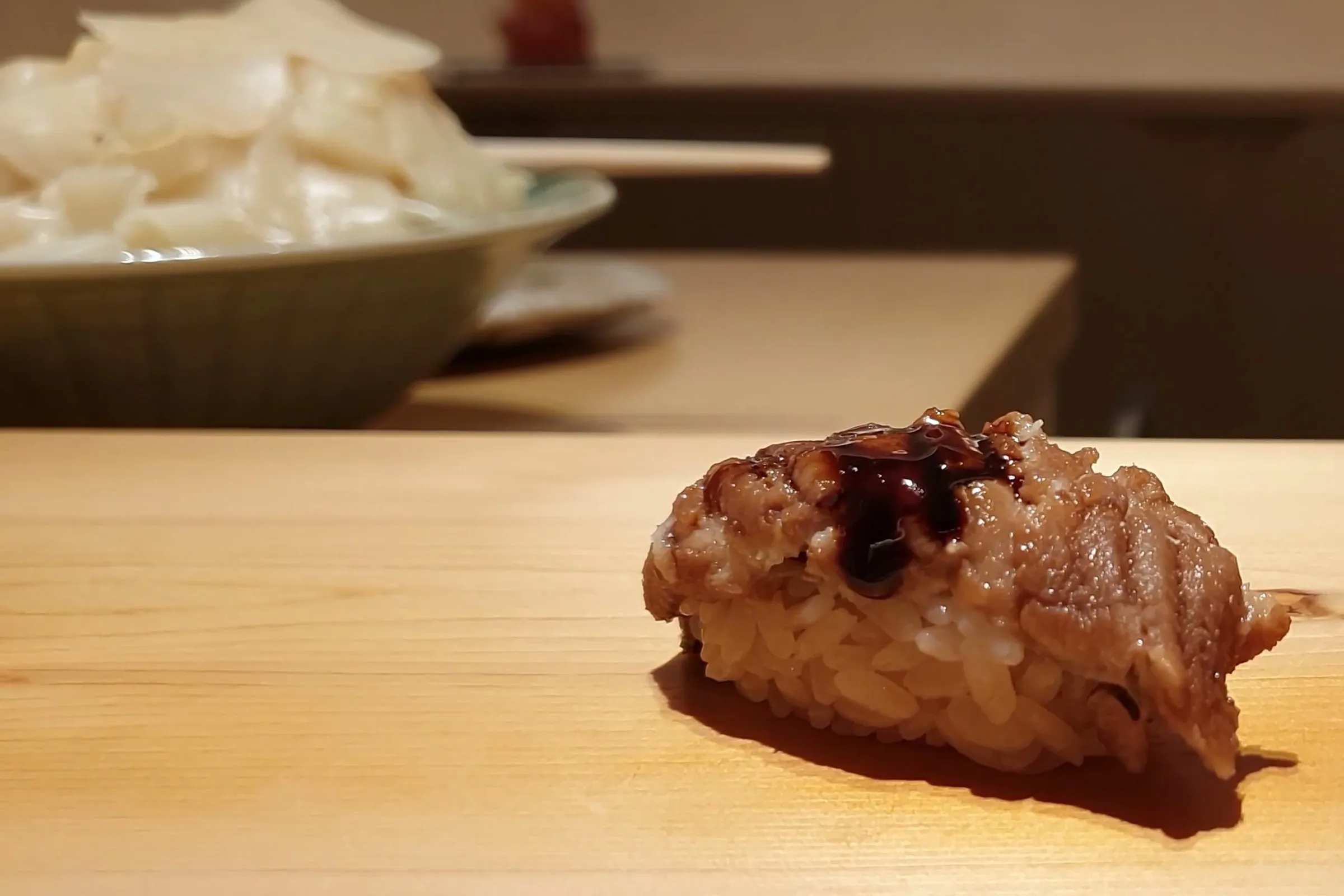
Anago already?
But seriously. Only about four tsumami so far, not that many nigiri either, and small ones, remember? And the anago is here already? This was a lunch of roughly ₩400,000 (about US$340, 2019/10).
It wasn’t over, more came after. Still, it was disappointing, especially thinking about the price. The shop’s own site describes the omakase as four or five tsumami and about ten nigiri, so short is the plan, not a bad day.
Of course, Sushi Arai is very hard to book. If you can’t get in, paying a service like TABLEALL for tuna this good could be worth it. It sounds like showing off, but I can get into Arai, and Arai costs about the same. For me, spending that much here doesn’t make sense.
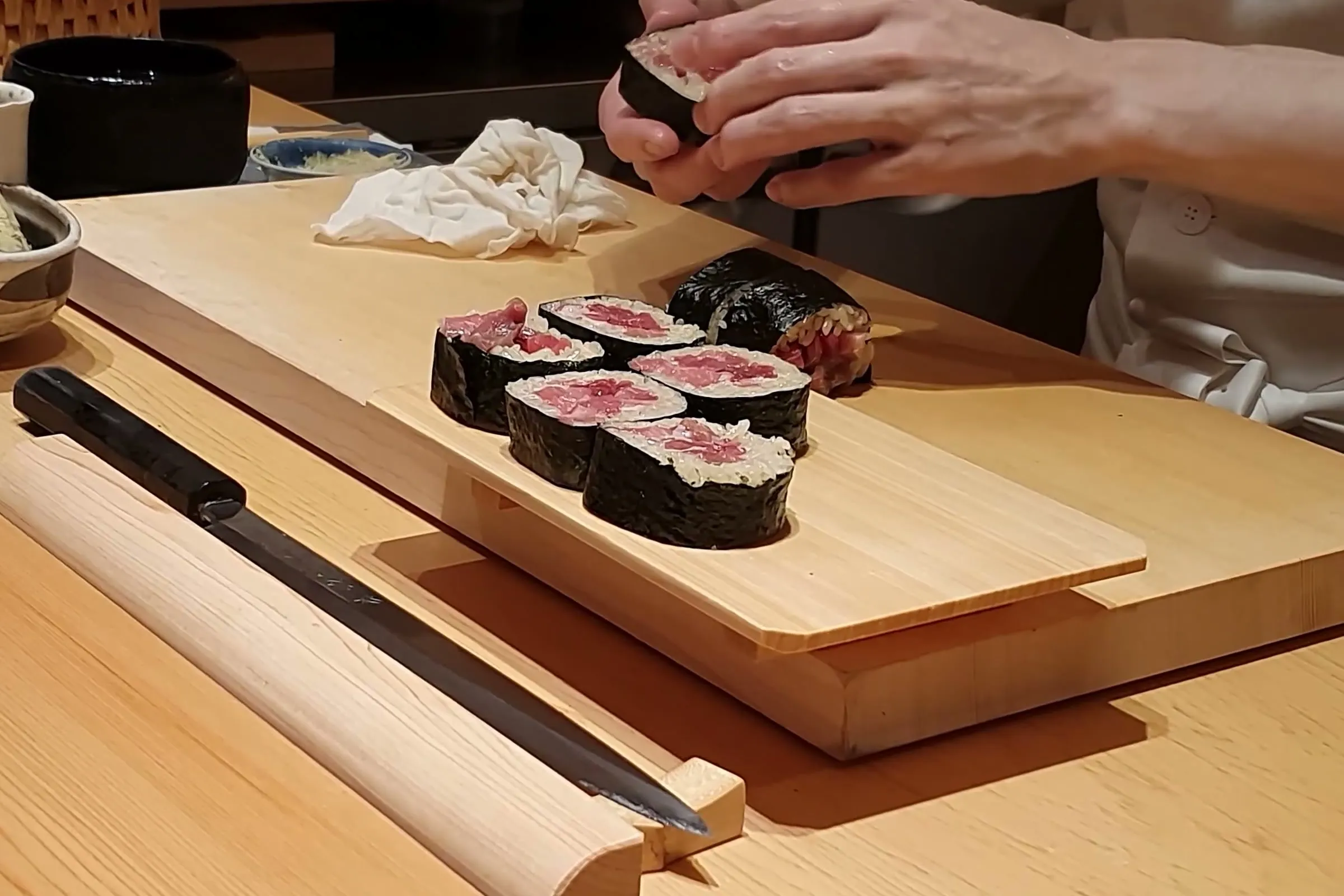
The giant tuna roll
As I said, the course wasn’t over. They made this next, and it seems to be the main event here. Arai’s giant tuna roll is all over Instagram, and I’ve ordered it there once myself.
That’s all the tuna for just one roll. An absurd amount. Considering what tuna costs, this softened my disappointment about the price a little. Yamayuki’s harakami ichiban must cost a fortune, though I don’t know exactly how much.
At Arai, four pieces, about half a roll and not even one this big, came to ¥20,000 (2019/10). At that rate a whole roll like this would be ¥40,000, around ₩450,000 or US$370 (2019/10). Here there’s no extra order. They slice it and serve one piece per person at the end, like a main dish.
Understanding why the price is high doesn’t make me more satisfied, though. After my roll at Arai I saw the bill and told myself, never doing that again. That was about the form, not the shop. In this form I don’t really feel sushi’s completeness. It’s lots of fatty tuna and rice, a giant gimbap.
What I love about tuna nigiri is the fat coating each grain of rice and spreading out in my mouth. However costly or good the tuna is, this shape can’t give me that. I’d decided never again, and here it’s a standard part of the meal.
About ₩400,000 for lunch (2019/10)
2019/10 video
I only said it in won. Lunch came to roughly ₩400,000, booked through TABLEALL. That’s about US$340, or around ¥37,000 at that month’s rate (2019/10). TABLEALL’s price includes its own booking fee, so booking direct may have cost less. With no other way in, what can you do?
When I checked in 2026/10, TABLEALL listed the Sugaya omakase course at ¥76,500, its ¥8,000 booking fee included. Tabelog reviewers put dinner at ¥60,000 to ¥79,999, and the shop adds a 10% service charge.
Would I go back?
No. The tuna is great, and if Arai is out of reach and you want tuna this good, Sugaya could be worth it to you. For me it’s short tsumami, small nigiri, loud rice and a giant roll I’d already sworn off, at Arai money.
I’ve tried it once, so I’m done. If I want tuna, I’ll go to Arai. The end.
How to book
How I booked
Through TABLEALL in 2019/10, and lunch came to about ₩400,000. TABLEALL’s price includes its own booking fee, so booking direct may cost less, but with no other way in I used it once.
- OMAKASE (omakase.in)
The booking link on the shop’s own site. When I checked in 2026/10 the next round of seats was TBD, and you can favorite the page to be told when seats or cancellations come up. One booking per quarter, the person who books has to come, and a change in party size counts as a cancellation. The price includes tax, a 10% service charge goes on top, and it can rise by about ¥5,500 with the market, abalone and crab. Cancelling costs 10% once booked, 50% from 31 days before and 100% from 7 days. No strong perfume, no children, and photos of the food only, with no flash or shutter sound.
- Tabelog
Online booking with instant confirmation. When I checked in 2026/10, Tabelog said the phone lines were closed and asked for online bookings, though the shop’s own site still lists 03-6230-9545. It also asks foreign guests to book by phone through a hotel or credit card concierge. Everyone starts together at 18:00 or 20:45 (Mon, Tue, Thu, Fri, Sat) and 17:00 or 19:45 (Sundays and holidays), so late arrivals may miss dishes. OMAKASE lists other times for Thursdays and Sundays, so check when you book. Lunch is irregular. Closed Wednesdays and some other days. Eight counter seats. Any change to the date, time or party size is charged as a cancellation.
- TABLEALL
How I booked in 2019/10. When I checked in 2026/10 it listed the Sugaya omakase course at ¥76,500, its own ¥8,000 booking fee included, as a reservation request.
Checked 2026/10. Booking rules change, so look at the official page before you go.
Where it is
- Address
- 1F Higashi-Azabu 296 Bldg, 1-29-15 Higashi-Azabu, Minato-ku, Tokyo東京都港区東麻布1-29-15 東麻布296ビル 1F
- Nearest station
- Akabanebashi (Toei Oedo Line), 2 minutes from the Nakanohashi exit
Plan the Tokyo trip
The boring bits I’d sort before flying, so the eating days stay free.
- Hotels in Tokyo*
Pick the room by where you eat, not by the sights. After a long dinner, a short ride back is the real luxury. This place is in Higashi-Azabu, Tokyo.
- Japan eSIM*
Data from the moment you land, no counter and no SIM swap. Set it up the night before.
- Keisei Skyliner from Narita*
Narita to Ueno in about 40 minutes. Buy it ahead and walk straight to the platform.
- Haneda airport limousine bus*
Landing at Haneda instead? The limousine bus drops you at the big hotels and stations with no transfers.
- Tsukiji Outer Market food tour*
A market morning with someone who knows which stalls are worth the line.
- Sushi-making class at Tsukiji*
Shape nigiri yourself once and the counter makes a lot more sense.
Links marked * are affiliate links. If you book through them I may earn a small commission, and you pay the same. How it works
Guides that mention this place
More places I have eaten at
All of Tokyo → Hongo, Tokyo
Yakiniku Jumbo Hanare
Thick harami, a tenderloin rice pot, and a naengmyeon to avoid.
≈ ¥10,000 2019/10 video Ginza, Tokyo
Ginza Kyubey
No booking, cold tuna, great shellfish, and the home of gunkan maki.
¥8,800 2023/10 video Shibuya, Tokyo
Hikiniku to Come
Three charcoal hamburgs, free rice, a drawer full of spices.
Sources
- 鮨 すが弥 Sushi Sugaya
- Sushi Sugaya OMAKASE
- Sushi Sugaya Tabelog
- Sushi Sugaya TABLEALL