Guide
16 Japanese food words you can’t guess, from ankimo to zuke
Some Japanese menu words you can work out. Maguro is tuna, ebi is shrimp. These 16 you can’t, and they turn up everywhere: sushi counters, kaiseki dinners, izakaya. For each one I pulled three photos from my videos, checked the facts against Japanese dictionaries and government pages, and dug up how it tasted to me, in my videos and in the Korean food blog I kept from 2015 to 2019, back when I wrote down every bite.
monster gourmetFrom 31 of my videos, 2019/06 to 2026/10
The short version
- Ankimo is monkfish liver. Shirako is milt, usually cod or fugu. Ikura is salmon roe. Uni is sea urchin.
- Karasumi is dried mullet roe and konowata is salted sea cucumber guts. With salted uni they were Edo Japan’s three great delicacies.
- Kuruma-ebi, hotaru-ika, kohada, nodoguro, kinmedai and anago are a prawn, a firefly squid, gizzard shad, blackthroat seaperch, alfonsino and conger eel. Engawa is the chewy fin of a flounder.
- Zuke, kobujime and shime tell you what was done to the fish: soaked in soy, pressed in kelp, cured with salt and vinegar.
- Most of the rich ones are at their best in winter.
Liver, milt, roe and guts
The richest things on the menu, and the hardest to guess from the name. Most of them are best in winter.
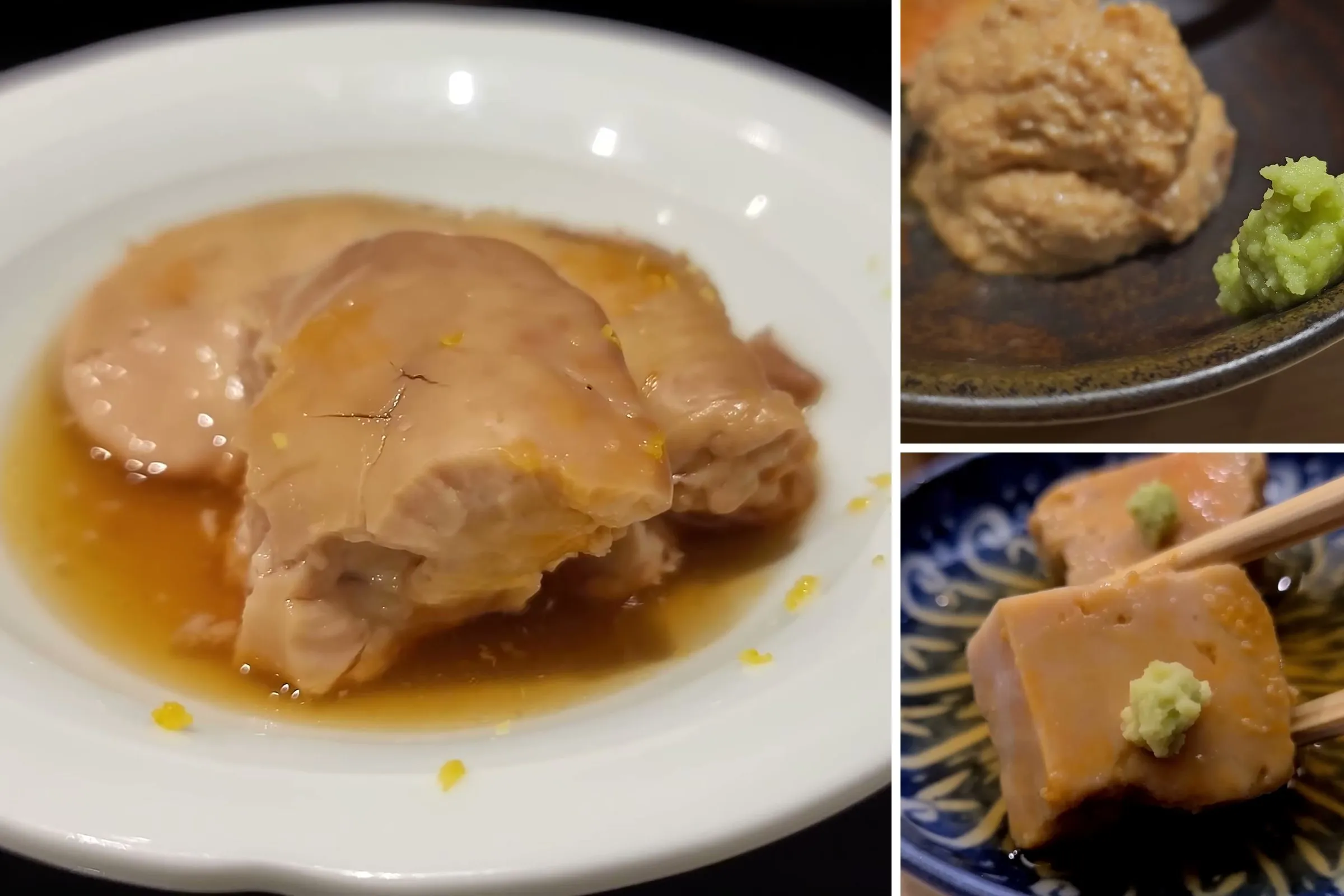
Ankimo あん肝
- Meaning
- Monkfish liver. Salted, steamed, chilled and sliced.
- Also written
- あん肝, アン肝, あんきも, アンキモ
- English
- monkfish liver, anglerfish liver
- Korean
- 아귀 간, 아귀간, 안키모
- How it’s made
- The liver gets salted, rolled tight in a bamboo mat, steamed for about an hour, then cooled and sliced. Sushi shops also simmer it sweet, or press it through a sieve into a mousse (uragoshi).
- Season
- Winter. Ibaraki, Japan’s monkfish prefecture, eats it November to March, and the liver is biggest from December to February.
On my old blog I went by 아귀 (agwi). In Korean it means a hungry ghost who can never eat enough, and it’s also the word for monkfish. I picked it for the first meaning. It still left me a little extra fond of monkfish liver.
Sugita serves ankimo in a trio of small plates meant to go with sweet sake. On my second visit, eight months after the first, he left the sake out of mine. He’d remembered I don’t drink. In 2023 he asked before he plated it: you don’t drink, right? That’s how a fan turns into a believer.
At Sushi Sora, chef Kim Seong-bok cut my ankimo only from the side where the orange gathers, the fattiest part. Since then I judge it by color. The more orange, the better.
How it tastes
Not 1 mg of off-flavor. None of that faintly funky smell foie gras has. Just the good part of the liver, like an extract.
Sushi Sanwon, my old blog, 2015/12So soft I could barely lift it with chopsticks. It looked ready to collapse on its own, and in my mouth it simply slid away.
Sushi Suzuki, my old blog, 2018/04The way I like it: pushed up against the roof of my mouth with my tongue, where it sticks, so the sweetness and the nutty fat stay for a long time.
A Seoul counter, 2021/01▶ 3:58Sweet, salty and punchy, next to miso-cured sujiko. Both were begging for plain rice. I charge them with attempted theft of rice and sentence them to detention in my stomach.
Sushi Sugita, my old blog, 2018/12
Where this happenedSushi Sugita→
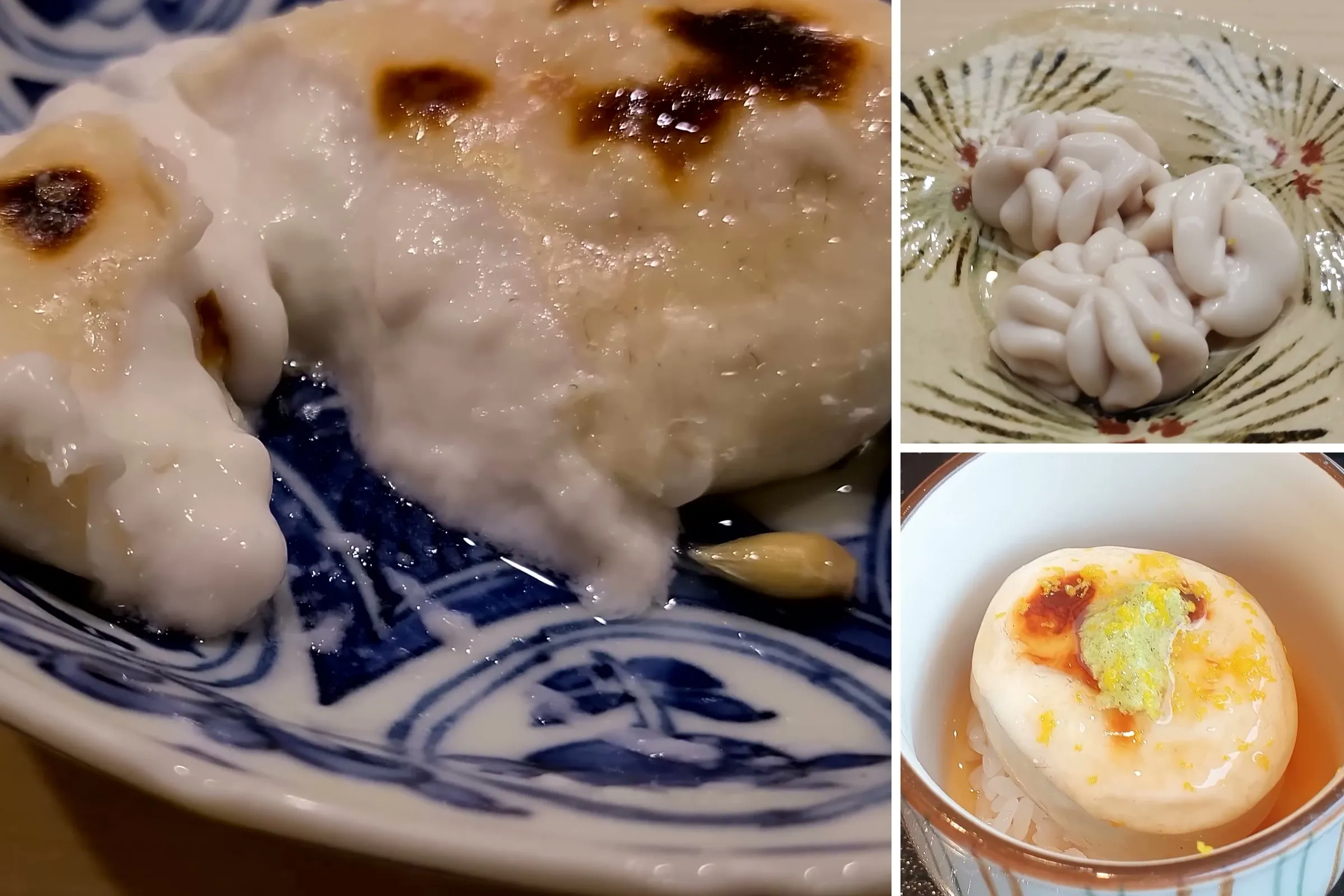
Shirako 白子
- Meaning
- Milt, the sperm sacs of a male fish. On menus it’s almost always cod or fugu.
- Also written
- 白子, しらこ. In Hokkaido, cod milt is tachi (タチ) or kumowata (雲腸, cloud guts).
- English
- milt, soft roe, cod milt, fugu milt
- Korean
- 이리 is the dictionary word: 대구 이리, 복어 이리. Most people say 곤이, though the dictionary gives 곤이 as roe.
- How it’s made
- Grilled with salt, fried, or dropped into hot pot and miso soup. Heat keeps it soft and creamy instead of firming it up.
- Season
- Winter.
- Good to know
- The testes of some pufferfish are poisonous, so fugu shirako has to come from safe species and a licensed cook.
At Sushi Iki in 2017 the chef put down a shirako so hot I went to cut it in half. He stopped me. Eat one more piece of sushi first, he said, then put it in whole once it’s cooled a little and roll it around your mouth. Cut it while it’s too hot and it tastes of nothing. Let it go cold and it’s no good either.
In 2023 Sugita grated yuzu over a cold cod shirako and told me not to dip it in anything. I’d had his cold shirako before and wasn’t sold, so I was nervous. It was the first shirako I’d had that tasted that deep and still finished clean.
Fugu shirako is the luxury version. I asked at Sushi Inn why Japanese sushi-ya rarely serve it, and the answer was simple: too expensive. A big torafugu’s milt can be as long and as thick as my forearm. Arai grills it with salt, slices it like a loaf of bread and hands over a kabosu to squeeze on top.
How it tastes
I avoid English words when I write about taste in Korean. Shirako broke me. The only word for it is creamy. Softer and milkier than our word 녹진하다.
Sushi Cho, my old blog, 2015/09Torched until the surface turns chewy, creamy inside, clean like a mild cheese. The first cool days of the year, on a plate.
Sushi Sanwon, my old blog, 2016/09I like it hot enough to peel the roof of my mouth, so the creamy nuttiness spreads everywhere. Cold, it goes a little blurry.
Sushi Sugita, 2020/04▶ 14:19Fresh fugu shirako in a clear soup. The only word I had for it was clear.
Sushi Sanwon, my old blog, 2015/11
Where this happenedSushi Arai→Sushi Sugita→
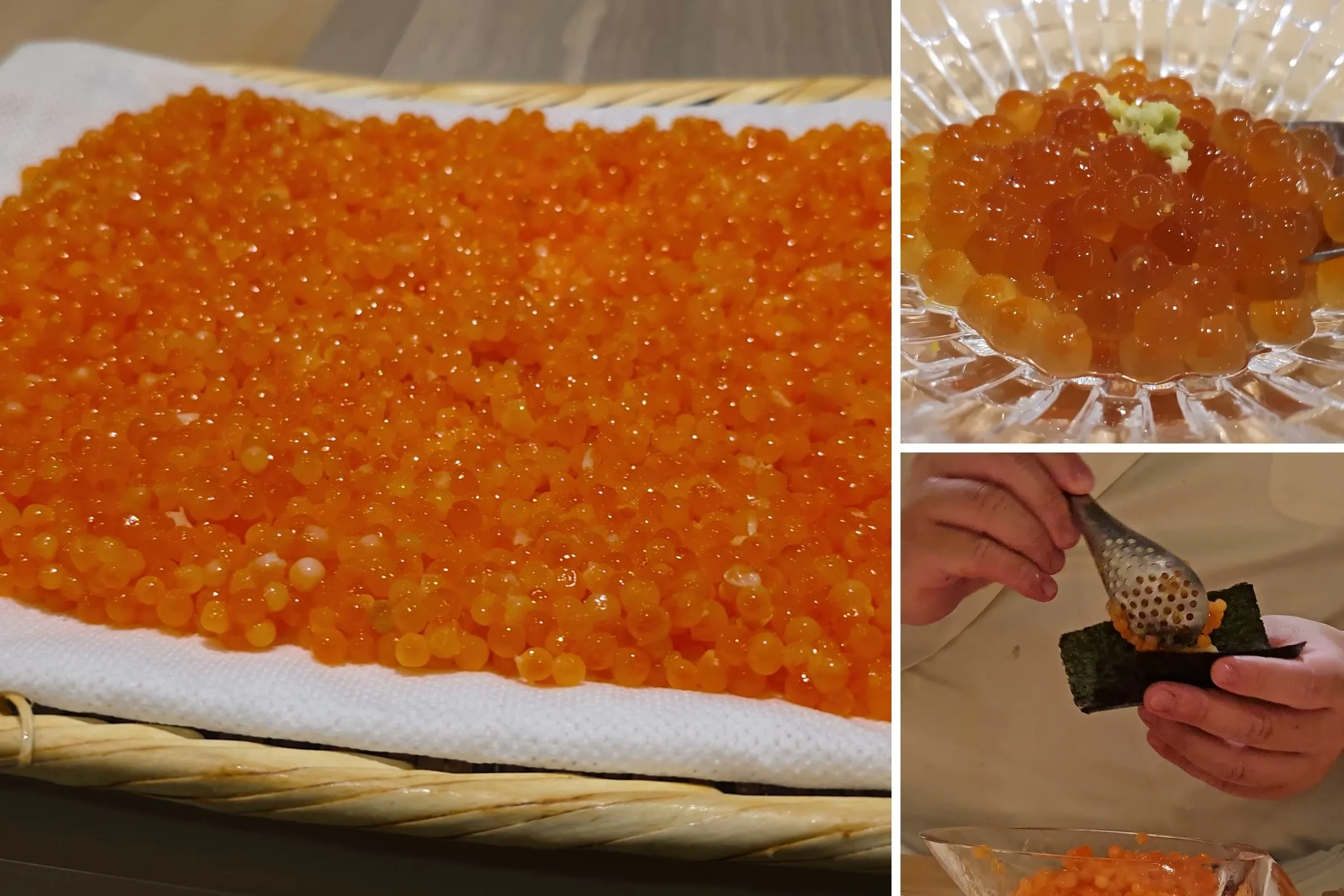
Ikura いくら
- Meaning
- Salmon roe, the eggs loosened one by one and cured in brine or soy sauce.
- Also written
- いくら, イクラ. Still in its membrane, it’s sujiko (筋子).
- English
- salmon roe
- Korean
- 연어알, 이쿠라
- How it’s made
- The eggs are rubbed free of the membrane, then either soaked in strong brine for 10 to 20 minutes or marinated overnight in soy sauce with sake or mirin, the Hokkaido home style.
- Season
- Autumn, when the salmon come back. The first batches of the season are the softest and the least salty.
- Good to know
- The word comes from Russian ikra, fish roe, and reached Japan around the Meiji era.
I used to dislike ikura because it’s usually too salty. New-season roe changed my mind: softer, barely salted. One August at Sushi Inn, chef Lee Jin-wook put down the first ikura of the year and said it’s still this hot out, but autumn has already come to the water.
In season, Sushi Koji was working through 5 kg of roe a day. He only makes it then, when it’s least salty.
At Shimazu the whole tray gets set down on my plate before it’s portioned out, and I love that moment. The last time, I asked for a spoon to eat straight from the tray. They took the tray away.
How it tastes
Unseasoned raw roe stirred into rice. So soft and rich it was like mixing in a soft-boiled egg yolk.
Kohaku, my old blog, 2016/10Slurp it, bite now and then, and it goes pop pop, filling your mouth with sweet-salty juice.
Ishikawa, my old blog, 2016/11Firm right at the edge. A little more bounce and I’d have called it hard. A happy kind of firm.
Sushi Iki, my old blog, 2015/11Thick and sticky, with a deep, nutty taste like egg yolk. A bit like Korean soy-sauce egg rice.
Sushi Arai, my old blog, 2018/09
Where this happenedSushi Shimazu→
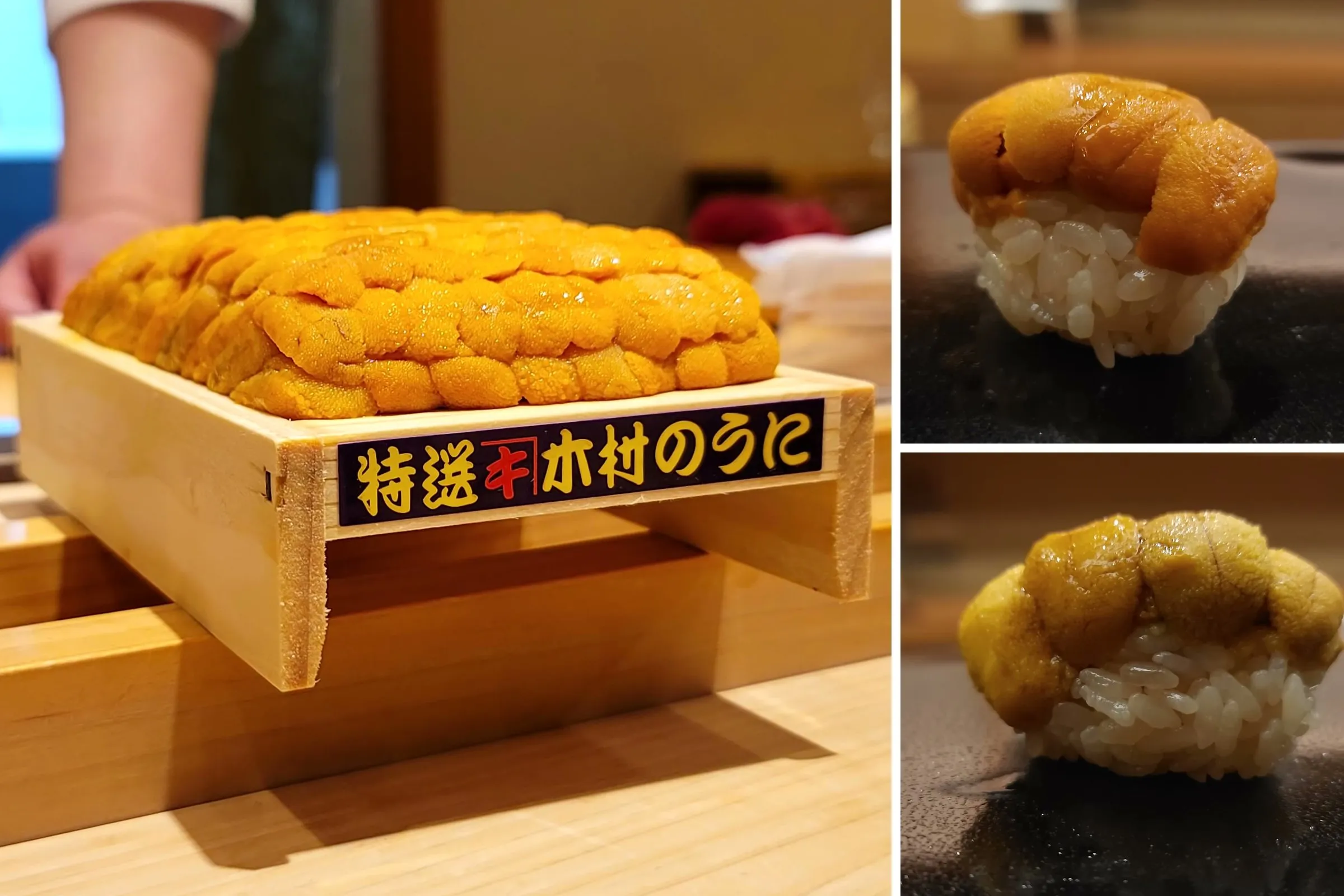
Uni 雲丹
- Meaning
- Sea urchin gonads. Usually called roe, but both males and females are eaten.
- Also written
- うに, ウニ, 雲丹 for the food, 海胆 or 海栗 for the animal. Bafun uni (バフンウニ) and murasaki uni (ムラサキウニ) are the two you’ll see most.
- English
- sea urchin
- Korean
- 성게알, 성게, 우니. Bafun is 말똥성게 and murasaki is 보라성게.
- How it’s made
- Served raw. Trays of raw uni are often treated with alum to keep the lobes firm. Uni packed in salt water skips that. The old preserved form is shio-uni, salted and aged into a paste.
- Season
- Depends on the species. Bafun February to April, murasaki June to August, aka uni August to October. Hokkaido uni is best around June and July.
- Good to know
- Bafun means horse dung, for the urchin’s looks. Korean 말똥성게 means the same thing.
At Arai in 2018, Shinohara-san and Arai-san went at it over murasaki uni. Shinohara-san: you eat murasaki for the aroma. Arai-san: no, for the sweetness. Every time Shinohara-san said kaori, aroma, Arai-san shook his head.
Nakajo in Yokohama started as a small second-generation shop that bought at the local market, and business was bad. One day the chef bought a very expensive uni and gave customers a choice: the usual one, or the pricey one for a big surcharge. Every single customer picked the pricey one. After that he moved his buying to Tsukiji and started taking the best of everything, and that’s how Nakajo became the shop people know for its ingredients.
How it tastes
People compare uni to ice cream for the texture. This one tasted like sugared milk, so of course I thought of vanilla ice cream.
Sushi Chohee, my old blog, 2017/02I’ll take bafun’s clean sweetness over murasaki’s faint funk. My palate is cheap!
Sushi Namba, my old blog, 2018/05Aka uni. Before I’d even swallowed, my finger was up for one more. Cleaner and sweeter than bafun, and so soft, like a mousse made from banana milk.
Sushi Shimazu, 2024/09▶ 11:34Deep, rich bafun, with none of the bitter alum taste and none of the smell that can linger after.
Sushi Sugita, 2023/01▶ 16:36
Where this happenedSushi Sugita→
Karasumi からすみ
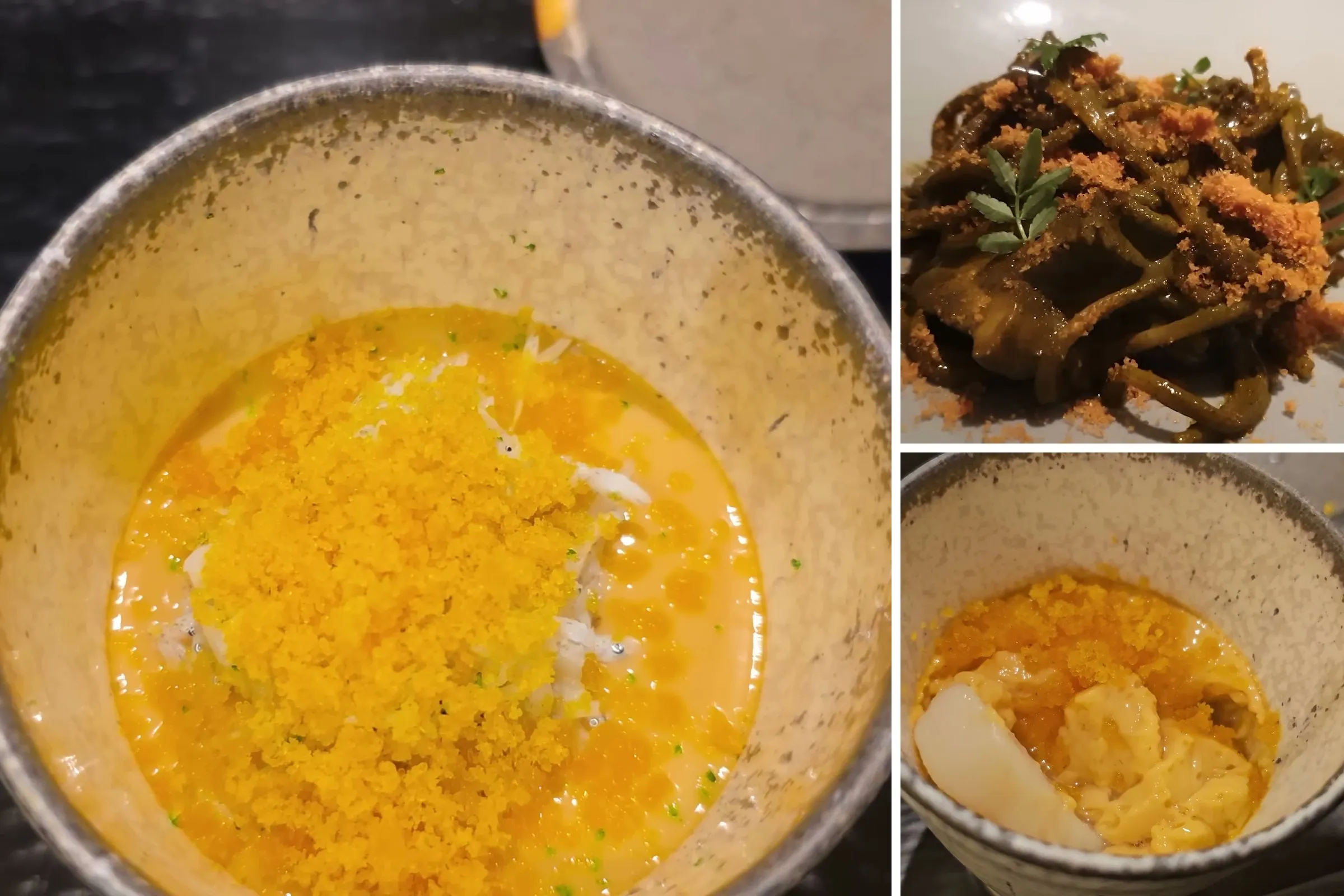
- Meaning
- Mullet roe, salted and slowly dried into a firm amber slab. Japan’s bottarga.
- Also written
- からすみ, カラスミ, 唐墨
- English
- dried mullet roe, bottarga
- Korean
- 어란, 숭어알
- How it’s made
- Whole roe sacs are salted, rinsed of extra salt, pressed between boards and dried in the sun and wind for about 20 days. Nagasaki’s protected karasumi uses mullet roe and salt only, no oil, no sake. Korean 어란 is brushed with sesame oil as it dries.
- Season
- Made in autumn and winter, when mullet full of roe gather off Nagasaki.
- Good to know
- The name means Chinese ink stick, for its shape. With uni and konowata it made up the Edo-era three delicacies of the realm.
Karasumi is a snack for sake, and I don’t drink, so I came to it late. The first one I really remember was a sample a Korean producer sent to Sushi Koji in 2015. The chef cut me a piece to try.
Shimazu-san grates it like snow over chawanmushi. Once it went over shirasu, the tiny white fish, and tasted just like the rice at the end of a meal at Matsukawa, a bowl I love. Another time it went over konowata, and the karasumi wiped out the part of konowata I don’t like.
How it tastes
Less salty than I expected, and then a deep umami that hangs on and on.
Sushi Koji, my old blog, 2015/06Made in-house from mullet roe. One piece came with cheese, one with a thin slice of daikon. Salty in a good way.
Sushi San, my old blog, 2015/06Cold capellini with bottarga and cuttlefish. Salt, sweetness and umami, each walking a tightrope right at the edge of too much.
Aroma Fresca, my old blog, 2016/11Grated over shirasu on chawanmushi, it tasted exactly like the rice at the end of a meal at Matsukawa.
Sushi Shimazu, 2025/07▶ 5:03
Where this happenedSushi Shimazu→
Konowata このわた
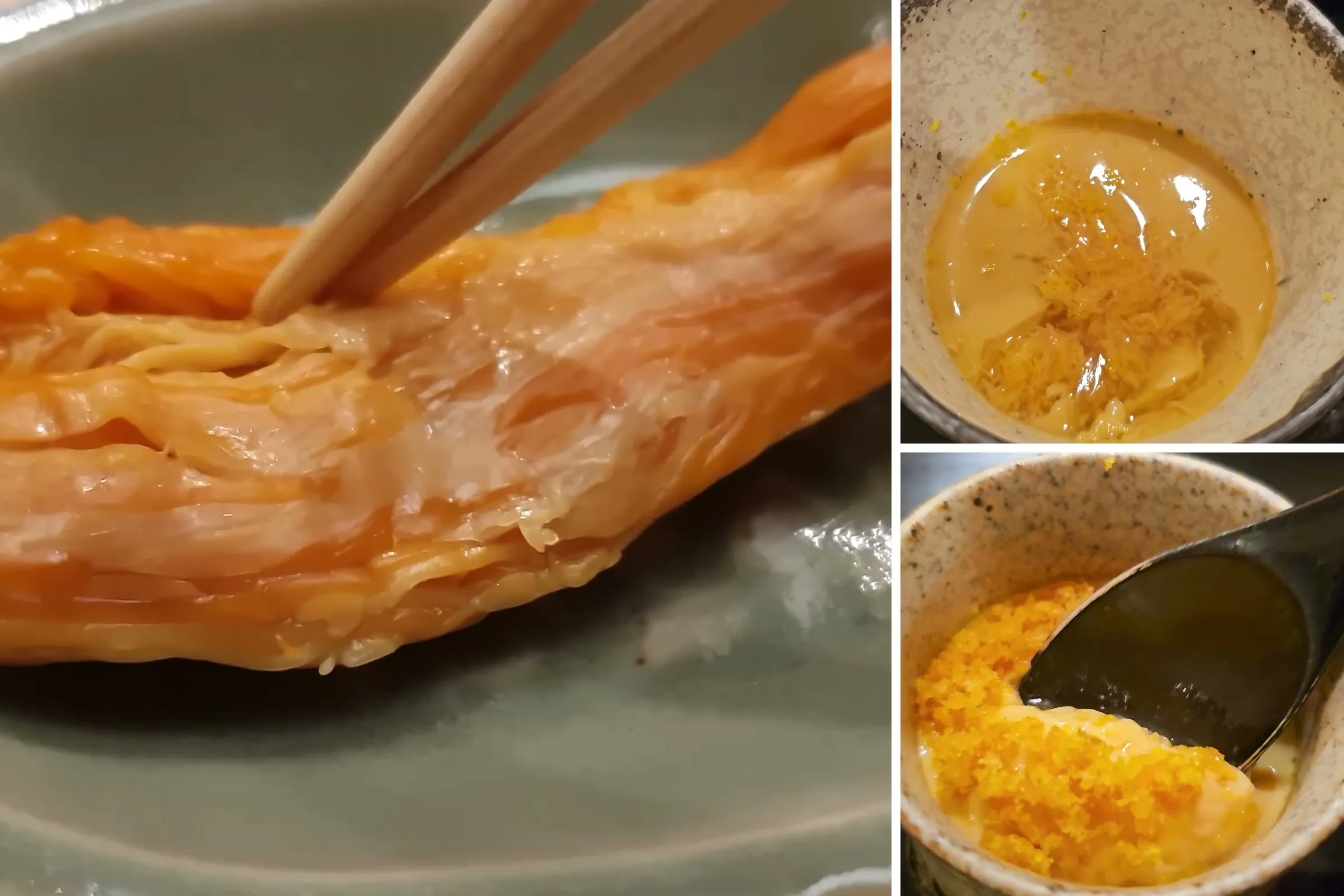
- Meaning
- Salted, fermented sea cucumber guts. A shiokara, eaten a spoonful at a time with sake.
- Also written
- このわた, コノワタ, 海鼠腸. The ovaries are kuchiko (くちこ) or konoko. Dried, they’re hoshi-kuchiko, the thing I order at Sugita as bachiko (ばちこ).
- English
- salted sea cucumber entrails
- Korean
- 해삼 내장 젓갈, 고노와다. Bachiko is 말린 해삼 난소.
- How it’s made
- Live sea cucumbers sit in tanks for a night or two to purge sand. The guts come out through a small cut and get washed, salted and briefly aged. Five kilos of sea cucumber give about 100 g.
- Season
- Midwinter batches are the best. In Noto (Ishikawa), kuchiko is hung to dry in the cold wind in early spring.
- Good to know
- One of the Edo-era three delicacies, with salted uni and karasumi.
A correction first. In my 2019 Sugita video I said konowata was sea cucumber testes and bachiko the ovaries. Bachiko is the ovaries, that part was right. Konowata is the guts, the intestines. I said it wrong for years. Sorry.
I don’t like konowata, and chefs know it. At Shinohara in Ginza the chef glazed a prawn with konowata and said anyone would love it, except maybe people who hate konowata. I told him I was one of those people, and that it was delicious. He was thrilled.
How it tastes
Bachiko. Closer to smoked cheese than to jerky, and the aroma lingers a long time.
Sushi Inn, my old blog, 2018/01Bachiko, dried, steamed, then grilled. It pulls apart like soft string cheese and tastes like smoked cheese. I hate konowata. This I ask for every time.
Sushi Sugita, 2019/07▶ 10:01Halibut dressed with konowata. Very nutty, and the smell was clean. When a food you dislike wins you over, the joy doubles.
Sushi Sanwon, my old blog, 2017/05The best konowata chawanmushi I’ve had. The karasumi on top played off the konowata and killed its bad smell.
Sushi Shimazu, 2024/04▶ 0:41
Where this happenedSushi Sugita→Sushi Shimazu→
Fish and shellfish you’ll only hear in Japanese
Most of these have English names, but nobody at the counter uses them, and the English names don’t tell you much either. Gizzard shad, anyone?
Kuruma ebi 車海老
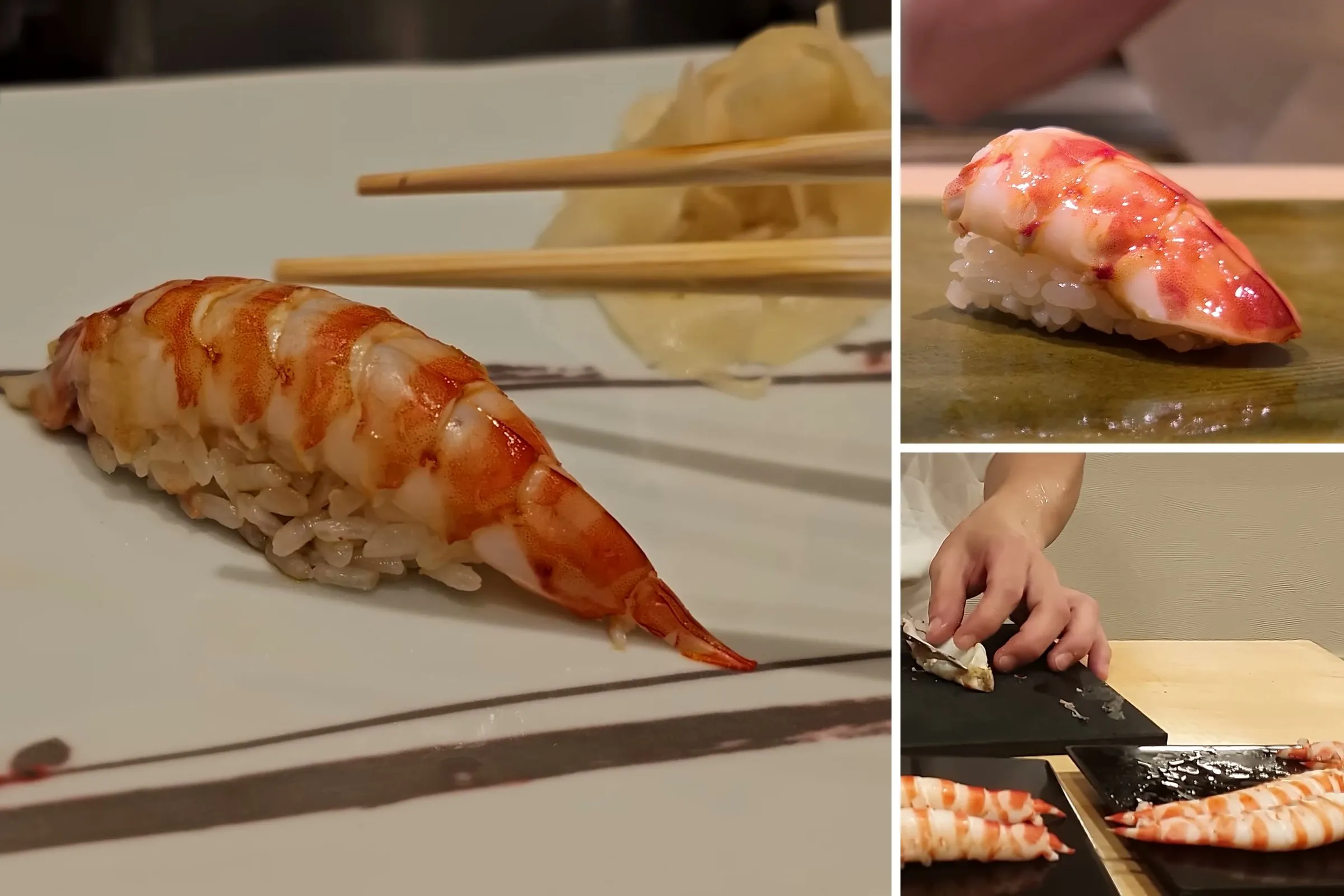
- Meaning
- Kuruma prawn, Japan’s top prawn. Boiled for nigiri and tempura, or eaten raw while still alive.
- Also written
- 車海老, 車えび, クルマエビ, kurumaebi. Small ones are saimaki, medium ones maki.
- English
- kuruma prawn
- Korean
- 보리새우, 구루마에비
- How it’s made
- At most counters it’s boiled, peeled and opened over the rice. Sushi Koji boiled his for exactly two and a half minutes, then peeled them at lightning speed.
- Season
- Most kuruma ebi are farmed now, and farmed ones are best in winter. Okinawa grows about 30% of Japan’s.
Kuruma means wheel. Boil one without a skewer and it curls into a circle, and its red bands look like the spokes. It never works in Korean. 차새우, car shrimp, sounds odd, and 바퀴새우, wheel shrimp, sounds like a cockroach.
At Ranmaru, some Hong Kong guests heard kuruma means car and asked, car shrimp? The chef, Yukichika-san, who now runs Shimazu, handed the next prawn down the counter as Hyundai shrimp. I said, not Toyota?! He loved it.
At Sushi Cho the chef asked me, nama or boiled? I said boiled. Then, like a steakhouse: rare, medium or well-done?
How it tastes
Barely cooked, yet dense instead of bouncy, with a cheesy nuttiness packed in. Very strange and very good.
Sushi Sugita, my old blog, 2016/11Blanched just enough to color the outside. Half the chew of a live prawn, half the sweetness of a cooked one.
Sushi Cho, my old blog, 2015/07Stuff the whole thing in, cheeks nearly bursting, and chew it by pressing it against the roof of your mouth.
Sushi Koji, my old blog, 2016/12Tail end first for the sweetness, then the head end, where the guts make it rich. And that red rim is so pretty.
Sushi Mizukami, 2020/03▶ 7:47
Where this happenedGinza Kyubey→Sushi Mizukami→
Hotaru ika 蛍烏賊
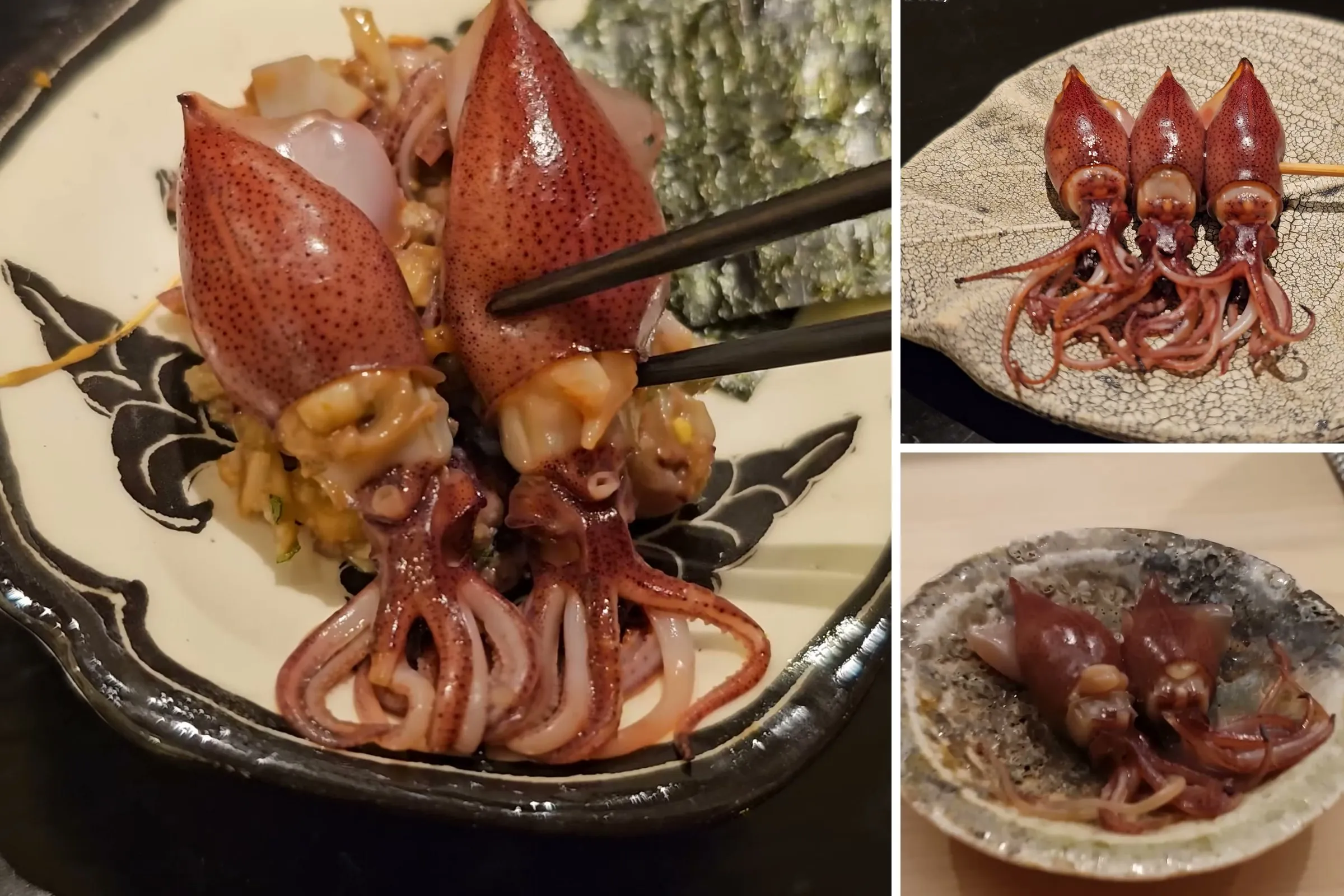
- Meaning
- Firefly squid, a tiny squid that glows blue. Eaten whole, usually boiled.
- Also written
- ホタルイカ, 蛍烏賊, hotaruika
- English
- firefly squid
- Korean
- 반딧불오징어 or 불똥꼴뚜기, plus 호타루이카. Neither Korean name is settled. I’ve always said 불똥꼴뚜기.
- How it’s made
- Boiled in salted water for about a minute, eyes pulled off, eaten with vinegared miso. Also grilled, cured in miso, or dropped live into soy (okizuke).
- Season
- Spring. Toyama Bay’s catch runs from March to about June.
- Good to know
- Raw firefly squid can carry a parasite. Japan’s rule is to freeze it at minus 30°C for 4 days or more, or cook it. Vinegar and wasabi don’t help.
Sushi Koji told me about the name in 2016. These came from Toyama, he said, and they glow at night like fireflies. In season they show up everywhere. At Shimazu one April I called it a cute, ugly little thing.
One practical tip. The guts are strong and they stay with you. Served early in a course, they can follow you through the next few pieces of sushi, even after ginger.
How it tastes
Grilled. Delicate, tender flesh, a charred aroma, bitter and nutty guts, and a faint heat at the very end. Firefly squid is definitely better warm.
Sushi Arai, my old blog, 2018/04In Korea I always had it cold. Hot, it’s more tender, and the bittersweet guts packed inside taste nutty.
Sushi Takeuchi, my old blog, 2018/04Cute and ugly at the same time, and in April it was on every menu I sat down to.
Sushi Shimazu, 2024/04▶ 1:56
Where this happenedSushi Shimazu→
Kohada 小肌
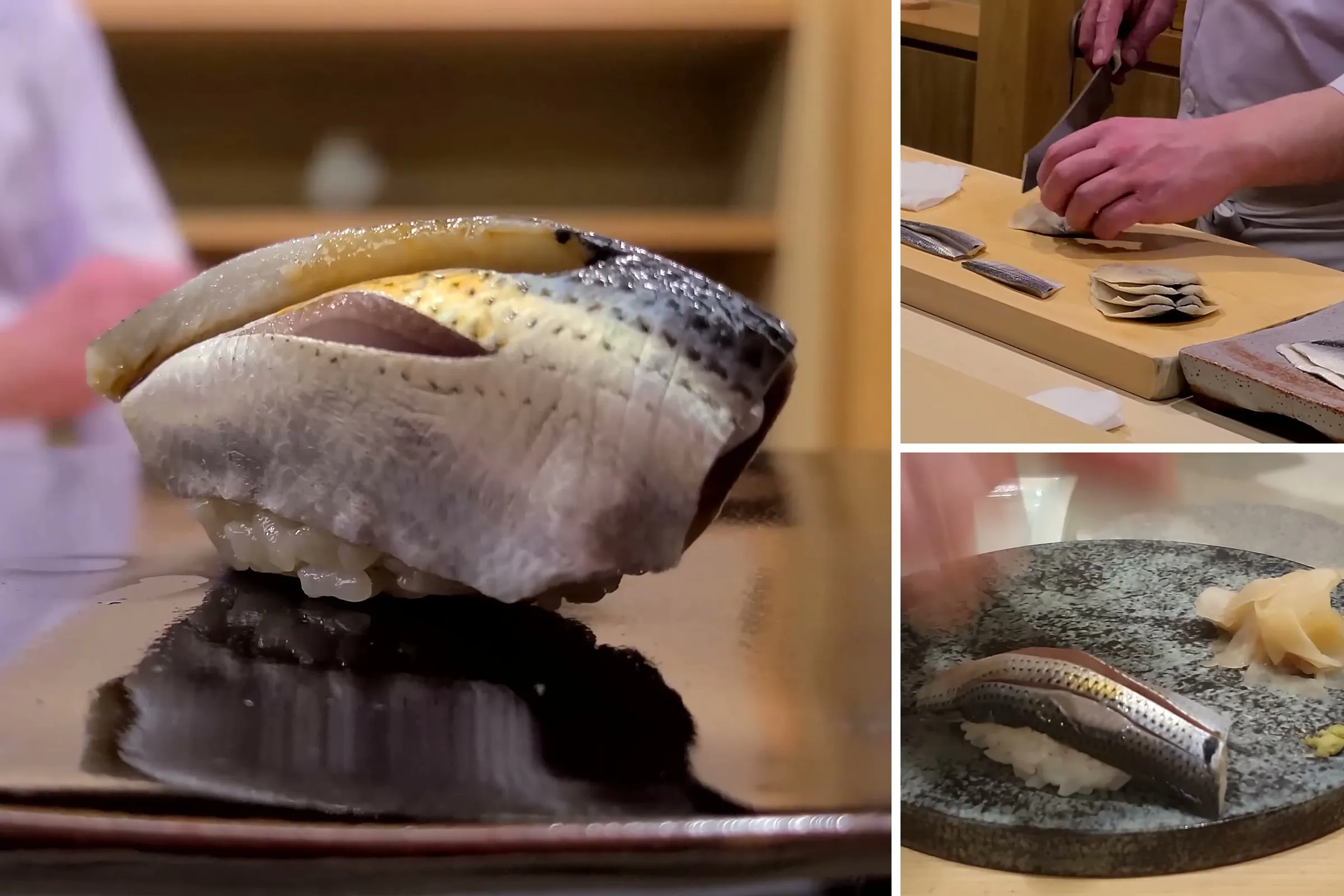
- Meaning
- A young gizzard shad, 10 to 15 cm, cured with salt and vinegar. The classic silver-skinned fish of Edo-style sushi.
- Also written
- 小肌, コハダ, こはだ. Its name changes as it grows: shinko, kohada, nakazumi, konoshiro.
- English
- gizzard shad
- Korean
- 전어, 고하다
- How it’s made
- Salted to firm it and draw out water, then soaked in vinegar. Every shop has its own timing, and it usually rests a few days before it’s served.
- Season
- Shinko, the tiny first fish of the year, arrive in summer and last a few weeks. Kohada is around most of the year, and the grown konoshiro is in season from November.
- Good to know
- Samurai supposedly avoided konoshiro. The name sounds like this castle, and grilling it sounded like burning this castle.
I didn’t like kohada for years. Too sour, too salty. In 2015 the best I could say about one was: I could eat this. Sugita fixed that. His first nigiri is almost always kohada, and in his book he names it as the one piece that stands for his shop.
He changes the cure by where the fish is from, how big it is, how fat, and how tough the skin is, and the knife cuts and the shaping change with it. A medium Amakusa kohada with thick flesh keeps its tail joined, gets cut and stacked at the front, and has one straight score on top. In 2017 I watched him taste and throw away five batches before he found one he’d serve.
How it tastes
The best kohada in the galaxy, easily. Moist without going limp, and the vinegar never jumps out at you.
Sushi Sugita, my old blog, 2018/12Like it had only had a quick splash in the curing liquid, a back-rinse on a hot day. Light and sweet.
Sushi Oshima, my old blog, 2017/09Crazy oily, juicy and soft. As good as Sugita on one of its good kohada days, which, coming from me, is close to blasphemy.
Sushi Inn, 2019/11▶ 6:31No anchovy smell at all. Moist, sweet, juicy.
Sushiya Shota, 2020/03▶ 6:54
Where this happenedSushi Sugita→
Nodoguro のどぐろ
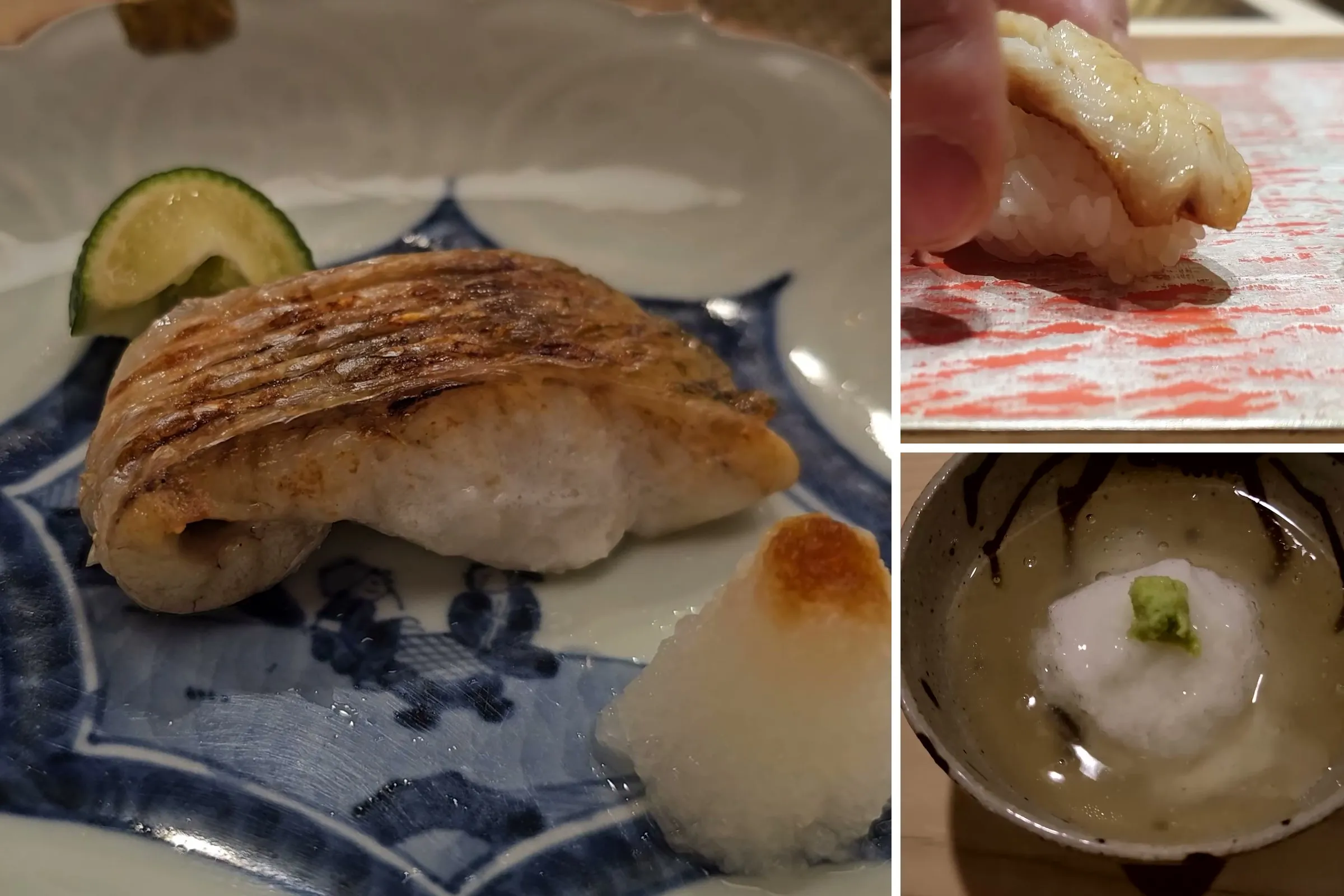
- Meaning
- Blackthroat seaperch, a red deep-sea fish that’s fatty all the way through. Nodoguro means black throat: the inside of its mouth is black.
- Also written
- のどぐろ, ノドグロ. The standard Japanese name is akamutsu (アカムツ, 赤鯥).
- English
- blackthroat seaperch
- Korean
- 눈볼대 is the standard name, 금태 is what most people say, and some menus write 노도구로.
- How it’s made
- Salt-grilled, simmered, sliced as sashimi, or seared (aburi) for nigiri. The fat is the whole point.
- Season
- No single answer. Kyoto’s main catch is September and October, and Shimane says it’s good all year.
- Good to know
- Nodoguro started as a regional name in San’in and Hokuriku, on the Sea of Japan side, before it went national.
Names first, because even I mix them up. In Korean the standard name is 눈볼대 and in Japanese it’s akamutsu, but Koreans mostly say 금태 and the Japanese mostly say nodoguro. At Sugita in 2024 he made a point of calling it akamutsu.
For years I preached that nodoguro is wasted raw and should always be grilled. Raw, it reminded me of the friend who answers every how was it? with eh, fine. Sushi Sanwon proved me wrong in 2016.
Sushi Koji once seared a piece I expected raw. The fish had only come in the day before, he said, so it wasn’t ready to serve plain, and it would have overlapped with the kinmedai before it.
How it tastes
So fatty I felt I could have swallowed it with my tongue alone, no chewing.
Sushi Sanwon, my old blog, 2016/05Skin that shatters, flesh running with oil. Something was running down my chin, and I couldn’t tell if it was drool or nodoguro fat.
Sushi Inn, my old blog, 2018/04With slightly warm, well-salted rice it’s the best side dish there could be. It made me think of Korean dried croaker.
Sushiya in Bundang, my old blog, 2018/06Grilled nodoguro took me straight back to the grilled Chilean sea bass I loved as a kid.
Sushi Chohee, my old blog, 2015/08
Where this happenedSushi Sugita→Sushi Arai→
Kinmedai 金目鯛
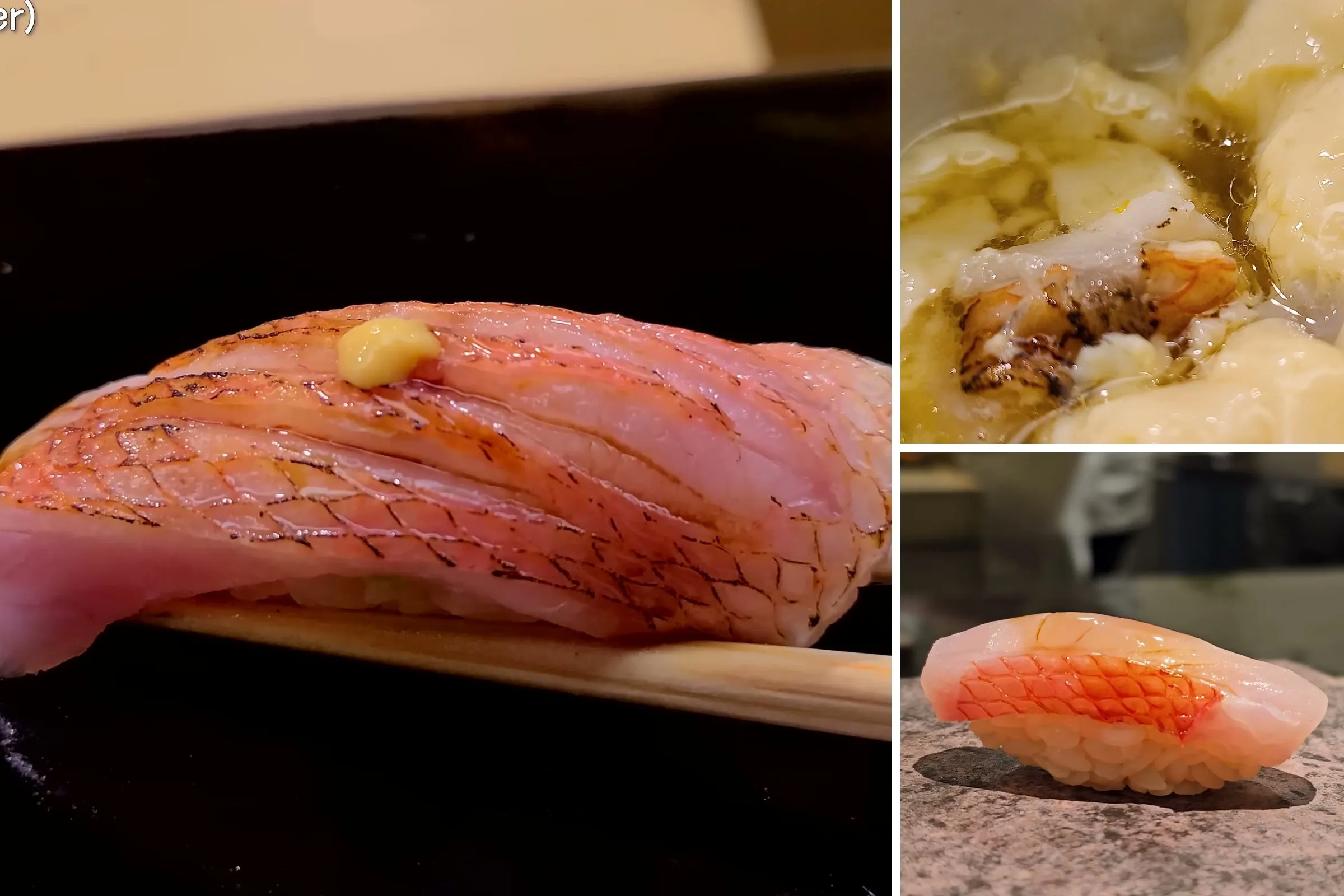
- Meaning
- Splendid alfonsino, a bright red deep-sea fish with big eyes that shine gold. Rich, fatty white flesh.
- Also written
- 金目鯛, キンメダイ, キンメ
- English
- splendid alfonsino, alfonsino
- Korean
- 빛금눈돔 is the standard name. Most people say 금눈돔 or 킨메다이.
- How it’s made
- The home classic is nitsuke, simmered in sweet soy. At the counters I go to, the skin is usually seared or grilled to melt the fat under it.
- Season
- Winter, December to March.
- Good to know
- Despite the name, it isn’t a real tai, sea bream.
Kinmedai on its own never did much for me. Never bad, never memorable. With this fish, fat is everything.
Sugita’s is the exception. Only the skin is grilled. The flesh under it stays raw, and a little mustard on top is the kick. The story goes that most people cry the first time. I didn’t cry, but I get it. If Sugita has kinmedai, eat it, and if he doesn’t offer it, ask.
The chef at Sushi Inn explained when to sear. If the fish hasn’t aged enough, searing pulls out the umami. Aged enough, it’s good plain.
How it tastes
Fat bursting and melting away. The word rich fits this better than it fits uni.
Sushi Sanwon, my old blog, 2016/06Seared kinmedai unrolled, Hokkaido uni, shiso and wasabi laid on, rolled back up and dipped in soy. Fireworks of flavor.
Sushi Cho, my old blog, 2015/05The sweetness of its fat is on another level.
Sushi Sugita, 2020/04▶ 26:38The chawanmushi of my life. Grilled kinmedai inside, its salt, its fat, its nuttiness. I had to stop recording to swallow.
Sushi Sugita, 2020/04▶ 8:56
Where this happenedSushi Sugita→
Engawa 縁側
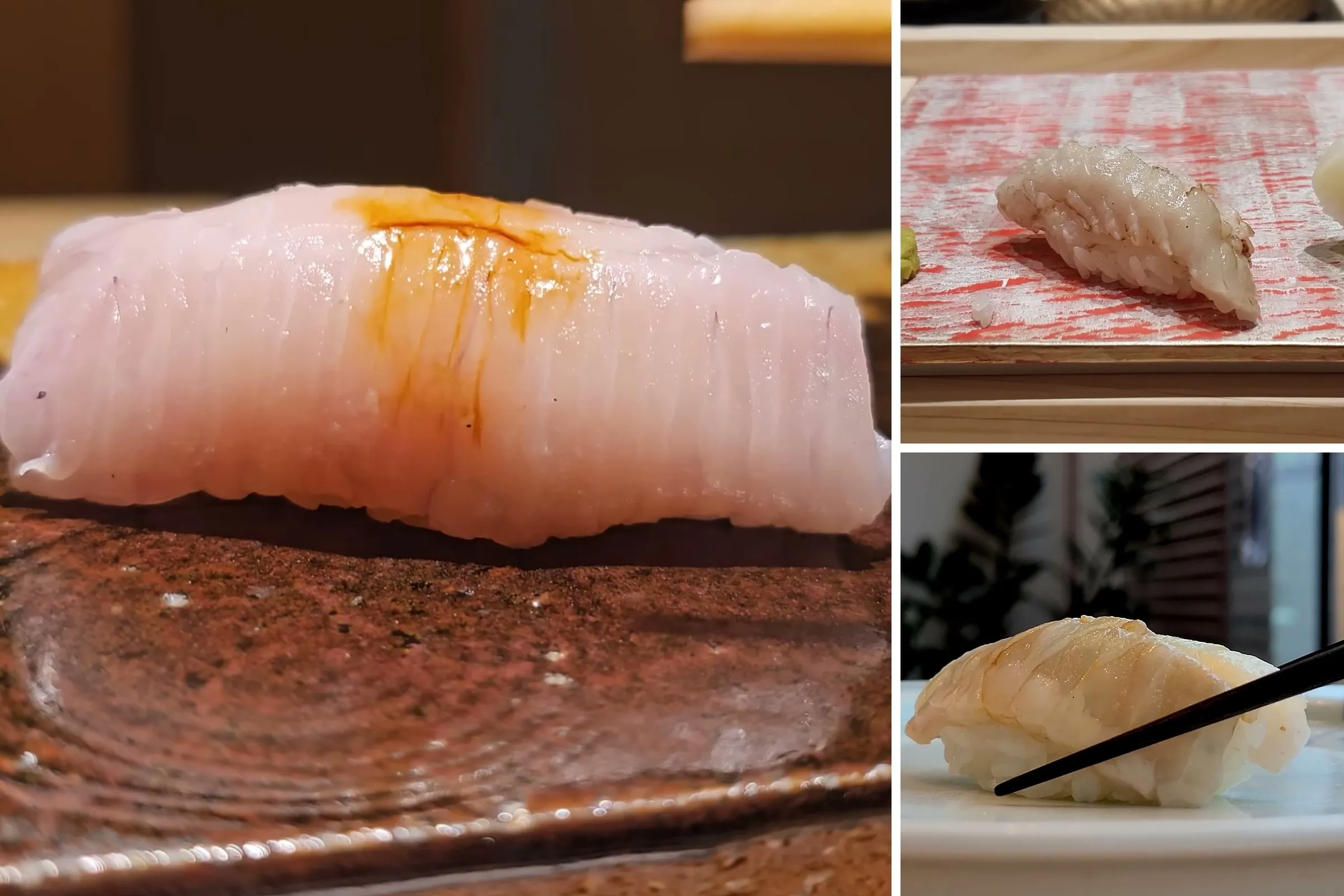
- Meaning
- The chewy, fatty strip of muscle that runs along the fins of a flounder or halibut.
- Also written
- えんがわ, 縁側, エンガワ
- English
- flounder fin, halibut fin
- Korean
- 광어 지느러미살, 엔가와. Older Koreans may say 엔삐라.
- How it’s made
- Served raw, as nigiri or sashimi. Many shops score it finely or sear it so the chew doesn’t win.
- Season
- Hirame is best in winter, and so is its engawa.
- Good to know
- Engawa means the wooden veranda along a Japanese house. In 1899 the novelist Izumi Kyōka wrote that with hirame, the engawa is best. Cheap conveyor-belt engawa is mostly Greenland halibut, one chain’s buyer told MONEY POST.
As a kid I ate nothing but engawa at Japanese restaurants in Gangnam. Back then everyone called it 엔삐라, and every place served it like a luxury. Now I rarely see it at sushi-ya.
The texture is the question. Raw and plain, you’re still chewing after the rice is gone. I like it scored finely with the knife. Some chefs sear it instead, so the fat melts.
At Sushi Inn it was so nutty I asked if there was dashi in the ponzu. No, the chef said, the flounder’s just that nutty.
How it tastes
A light, clean, juicy sweetness that spreads like fruit.
Sushi Chohee, my old blog, 2017/01Scored and seared, so the fat melts and it goes nutty and soft. Once your lips turn glossy, one piece is just right.
Sushi San, my old blog, 2015/08Hirame, makogarei, any flatfish. The engawa all tastes about the same: oily, nutty, crunchy.
Sushi Miura, 2023/12▶ 20:16Sweet soy and a little char from the grill. So good.
Sushi Sumire, 2020/05▶ 4:23
Where this happenedSushi Miura→
Anago 穴子
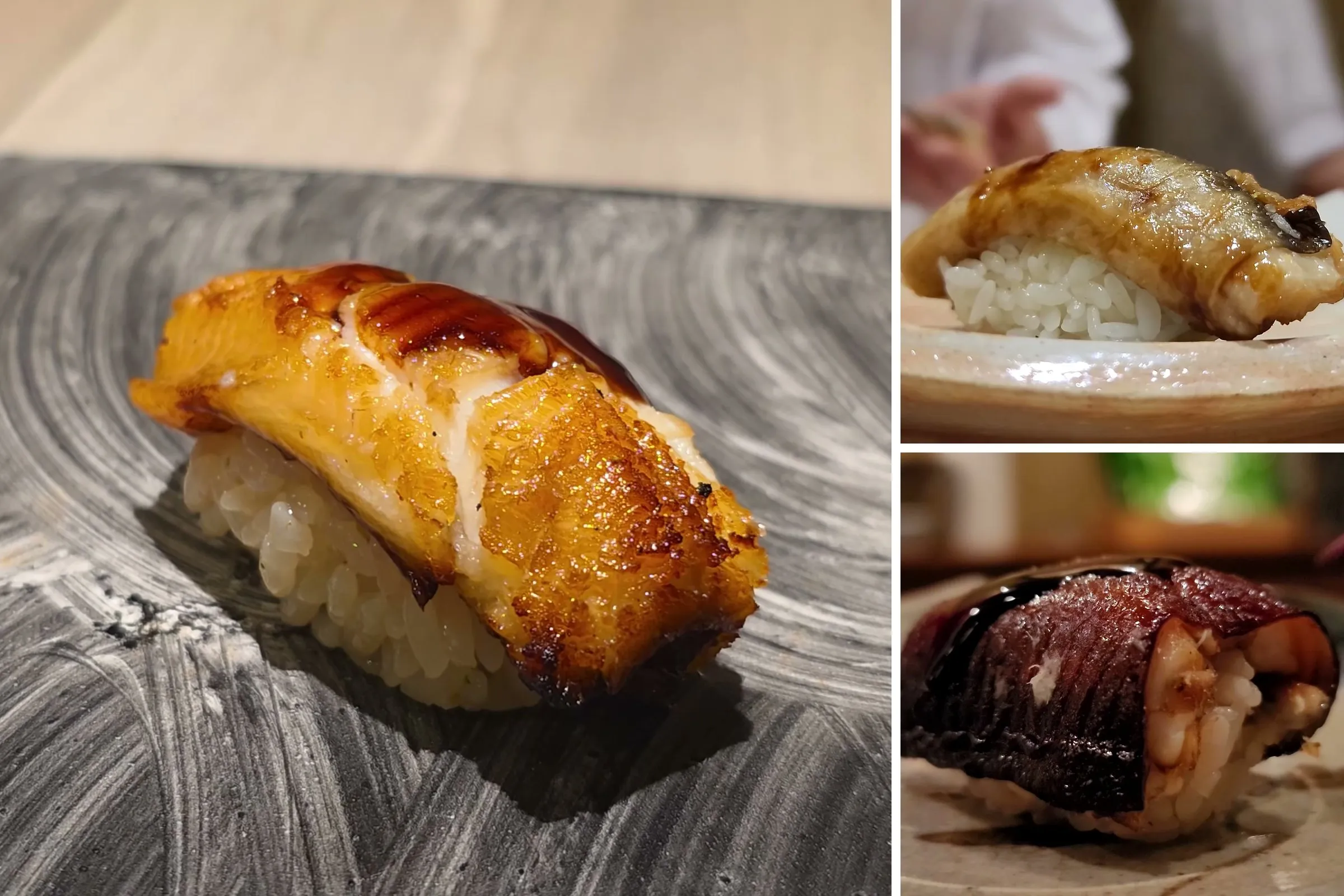
- Meaning
- Conger eel, the saltwater eel. For Edo-style sushi it’s simmered soft and brushed with sweet tsume sauce.
- Also written
- 穴子, アナゴ, あなご. Ni-anago (煮穴子) is simmered. Shirayaki (白焼き) is grilled plain.
- English
- conger eel, sea eel
- Korean
- 붕장어, 바닷장어, 아나고
- How it’s made
- Simmered in soy, sugar and sake until soft, then often warmed on the grill. Tsume (nitsume) is that simmering liquid boiled down with soy, mirin and sugar until thick. Some shops offer salt instead, or both.
- Season
- Summer.
- Good to know
- Not unagi, the freshwater eel. Anago is lighter and milder.
Sugita always asks: salt or tsume? I always say both. Anywhere I go I’m a tsume person, though. The tsume pieces get shaped skin side out, and I love how the sauce runs down over the skin.
Sushi Iki told me their crisp-style anago is impossible with market eel, it falls apart. They brought theirs up from Busan. And Sushi Namba once grilled raw anago for about an hour instead of simmering it first, Kansai style.
How it tastes
In the order your teeth meet it: crisp, chewy, moist, crumbling, and the chewy skin to finish.
Sushi Cho, my old blog, 2015/09The last piece tastes like the day you’re discharged from the army. Sweet, with a little sadness in it.
Sushi Cho, my old blog, 2015/09It arrived the way aging does. There was no stopping it.
Sushi Inn, my old blog, 2018/04So soft, and the sweetness and the nuttiness of the flesh were so strong that, for once, I remembered an anago nigiri.
Sushiya in Bundang, 2021/03▶ 6:59
Where this happenedSushi Shimazu→Sushi Sugita→
Words for what was done to the fish
Zuke, kobujime and shime aren’t fish. They tell you what the chef did to the fish before it reached you, and they stick onto other words: maguro no zuke, hirame kobujime, shime saba.
Zuke 漬け
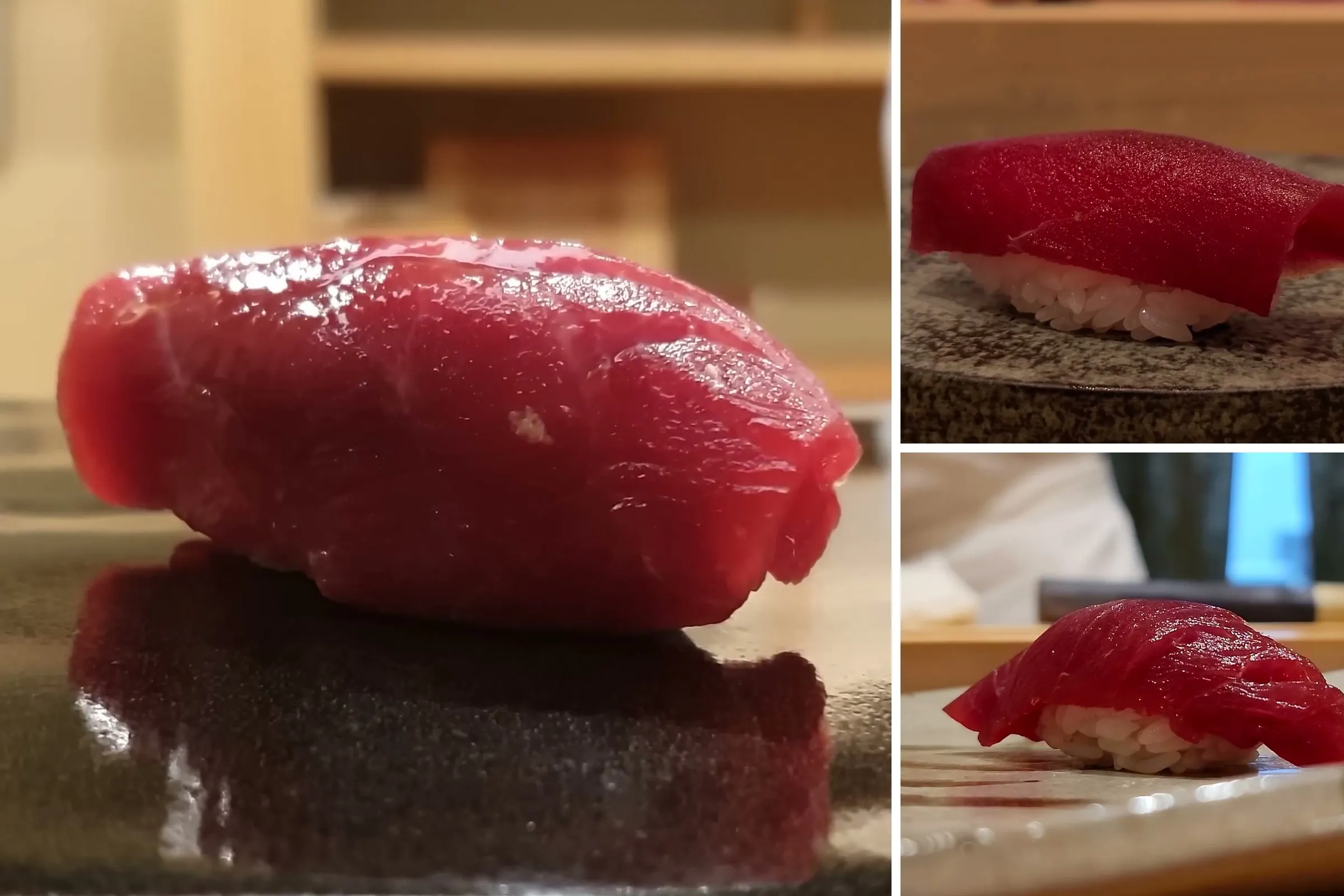
- Meaning
- Lean tuna (akami) marinated in soy sauce. Now also any topping soaked in a soy-based marinade.
- Also written
- 漬け, づけ, ヅケ
- English
- soy-marinated tuna
- Korean
- 참치 간장 절임. Korean has no set word for it, so most shops just say 즈케.
- How it’s made
- Slices of akami are soaked in soy sauce, sometimes mixed with sake or mirin, for anything from a few seconds to a few hours. Some shops blanch the surface first (yubiki) so it soaks in evenly.
- Season
- Follows the tuna.
- Good to know
- Around 1832, tuna was so plentiful and cheap in Edo that sushi shops started using it, soaked in soy to make it keep. That’s where zuke comes from. Toro was the part nobody wanted back then.
Chefs proud of their tuna like to say great akami doesn’t need zuke. Every time, I wanted to answer: then this one should have been zuke’d. At Arai I finally got what they meant. His tuna doesn’t need it.
Sugita cuts his akami very thin and wide, marinates it, and folds it in about three layers, like folding a blanket. On days the flavor is weak, he tucks in some ginger.
I call myself the yokan faction. My favorite akami zuke is lean, translucent and firm like a bar of yokan bean jelly, not soft and squishy.
How it tastes
Akami zuke done right. Sweet, a little acidic, the wasabi and the soy both clear, and not salty at all.
Sushi Sugita, my old blog, 2016/11Katsuo zuke. Oily, then the acidity smacks you on the forehead. The friend with me said it felt like kissing the bonito.
Sushi Sugita, my old blog, 2016/11The zuke was so precise. The texture, the salt, the sweetness. Plain, I might not even have called it great akami.
Sushiya in Bundang, 2021/03▶ 5:36Zuke made humble bigeye the best tuna of the night. Seasoned, savory, chewy like rice cake but snapping clean under the teeth.
Sushi San, my old blog, 2015/07
Where this happenedSushi Arai→Sushi Sugita→
Kobujime 昆布締め
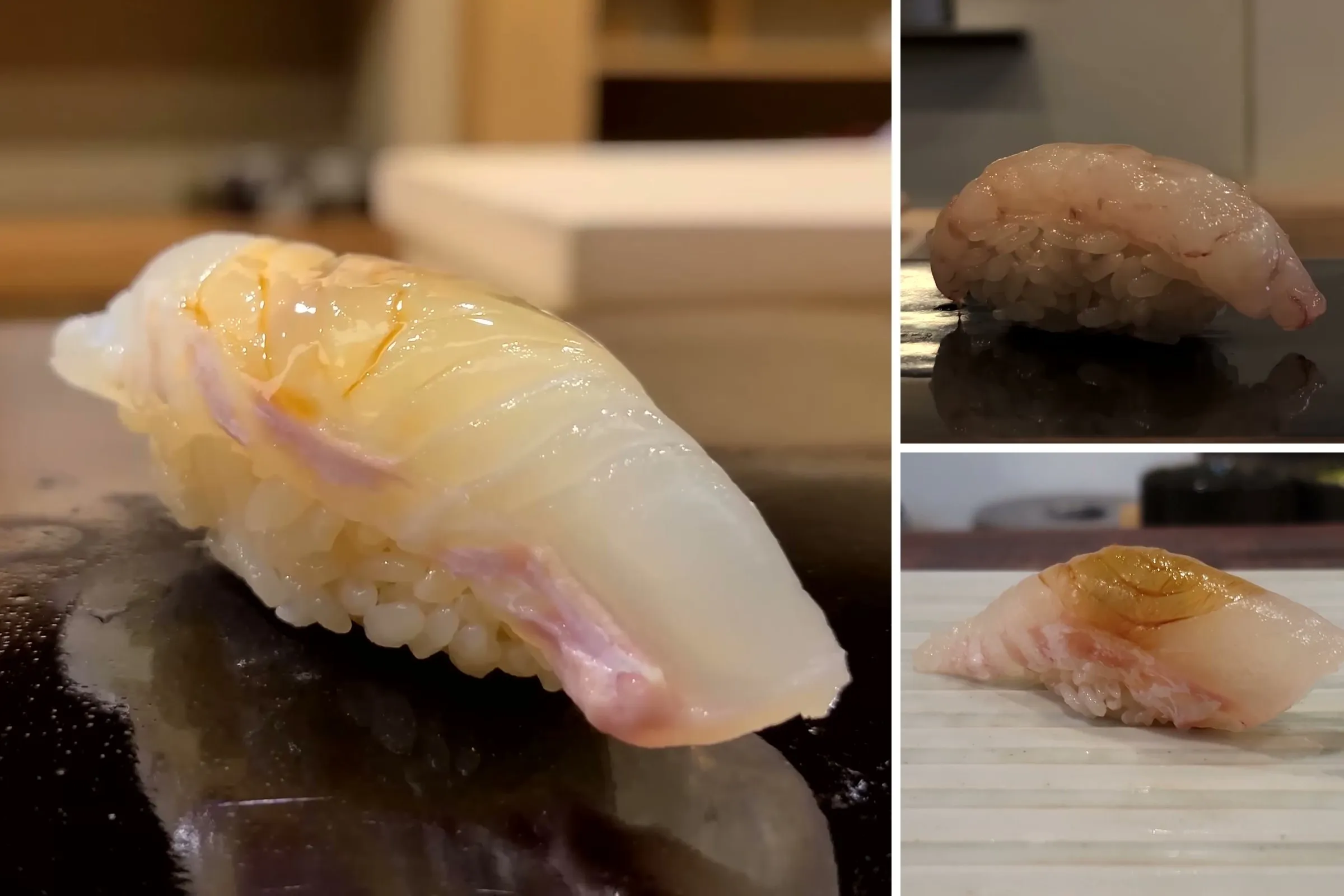
- Meaning
- Fish pressed between sheets of kombu kelp, so the kelp draws out water, firms the flesh and seasons it.
- Also written
- 昆布締め, 昆布〆, こぶじめ. People say kobujime or kombujime. Dictionaries list kobujime.
- English
- kelp-cured fish, kombu-cured fish
- Korean
- 다시마 숙성, 다시마 절임. Korean has no set word, so shops say 코부지메 or 곤부지메.
- How it’s made
- Lightly salted white fish, squid or shrimp goes between two sheets of kombu. Toyama’s home method brushes the kombu with vinegar, adds grated ginger, presses it under a light weight and leaves it overnight. Sushi shops go anywhere from a few minutes to a day or more.
- Season
- Any time. It’s a technique.
- Good to know
- It comes from Toyama, where Edo-era trading ships brought kombu down from Hokkaido. Before fridges, the kelp helped raw fish keep.
Sugita says it kobujime, which matches the dictionary. You’ll hear kombujime too.
Sushi Koji explained why lunch fish is so often kombu-cured. An expensive fish gets killed for dinner, and whatever’s left goes out at lunch the next day, so it naturally ends up on kombu.
At Ranmaru, Yukichika-san was explaining it to Hong Kong guests in English. Kombu… abalone? No… Kelp! I said. Kelp? Kelp.
How it tastes
Some people think I hate kobujime. I don’t. Done well, it gives you the texture and none of the bitter kelp smell.
Sushi Arai, my old blog, 2017/07Amadai, and I thought, wait, where did the kelp go? The white fish’s sweetness untouched, only the chew brought out.
Sushi Inn, my old blog, 2016/06Flesh that pushes back against your teeth, or grips them.
Sushi Cho, my old blog, 2016/05Hirame kobujime. Very springy, with deep umami.
Sushi Sugita, 2020/04▶ 16:49
Where this happenedSushi Sugita→
Shime saba 〆鯖
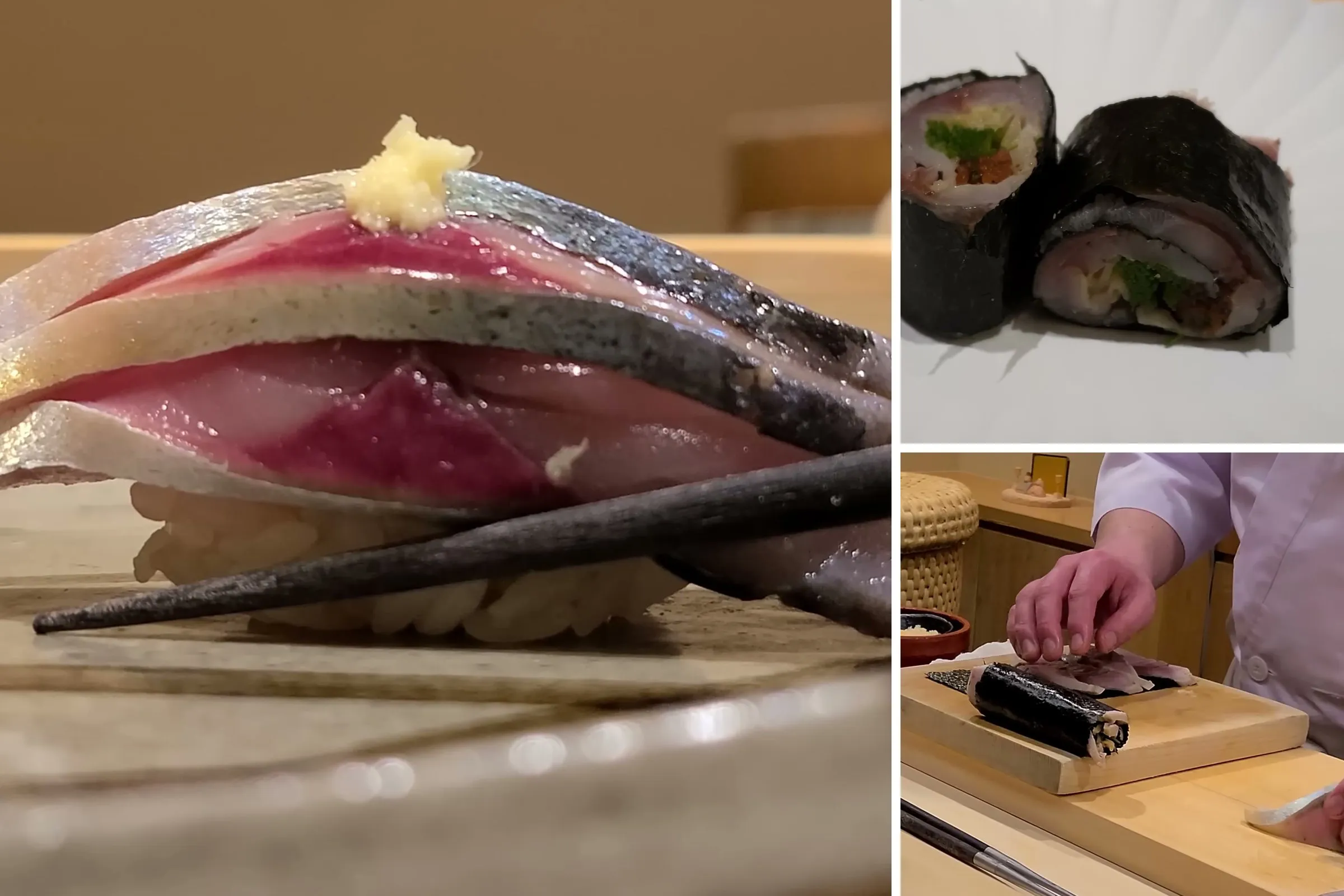
- Meaning
- Mackerel salted, then cured in vinegar. Shime means firming fish with salt or vinegar.
- Also written
- しめ鯖, 〆鯖, 締め鯖, shimesaba. In Kansai it’s kizushi (きずし).
- English
- vinegar-cured mackerel
- Korean
- 고등어 초절임, 시메사바
- How it’s made
- Fillet, pull the pin bones, salt for about 30 minutes until the flesh firms, rinse, then cover with vinegar for about half a day. Every shop changes those times.
- Season
- Autumn into winter, when chub mackerel is fattest.
- Good to know
- Vinegar doesn’t kill anisakis, a parasite common in mackerel. Only freezing (minus 20°C for 24 hours) or cooking does.
Sugita’s saba isobemaki, mackerel rolled in nori, is where the whole fashion for rolling silver fish in nori came from. He’s been rolling it for 15 years. In sardine season he switches to sardine, and yet somehow I always get mackerel.
The cure decides everything. A sour, salty, crumbly cure can ruin a good fish. Unless the cure itself is superb, I’d take it very light.
At Sushi Chohee the chef asked, you like mackerel, right? How many pieces? All of them! I said. And at Sushi Inn a mackerel looked long-aged but had been caught that day. It just has an old face, the chef said.
How it tastes
Sugita’s saba is practically blue cheese. Very oily, soft, nutty, salty and sour, and not a trace of funk or fishiness.
My old blog, 2017/10The hardest thing to explain to anyone who hasn’t had it. Sharp, sour and salty, and still moist and oily.
Sushi Inn, my old blog, 2016/09Tastes cured, chews like raw.
Sushi Cho, my old blog, 2015/09So pretty I kissed it before I ate it. The nigiri, I mean.
Sushiya in Bundang, 2020/07▶ 11:47
Where this happenedSushi Sugita→
Plan the Tokyo trip
The boring bits I’d sort before flying, so the eating days stay free.
- Hotels in Tokyo*
Pick the room by where you eat, not by the sights. After a long dinner, a short ride back is the real luxury.
- Japan eSIM*
Data from the moment you land, no counter and no SIM swap. Set it up the night before.
- Keisei Skyliner from Narita*
Narita to Ueno in about 40 minutes. Buy it ahead and walk straight to the platform.
- Haneda airport limousine bus*
Landing at Haneda instead? The limousine bus drops you at the big hotels and stations with no transfers.
- Tsukiji Outer Market food tour*
A market morning with someone who knows which stalls are worth the line.
- Sushi-making class at Tsukiji*
Shape nigiri yourself once and the counter makes a lot more sense.
Links marked * are affiliate links. If you book through them I may earn a small commission, and you pay the same. How it works
The videos this guide comes from
- The God of Sushi Makes Even ₩530,000 a Person Feel Fair22:202023/01
- Tokyo Sushi Sugita: A ¥50,000 Omakase I’d Happily Eat Again (2020)29:542020/04
- Tokyo Sushi Sugita: ¥450,000 for 9 Guests | My Sushi God (2019)22:522019/07
- A slightly sad omakase from the gods | Sugita22:482024/10
- Now is the best season to eat sushi!14:112024/09
- Prices Went Up. I Still Go Back. | Shimazu, Tokyo Sushi10:032026/10
- Sweet, so sweet!!!10:072024/04
- This is what a real lead looks like12:362024/06
- The best lunchbox I’ve ever tasted at a sushi restaurant12:042024/06
- Nvidia on sushi13:122025/07
- The end of the year is a series of events17:162025/01
- You can Try the Best Tuna Sushi in the World Here [Sushi Arai]15:392020/03
- Tokyo Sushi Mizukami | Does Jiro’s Apprentice Live Up to the Name?12:362020/03
- Sushi omakase at this price, in the middle of Ginza?!12:092023/10
- The best option when you can’t reserve the famous sushi places in Japan | Sushi Ranmaru16:142019/10
- When in Tokyo, this restaurant is a must go!! | Ranmaru10:572020/04
- A new sushi restaurant in Tokyo that’s perfect for anyone | Sushi Miura21:542023/12
- The rice carries the sushi.5:452020/12
- A Korean chef in charge of Sushi Omakase in Tokyo!! [Sushiya Shota]10:212020/03
- Legit Italian restaurant used to be impossible to book in Japan9:532019/06
- Legendary Sushi restaurant in Seoul, Korea. Impossible to book!10:102019/11
- Fluffy rice + Fatty fish = Incredible Sushi13:272020/07
- The rice texture is top-tier at Sushi Ito as always8:222021/07
- You can’t find anything like this Sushi Omakase lunch at this price.12:392019/12
- Bet you’re drooling from the tuna in the thumbnail [Sushi Sumire]6:592020/05
- This is what well-made tuna sushi tastes like.8:242021/03
- The Best sushi in Korea by M.G12:522020/07
- This Sushi place is Gonna Get Far, Far Better from Now!14:412020/02
- The Best Sushi place for who never tried Omakase before12:392019/11
- Is it my brain or the cost of living that makes 200,000 won a meal seem cheap?8:222021/01
- The Best Choice in an Era Where 200,000 Won Is Considered Cheap10:092023/04
Sources
- アンコウ (あん肝) Kotobank
- 茨城県 郷土料理ストーリー (あんこう) MAFF Japan
- 白子 Kotobank
- マダラ (タチ) Hokkaido Government
- イクラ Kotobank
- Salmon roe pickled in soy sauce MAFF Japan
- ウニ Kotobank
- 越前塩うに 福井県 MAFF Japan
- からすみ Kotobank
- Nagasaki Karasumi (GI No.132) MAFF Japan
- 어란 Encyclopedia of Korean Culture
- このわた Kotobank
- このわた・くちこ 石川県 MAFF Japan
- クルマエビ Kotobank
- 県産食材 クルマエビ Okinawa Prefecture
- ホタルイカ Kotobank
- ほたるいかの酢味噌和え 富山県 MAFF Japan
- 旋尾線虫症 Aichi Prefectural Institute of Public Health
- コハダ Kotobank
- コノシロ Funabashi City
- アカムツ (のどぐろ) Kotobank
- アカムツ Kyoto Prefecture
- キンメダイ Kotobank
- 縁側 Kotobank
- 回転寿司のエンガワ MONEY POST (Shogakukan)
- ヒラメ Miyagi Prefecture
- アナゴ Kotobank
- 煮詰め Kotobank
- 漬け / づけ Kotobank
- 昆布締め Kotobank
- 昆布〆 富山県 MAFF Japan
- しめさば Kotobank
- アニサキス Saitama City